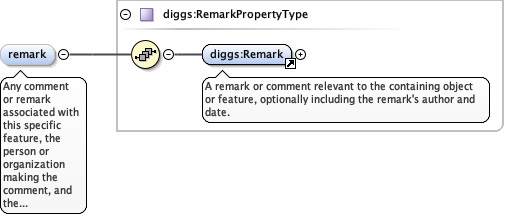
Any comment or remark associated with this specificfeature, the person or organization making the comment, and the timecomment was made.Any comment or remark associated with this specificfeature, the person or organization making the comment, and the timecomment was made.
<element name="remark" type="diggs:RemarkPropertyType" minOccurs="0" maxOccurs="unbounded"><annotation><documentation>Any comment or remark associated with this specific feature, the person or organization making the comment, and the time comment was made.Any comment or remark associated with this specific feature, the person or organization making the comment, and the time comment was made.</documentation></annotation></element>
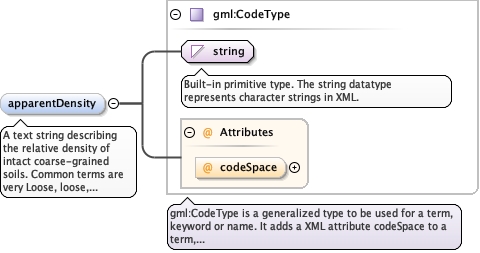
A text string describing the relative density of intact coarse-grained soils. Common terms are very Loose, loose, medium dense, dense, very Dense; intended to come from a controlled list
<element name="apparentDensity" type="gml:CodeType" minOccurs="0"><annotation><documentation>A text string describing the relative density of intact coarse-grained soils. Common terms are very Loose, loose, medium dense, dense, very Dense; intended to come from a controlled list</documentation></annotation></element>
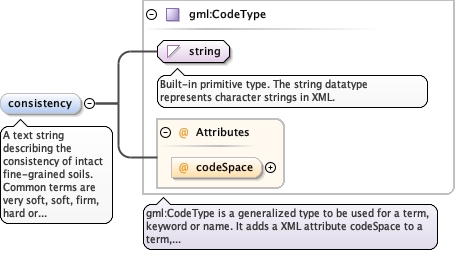
A text string describing the consistency of intact fine-grained soils. Common terms are very soft, soft, firm, hard or very hard; intended to come from a controlled list
<element name="consistency" type="gml:CodeType" minOccurs="0"><annotation><documentation>A text string describing the consistency of intact fine-grained soils. Common terms are very soft, soft, firm, hard or very hard; intended to come from a controlled list</documentation></annotation></element>
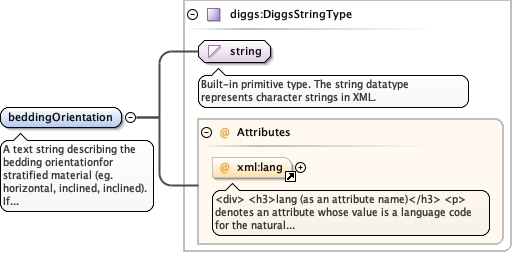
A text string describing the bedding orientationfor stratified material (eg. horizontal, inclined, inclined). If quantitative strike and or dip data is available, dipAngle and dipDirection properties instead.
<div><h3>lang (as an attribute name)</h3><p>denotes an attribute whose value is a language code for the natural language of the content of any element; its value is inherited. This name is reserved by virtue of its definition in the XML specification.</p></div><div><h4>Notes</h4><p>Attempting to install the relevant ISO 2- and 3-letter codes as the enumerated possible values is probably never going to be a realistic possibility.</p><p>See BCP 47 at<a href="http://www.rfc-editor.org/rfc/bcp/bcp47.txt">http://www.rfc-editor.org/rfc/bcp/bcp47.txt</a>and the IANA language subtag registry at<a href="http://www.iana.org/assignments/language-subtag-registry">http://www.iana.org/assignments/language-subtag-registry</a>for further information.</p><p>The union allows for the 'un-declaration' of xml:lang with the empty string.</p></div>
Source
<element name="beddingOrientation" type="diggs:DiggsStringType" minOccurs="1"><annotation><documentation>A text string describing the bedding orientationfor stratified material (eg. horizontal, inclined, inclined). If quantitative strike and or dip data is available, dipAngle and dipDirection properties instead.</documentation></annotation></element>
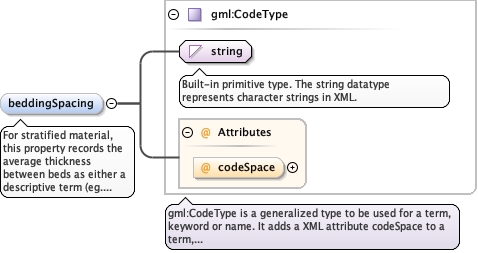
For stratified material, this property records the average thickness between beds as either a descriptive term (eg. thick, thin, etc., from a controlled list of terms, or as a string representation of a numeric value (eg. 10 cm).
<element name="beddingSpacing" type="gml:CodeType" minOccurs="0"><annotation><documentation>For stratified material, this property records the average thickness between beds as either a descriptive term (eg. thick, thin, etc., from a controlled list of terms, or as a string representation of a numeric value (eg. 10 cm).</documentation></annotation></element>
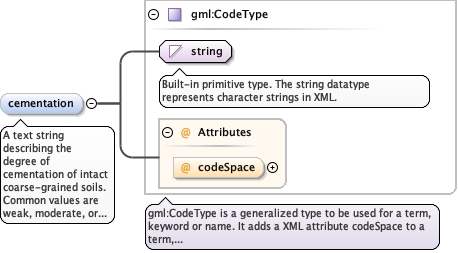
A text string describing the degree of cementation of intact coarse-grained soils. Common values are weak, moderate, or strong; intended to come from a controlled list
<element name="cementation" type="gml:CodeType" minOccurs="0"><annotation><documentation>A text string describing the degree of cementation of intact coarse-grained soils. Common values are weak, moderate, or strong; intended to come from a controlled list</documentation></annotation></element>
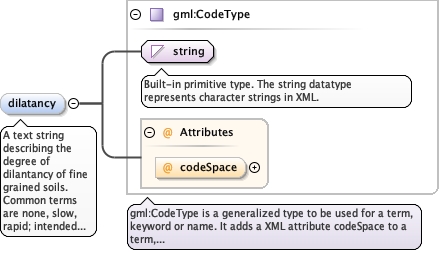
<element name="dilatancy" type="gml:CodeType" minOccurs="0"><annotation><documentation>A text string describing the degree of dilantancy of fine grained soils. Common terms are none, slow, rapid; intended to come from a controlled list</documentation></annotation></element>
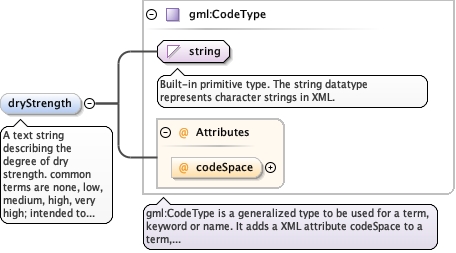
<element name="dryStrength" type="gml:CodeType" minOccurs="0"><annotation><documentation>A text string describing the degree of dry strength. common terms are none, low, medium, high, very high; intended to come from a controlled list</documentation></annotation></element>
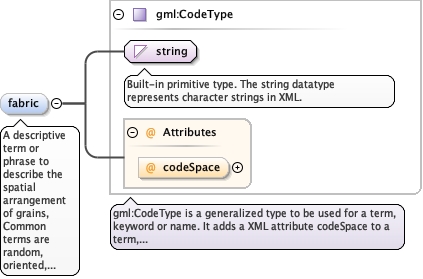
A descriptive term or phrase to describe the spatial arrangement of grains, Common terms are random, oriented, imbricated, etc. Intended to come from a controlled list of terms.I
<element minOccurs="0" name="fabric" type="gml:CodeType" maxOccurs="1"><annotation><documentation>A descriptive term or phrase to describe the spatial arrangement of grains, Common terms are random, oriented, imbricated, etc. Intended to come from a controlled list of terms. I</documentation></annotation></element>
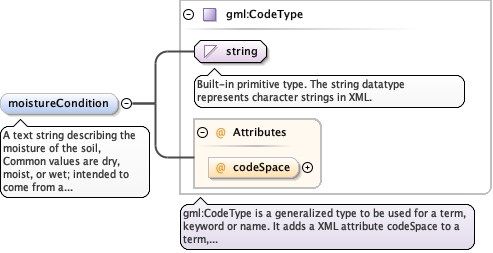
<element name="moistureCondition" type="gml:CodeType" minOccurs="0"><annotation><documentation>A text string describing the moisture of the soil, Common values are dry, moist, or wet; intended to come from a controlled list</documentation></annotation></element>
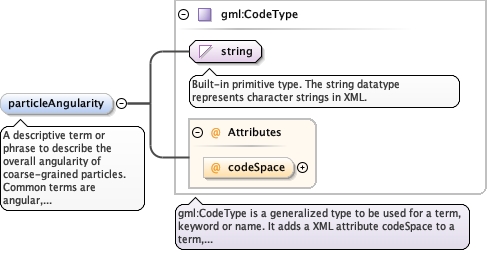
A descriptive term or phrase to describe the overallangularity of coarse-grained particles. Common terms are angular, subangular, subrounded, rounded). Intended to come from a controlled list.
<element minOccurs="0" name="particleAngularity" type="gml:CodeType" maxOccurs="1"><annotation><documentation>A descriptive term or phrase to describe the overall angularity of coarse-grained particles. Common terms are angular, subangular, subrounded, rounded). Intended to come from a controlled list.</documentation></annotation></element>
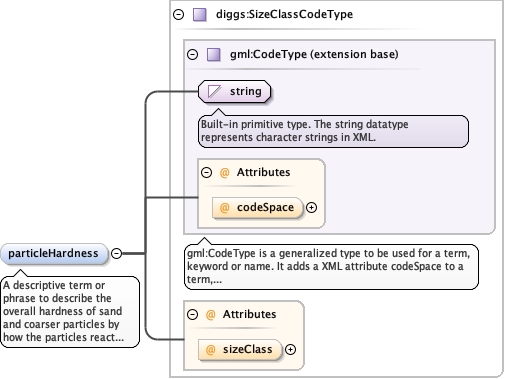
A descriptive term or phrase to describe the overallhardness of sand and coarser particles by how the particles react to a hammer blow. Common terms are crack, fracture, or crumble. Hard is typically used if no cracking occurs. Intended to come from a controlled list.
<element minOccurs="0" name="particleHardness" type="diggs:SizeClassCodeType" maxOccurs="1"><annotation><documentation>A descriptive term or phrase to describe the overall hardness of sand and coarser particles by how the particles react to a hammer blow. Common terms are crack, fracture, or crumble. Hard is typically used if no cracking occurs. Intended to come from a controlled list.</documentation></annotation></element>
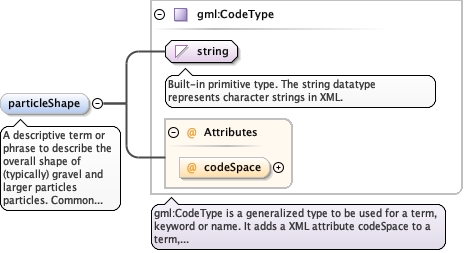
A descriptive term or phrase to describe the overallshape of (typically) gravel and larger particles particles. Common terms are flat, elongated, and flat and elongated. Intended to come from a controlled list.
<element minOccurs="0" name="particleShape" type="gml:CodeType" maxOccurs="1"><annotation><documentation>A descriptive term or phrase to describe the overall shape of (typically) gravel and larger particles particles. Common terms are flat, elongated, and flat and elongated. Intended to come from a controlled list.</documentation></annotation></element>
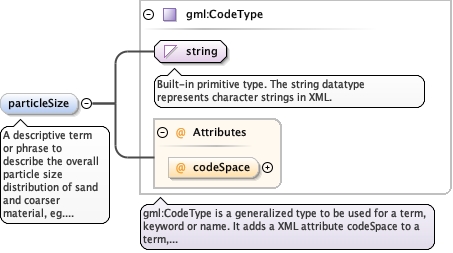
A descriptive term or phrase to describe the overall particle size distribution of sand and coarser material, eg. "fine", "fine to coarse", "medium. Intended to come from a controlled list.
<element minOccurs="0" name="particleSize" type="gml:CodeType" maxOccurs="1"><annotation><documentation>A descriptive term or phrase to describe the overall particle size distribution of sand and coarser material, eg. "fine", "fine to coarse", "medium. Intended to come from a controlled list.</documentation></annotation></element>
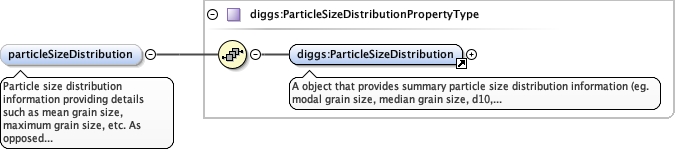
Particle size distribution information providing details such as mean grain size, maximum grain size, etc. As opposed to Properties in this object support quantitative values derived from laboratory analyses can carry descriptive terms. Detailed properties of a grain size distribution curve should be reported as test results of a ParticleSizeTest
<element minOccurs="0" name="particleSizeDistribution" type="diggs:ParticleSizeDistributionPropertyType" maxOccurs="1"><annotation><documentation>Particle size distribution information providing details such as mean grain size, maximum grain size, etc. As opposed to Properties in this object support quantitative values derived from laboratory analyses can carry descriptive terms. Detailed properties of a grain size distribution curve should be reported as test results of a ParticleSizeTest</documentation></annotation></element>
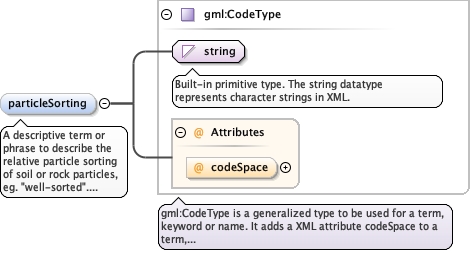
A descriptive term or phrase to describe the relativeparticle sorting of soil or rock particles, eg. "well-sorted". Intended to comefrom a controlled list.
<element minOccurs="0" name="particleSorting" type="gml:CodeType" maxOccurs="unbounded"><annotation><documentation>A descriptive term or phrase to describe the relative particle sorting of soil or rock particles, eg. "well-sorted". Intended to come from a controlled list.</documentation></annotation></element>
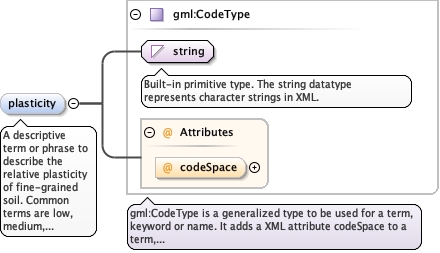
A descriptive term or phrase to describe the relative plasticity of fine-grained soil. Common terms are low, medium, high. Intended to come from a controlled list.
<element minOccurs="0" name="plasticity" type="gml:CodeType"><annotation><documentation>A descriptive term or phrase to describe the relative plasticity of fine-grained soil. Common terms are low, medium, high. Intended to come from a controlled list.</documentation></annotation></element>
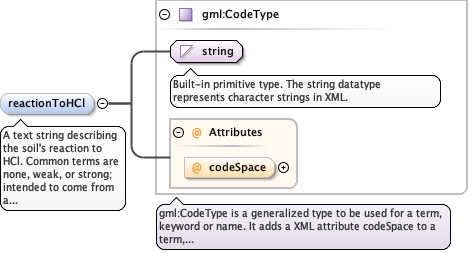
<element name="reactionToHCl" type="gml:CodeType" minOccurs="0"><annotation><documentation>A text string describing the soil's reaction to HCl. Common terms are none, weak, or strong; intended to come from a controlled list</documentation></annotation></element>
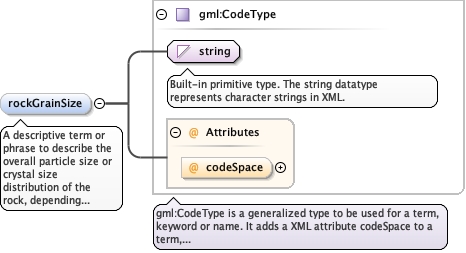
A descriptive term or phrase to describe the overallparticle size or crystal size distribution of the rock, depending onrock origin. For example, for cystalline igneous or metamorphicrocks, terms such as pegmatitic or aphanitic may be used. Forclastic sedimentary rocks, terms such as fine sand or cobbles may beused, and for pyroclastic igneous rocks, terms such as "coarse ash"or "lapili" may be used. Intended to come from a controlled list ofterms.
<element minOccurs="0" name="rockGrainSize" type="gml:CodeType"><annotation><documentation>A descriptive term or phrase to describe the overall particle size or crystal size distribution of the rock, depending on rock origin. For example, for cystalline igneous or metamorphic rocks, terms such as pegmatitic or aphanitic may be used. For clastic sedimentary rocks, terms such as fine sand or cobbles may be used, and for pyroclastic igneous rocks, terms such as "coarse ash" or "lapili" may be used. Intended to come from a controlled list of terms.</documentation></annotation></element>
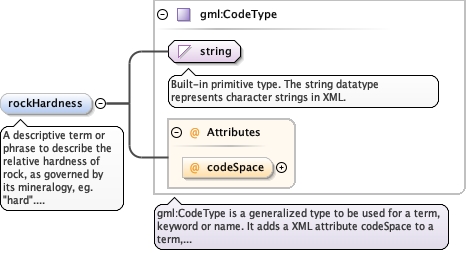
A descriptive term or phrase to describe the relativehardness of rock, as governed by its mineralogy, eg. "hard".Intended to come from a controlled list.
<element minOccurs="0" name="rockHardness" type="gml:CodeType"><annotation><documentation>A descriptive term or phrase to describe the relative hardness of rock, as governed by its mineralogy, eg. "hard". Intended to come from a controlled list.</documentation></annotation></element>
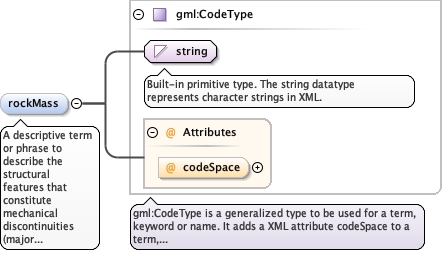
A descriptive term or phrase to describe the structuralfeatures that constitute mechanical discontinuities (majorgeological features). Rock mass refers to any in situ rock with allinherent geomechanical discontinuities (eg. fissile, blocky,fractured, etc.)
<element minOccurs="0" name="rockMass" type="gml:CodeType"><annotation><documentation>A descriptive term or phrase to describe the structural features that constitute mechanical discontinuities (major geological features). Rock mass refers to any in situ rock with all inherent geomechanical discontinuities (eg. fissile, blocky, fractured, etc.)</documentation></annotation></element>
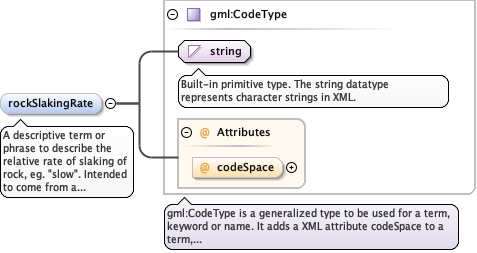
<element minOccurs="0" name="rockSlakingRate" type="gml:CodeType"><annotation><documentation>A descriptive term or phrase to describe the relative rate of slaking of rock, eg. "slow". Intended to come from a controlled list.</documentation></annotation></element>
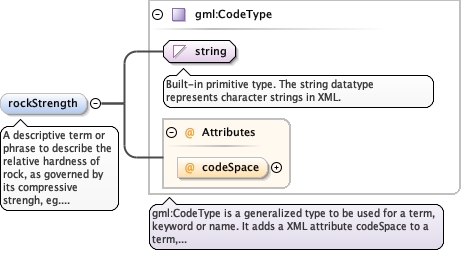
A descriptive term or phrase to describe the relativehardness of rock, as governed by its compressive strengh, eg."strong". Intended to come from a controlled list.
<element minOccurs="0" name="rockStrength" type="gml:CodeType"><annotation><documentation>A descriptive term or phrase to describe the relative hardness of rock, as governed by its compressive strengh, eg. "strong". Intended to come from a controlled list.</documentation></annotation></element>
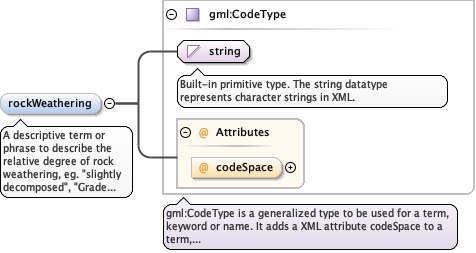
A descriptive term or phrase to describe the relativedegree of rock weathering, eg. "slightly decomposed", "Grade III",etc. Intended to come from a controlled list.
<element minOccurs="0" name="rockWeathering" type="gml:CodeType"><annotation><documentation>A descriptive term or phrase to describe the relative degree of rock weathering, eg. "slightly decomposed", "Grade III", etc. Intended to come from a controlled list.</documentation></annotation></element>
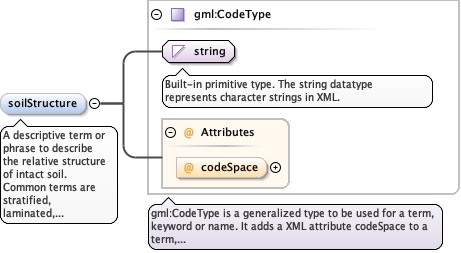
A descriptive term or phrase to describe the relativestructure of intact soil. Common terms are stratified, laminated, fissured, slickensided, blocky, lensed, homogeneous, varved, etc. Intended to come from a controlled list.
<element minOccurs="0" name="soilStructure" type="gml:CodeType"><annotation><documentation>A descriptive term or phrase to describe the relative structure of intact soil. Common terms are stratified, laminated, fissured, slickensided, blocky, lensed, homogeneous, varved, etc. Intended to come from a controlled list.</documentation></annotation></element>
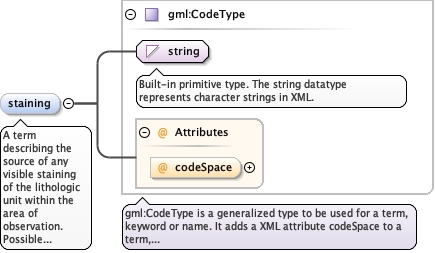
A term describing the source of any visible staining of the lithologic unit within the area of observation. Possible terms include iron, manganese, hydrocarbons, etc. Intended to come from a controlled list of terms.
<element minOccurs="0" name="staining" type="gml:CodeType"><annotation><documentation>A term describing the source of any visible staining of the lithologic unit within the area of observation. Possible terms include iron, manganese, hydrocarbons, etc. Intended to come from a controlled list of terms.</documentation></annotation></element>
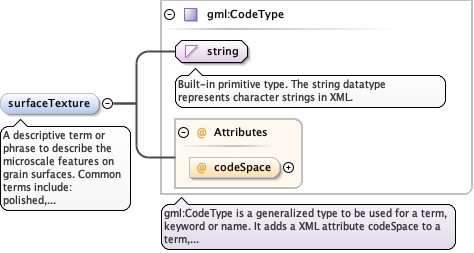
A descriptive term or phrase to describe the microscale features on grain surfaces. Common terms include: polished, smooth, pitted, striated, etc. Intended to come from a controlled list of terms.Includes:
<element minOccurs="0" name="surfaceTexture" type="gml:CodeType" maxOccurs="1"><annotation><documentation>A descriptive term or phrase to describe the microscale features on grain surfaces. Common terms include: polished, smooth, pitted, striated, etc. Intended to come from a controlled list of terms. Includes:</documentation></annotation></element>
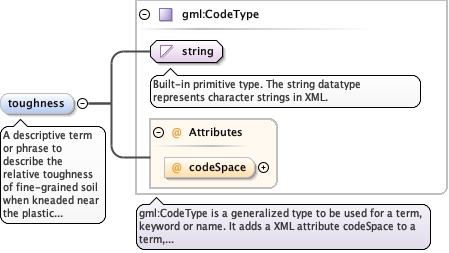
A descriptive term or phrase to describe the relativetoughness of fine-grained soil when kneaded near the plastic limit. Common termes are low, medium, high. Intended to come from a controlled list.
<element minOccurs="0" name="toughness" type="gml:CodeType"><annotation><documentation>A descriptive term or phrase to describe the relative toughness of fine-grained soil when kneaded near the plastic limit. Common termes are low, medium, high. Intended to come from a controlled list.</documentation></annotation></element>
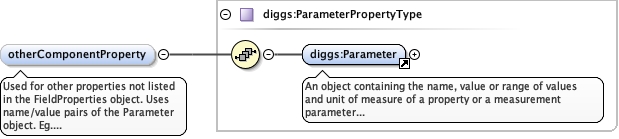
Used for other properties not listed in theFieldProperties object. Uses name/value pairs of the Parameterobject. Eg. name = Additional Description, value = withslag
<element minOccurs="0" name="otherComponentProperty" maxOccurs="unbounded" type="diggs:ParameterPropertyType"><annotation><documentation>Used for other properties not listed in the FieldProperties object. Uses name/value pairs of the Parameter object. Eg. name = Additional Description, value = with slag</documentation></annotation></element>
Database handle for the object. It is of XML type ID, so is constrained to beunique in the XML document within which it occurs. An external identifier for the object inthe form of a URI may be constructed using standard XML and XPointer methods. This is doneby concatenating the URI for the document, a fragment separator, and the value of the idattribute.
Source
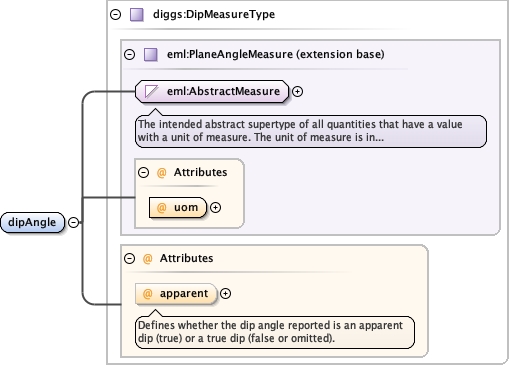
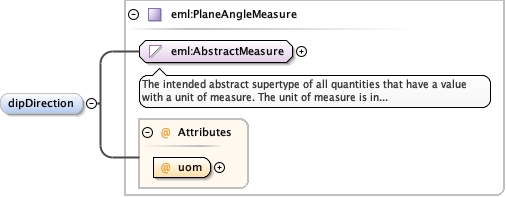
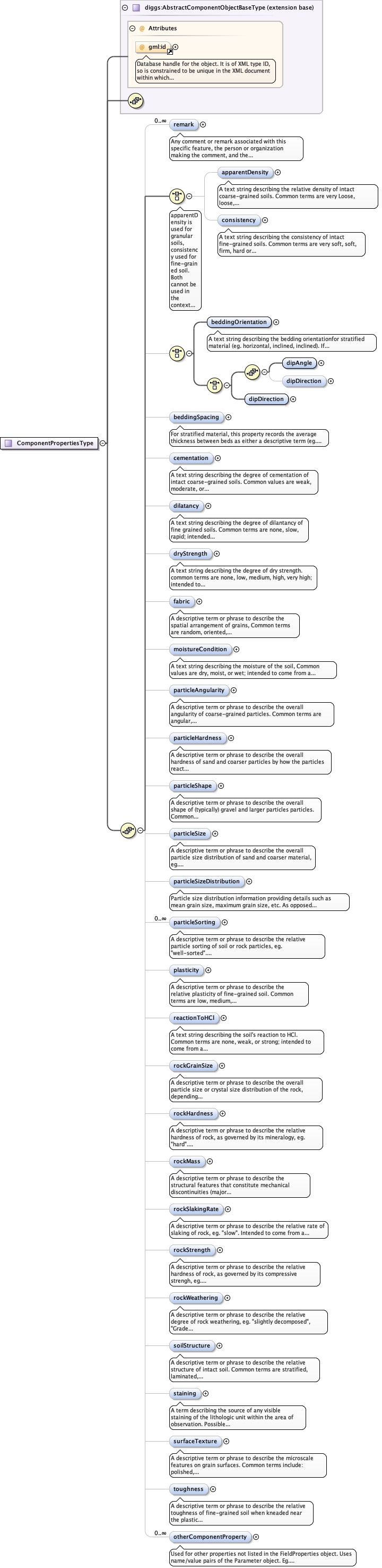
<complexType name="ComponentPropertiesType"><complexContent><extension base="diggs:AbstractComponentObjectBaseType"><sequence><element name="remark" type="diggs:RemarkPropertyType" minOccurs="0" maxOccurs="unbounded"><annotation><documentation>Any comment or remark associated with this specific feature, the person or organization making the comment, and the time comment was made.Any comment or remark associated with this specific feature, the person or organization making the comment, and the time comment was made.</documentation></annotation></element><choice><annotation><documentation>apparentDensity is used for granular soils, consistency used for fine-grained soil. Both cannot be used in the context of a single lithology class.</documentation></annotation><element name="apparentDensity" type="gml:CodeType" minOccurs="0"><annotation><documentation>A text string describing the relative density of intact coarse-grained soils. Common terms are very Loose, loose, medium dense, dense, very Dense; intended to come from a controlled list</documentation></annotation></element><element name="consistency" type="gml:CodeType" minOccurs="0"><annotation><documentation>A text string describing the consistency of intact fine-grained soils. Common terms are very soft, soft, firm, hard or very hard; intended to come from a controlled list</documentation></annotation></element></choice><choice minOccurs="0"><element name="beddingOrientation" type="diggs:DiggsStringType" minOccurs="1"><annotation><documentation>A text string describing the bedding orientationfor stratified material (eg. horizontal, inclined, inclined). If quantitative strike and or dip data is available, dipAngle and dipDirection properties instead.</documentation></annotation></element><choice><sequence><element name="dipAngle" type="diggs:DipMeasureType"/><element minOccurs="0" name="dipDirection" type="eml:PlaneAngleMeasure"/></sequence><element minOccurs="1" name="dipDirection" type="eml:PlaneAngleMeasure"/></choice></choice><element name="beddingSpacing" type="gml:CodeType" minOccurs="0"><annotation><documentation>For stratified material, this property records the average thickness between beds as either a descriptive term (eg. thick, thin, etc., from a controlled list of terms, or as a string representation of a numeric value (eg. 10 cm).</documentation></annotation></element><element name="cementation" type="gml:CodeType" minOccurs="0"><annotation><documentation>A text string describing the degree of cementation of intact coarse-grained soils. Common values are weak, moderate, or strong; intended to come from a controlled list</documentation></annotation></element><element name="dilatancy" type="gml:CodeType" minOccurs="0"><annotation><documentation>A text string describing the degree of dilantancy of fine grained soils. Common terms are none, slow, rapid; intended to come from a controlled list</documentation></annotation></element><element name="dryStrength" type="gml:CodeType" minOccurs="0"><annotation><documentation>A text string describing the degree of dry strength. common terms are none, low, medium, high, very high; intended to come from a controlled list</documentation></annotation></element><element minOccurs="0" name="fabric" type="gml:CodeType" maxOccurs="1"><annotation><documentation>A descriptive term or phrase to describe the spatial arrangement of grains, Common terms are random, oriented, imbricated, etc. Intended to come from a controlled list of terms. I</documentation></annotation></element><element name="moistureCondition" type="gml:CodeType" minOccurs="0"><annotation><documentation>A text string describing the moisture of the soil, Common values are dry, moist, or wet; intended to come from a controlled list</documentation></annotation></element><element minOccurs="0" name="particleAngularity" type="gml:CodeType" maxOccurs="1"><annotation><documentation>A descriptive term or phrase to describe the overall angularity of coarse-grained particles. Common terms are angular, subangular, subrounded, rounded). Intended to come from a controlled list.</documentation></annotation></element><element minOccurs="0" name="particleHardness" type="diggs:SizeClassCodeType" maxOccurs="1"><annotation><documentation>A descriptive term or phrase to describe the overall hardness of sand and coarser particles by how the particles react to a hammer blow. Common terms are crack, fracture, or crumble. Hard is typically used if no cracking occurs. Intended to come from a controlled list.</documentation></annotation></element><element minOccurs="0" name="particleShape" type="gml:CodeType" maxOccurs="1"><annotation><documentation>A descriptive term or phrase to describe the overall shape of (typically) gravel and larger particles particles. Common terms are flat, elongated, and flat and elongated. Intended to come from a controlled list.</documentation></annotation></element><element minOccurs="0" name="particleSize" type="gml:CodeType" maxOccurs="1"><annotation><documentation>A descriptive term or phrase to describe the overall particle size distribution of sand and coarser material, eg. "fine", "fine to coarse", "medium. Intended to come from a controlled list.</documentation></annotation></element><element minOccurs="0" name="particleSizeDistribution" type="diggs:ParticleSizeDistributionPropertyType" maxOccurs="1"><annotation><documentation>Particle size distribution information providing details such as mean grain size, maximum grain size, etc. As opposed to Properties in this object support quantitative values derived from laboratory analyses can carry descriptive terms. Detailed properties of a grain size distribution curve should be reported as test results of a ParticleSizeTest</documentation></annotation></element><element minOccurs="0" name="particleSorting" type="gml:CodeType" maxOccurs="unbounded"><annotation><documentation>A descriptive term or phrase to describe the relative particle sorting of soil or rock particles, eg. "well-sorted". Intended to come from a controlled list.</documentation></annotation></element><element minOccurs="0" name="plasticity" type="gml:CodeType"><annotation><documentation>A descriptive term or phrase to describe the relative plasticity of fine-grained soil. Common terms are low, medium, high. Intended to come from a controlled list.</documentation></annotation></element><element name="reactionToHCl" type="gml:CodeType" minOccurs="0"><annotation><documentation>A text string describing the soil's reaction to HCl. Common terms are none, weak, or strong; intended to come from a controlled list</documentation></annotation></element><element minOccurs="0" name="rockGrainSize" type="gml:CodeType"><annotation><documentation>A descriptive term or phrase to describe the overall particle size or crystal size distribution of the rock, depending on rock origin. For example, for cystalline igneous or metamorphic rocks, terms such as pegmatitic or aphanitic may be used. For clastic sedimentary rocks, terms such as fine sand or cobbles may be used, and for pyroclastic igneous rocks, terms such as "coarse ash" or "lapili" may be used. Intended to come from a controlled list of terms.</documentation></annotation></element><element minOccurs="0" name="rockHardness" type="gml:CodeType"><annotation><documentation>A descriptive term or phrase to describe the relative hardness of rock, as governed by its mineralogy, eg. "hard". Intended to come from a controlled list.</documentation></annotation></element><element minOccurs="0" name="rockMass" type="gml:CodeType"><annotation><documentation>A descriptive term or phrase to describe the structural features that constitute mechanical discontinuities (major geological features). Rock mass refers to any in situ rock with all inherent geomechanical discontinuities (eg. fissile, blocky, fractured, etc.)</documentation></annotation></element><element minOccurs="0" name="rockSlakingRate" type="gml:CodeType"><annotation><documentation>A descriptive term or phrase to describe the relative rate of slaking of rock, eg. "slow". Intended to come from a controlled list.</documentation></annotation></element><element minOccurs="0" name="rockStrength" type="gml:CodeType"><annotation><documentation>A descriptive term or phrase to describe the relative hardness of rock, as governed by its compressive strengh, eg. "strong". Intended to come from a controlled list.</documentation></annotation></element><element minOccurs="0" name="rockWeathering" type="gml:CodeType"><annotation><documentation>A descriptive term or phrase to describe the relative degree of rock weathering, eg. "slightly decomposed", "Grade III", etc. Intended to come from a controlled list.</documentation></annotation></element><element minOccurs="0" name="soilStructure" type="gml:CodeType"><annotation><documentation>A descriptive term or phrase to describe the relative structure of intact soil. Common terms are stratified, laminated, fissured, slickensided, blocky, lensed, homogeneous, varved, etc. Intended to come from a controlled list.</documentation></annotation></element><element minOccurs="0" name="staining" type="gml:CodeType"><annotation><documentation>A term describing the source of any visible staining of the lithologic unit within the area of observation. Possible terms include iron, manganese, hydrocarbons, etc. Intended to come from a controlled list of terms.</documentation></annotation></element><element minOccurs="0" name="surfaceTexture" type="gml:CodeType" maxOccurs="1"><annotation><documentation>A descriptive term or phrase to describe the microscale features on grain surfaces. Common terms include: polished, smooth, pitted, striated, etc. Intended to come from a controlled list of terms. Includes:</documentation></annotation></element><element minOccurs="0" name="toughness" type="gml:CodeType"><annotation><documentation>A descriptive term or phrase to describe the relative toughness of fine-grained soil when kneaded near the plastic limit. Common termes are low, medium, high. Intended to come from a controlled list.</documentation></annotation></element><element minOccurs="0" name="otherComponentProperty" maxOccurs="unbounded" type="diggs:ParameterPropertyType"><annotation><documentation>Used for other properties not listed in the FieldProperties object. Uses name/value pairs of the Parameter object. Eg. name = Additional Description, value = with slag</documentation></annotation></element></sequence></extension></complexContent></complexType>