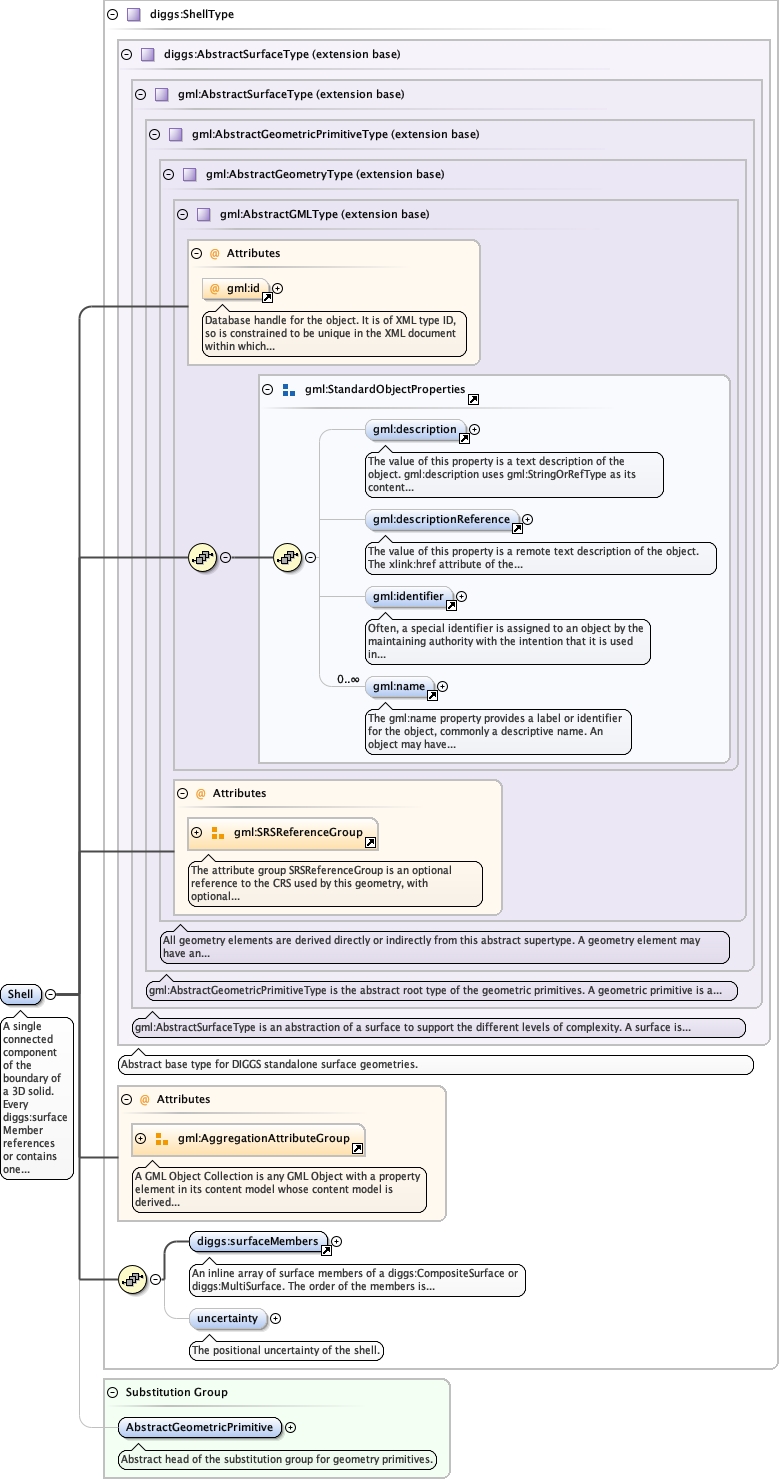
A single connected component of the boundary of a 3D solid. Everydiggs:surfaceMember references or contains one surface, any element substitutablefor diggs:AbstractSurface; in a shell, the surfaces describe the boundary of thesolid. A shell is topologically a surface (the ISO 19107 boundary-of-a-solidconcept), but its element does not substitute diggs:AbstractSurface, because it is aboundary component rather than a standalone surface. If the aggregationTypeattribute is given, its value shall be "set".
Database handle for the object. It is of XML type ID, so is constrained to beunique in the XML document within which it occurs. An external identifier for the object inthe form of a URI may be constructed using standard XML and XPointer methods. This is doneby concatenating the URI for the document, a fragment separator, and the value of the idattribute.
<element name="Shell" substitutionGroup="diggs:AbstractGeometricPrimitive" type="diggs:ShellType"><annotation><documentation>A single connected component of the boundary of a 3D solid. Every diggs:surfaceMember references or contains one surface, any element substitutable for diggs:AbstractSurface; in a shell, the surfaces describe the boundary of the solid. A shell is topologically a surface (the ISO 19107 boundary-of-a-solid concept), but its element does not substitute diggs:AbstractSurface, because it is a boundary component rather than a standalone surface. If the aggregationType attribute is given, its value shall be "set".</documentation></annotation></element>