Showing:

Annotations
Attributes
Diagrams
Instances
Model
Properties
Source
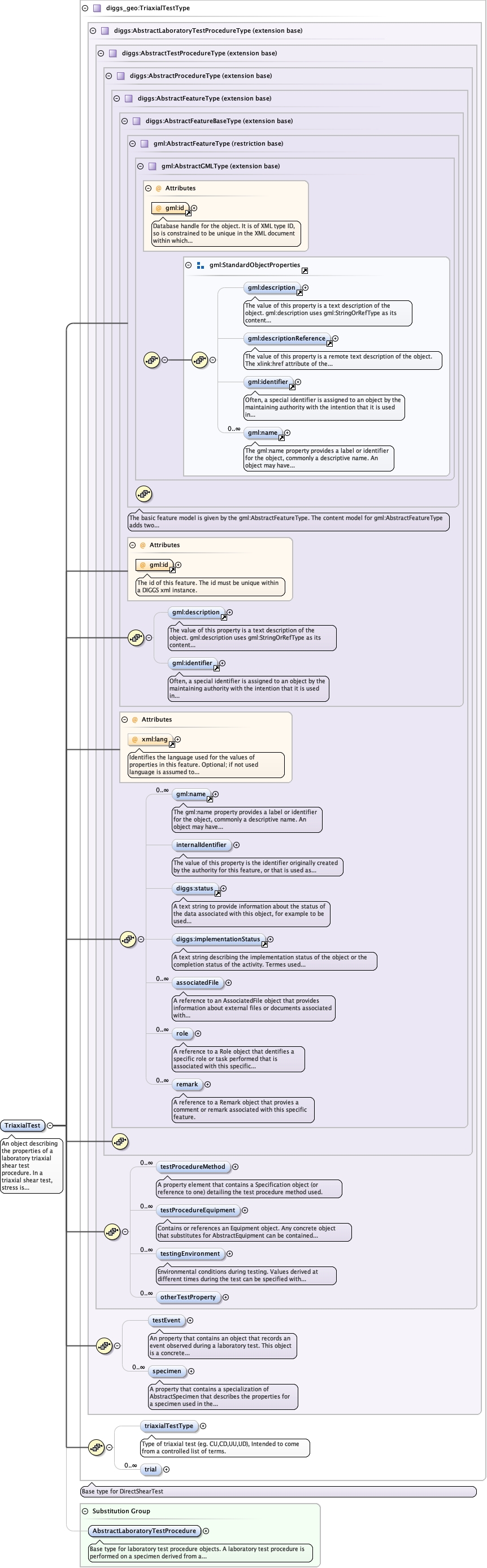
Element diggs_geo:TriaxialTest
Namespace http://diggsml.org/schema-dev/geotechnical
Annotations
An object describing the properties of a laboratory triaxial shear test procedure. In a triaxial shear test, stress is applied to a sample in a way which
results in stresses along one axis being different from the stresses in
perpendicular directions. In conventional triaxial tests, this involves subjecting a
cylindrical soil sample to radial stresses (confining pressure) and controlled
increases in axial stresses or axial displacements. Depending on the combination of
loading and drainage condition, three main types of triaxial tests can be carried
out: 1) Consolidated – Drained (CD), 2) Consolidated – Undrained (CU), 3)
Unconsolidated - Undrained (UU). From the triaxial test results, it is possible to
deduce the shear strength parameters, namely friction angle, cohesion, dilatancy
angle and the other dependent parameters.
Diagram
Diagramgml3_2Profile_diggs_xsd_Attribute_gml_id.tmp#idgml3_2Profile_diggs_xsd_Element_gml_description.tmp#descriptiongml3_2Profile_diggs_xsd_Element_gml_descriptionReference.tmp#descriptionReferencegml3_2Profile_diggs_xsd_Element_gml_identifier.tmp#identifiergml3_2Profile_diggs_xsd_Element_gml_name.tmp#namegml3_2Profile_diggs_xsd_Element_Group_gml_StandardObjectProperties.tmp#StandardObjectPropertiesgml3_2Profile_diggs_xsd_Complex_Type_gml_AbstractGMLType.tmp#AbstractGMLTypegml3_2Profile_diggs_xsd_Complex_Type_gml_AbstractFeatureType.tmp#http___www.opengis.net_gml_3.2_AbstractFeatureTypegml3_2Profile_diggs_xsd_Attribute_gml_id.tmp#idgml3_2Profile_diggs_xsd_Element_gml_description.tmp#descriptiongml3_2Profile_diggs_xsd_Element_gml_identifier.tmp#identifierKernel_xsd_Complex_Type_diggs_AbstractFeatureBaseType.tmp#AbstractFeatureBaseTypexml_xsd_Attribute_xml_lang.tmp#langgml3_2Profile_diggs_xsd_Element_gml_name.tmp#nameKernel_xsd_Complex_Type_diggs_AbstractFeatureType.tmp#AbstractFeatureType_internalIdentifierKernel_xsd_Element_diggs_status.tmp#statusKernel_xsd_Element_diggs_implementationStatus.tmp#implementationStatusKernel_xsd_Complex_Type_diggs_AbstractFeatureType.tmp#AbstractFeatureType_associatedFileKernel_xsd_Complex_Type_diggs_AbstractFeatureType.tmp#AbstractFeatureType_roleKernel_xsd_Complex_Type_diggs_AbstractFeatureType.tmp#AbstractFeatureType_remarkKernel_xsd_Complex_Type_diggs_AbstractFeatureType.tmp#AbstractFeatureTypeKernel_xsd_Complex_Type_diggs_AbstractProcedureType.tmp#AbstractProcedureTypeKernel_xsd_Complex_Type_diggs_AbstractTestProcedureType.tmp#AbstractTestProcedureType_testProcedureMethodKernel_xsd_Complex_Type_diggs_AbstractTestProcedureType.tmp#AbstractTestProcedureType_testProcedureEquipmentKernel_xsd_Complex_Type_diggs_AbstractTestProcedureType.tmp#AbstractTestProcedureType_testingEnvironmentKernel_xsd_Complex_Type_diggs_AbstractTestProcedureType.tmp#AbstractTestProcedureType_otherTestPropertyKernel_xsd_Complex_Type_diggs_AbstractTestProcedureType.tmp#AbstractTestProcedureTypeKernel_xsd_Complex_Type_diggs_AbstractLaboratoryTestProcedureType.tmp#AbstractLaboratoryTestProcedureType_testEventKernel_xsd_Complex_Type_diggs_AbstractLaboratoryTestProcedureType.tmp#AbstractLaboratoryTestProcedureType_specimenKernel_xsd_Complex_Type_diggs_AbstractLaboratoryTestProcedureType.tmp#AbstractLaboratoryTestProcedureTypeDiggs_geo_deprecated_xsd_Complex_Type_diggs_geo_TriaxialTestType.tmp#TriaxialTestType_triaxialTestTypeDiggs_geo_deprecated_xsd_Complex_Type_diggs_geo_TriaxialTestType.tmp#TriaxialTestType_trialDiggs_geo_deprecated_xsd_Complex_Type_diggs_geo_TriaxialTestType.tmp#TriaxialTestTypeKernel_xsd_Element_diggs_AbstractLaboratoryTestProcedure.tmp#AbstractLaboratoryTestProcedure
Type diggs_geo:TriaxialTestType
Type hierarchy
Properties
content complex
abstract false
Substitution Group Affiliation
Model
Children diggs:associatedFile, diggs:implementationStatus, diggs:internalIdentifier, diggs:otherTestProperty, diggs:remark, diggs:role, diggs:specimen, diggs:status, diggs:testEvent, diggs:testProcedureEquipment, diggs:testProcedureMethod, diggs:testingEnvironment, diggs_geo:trial, diggs_geo:triaxialTestType, gml:description, gml:identifier, gml:name
Instance
<diggs_geo:TriaxialTest gml:id="" xml:lang="" xmlns:diggs_geo="http://diggsml.org/schema-dev/geotechnical" xmlns:gml="http://www.opengis.net/gml/3.2" xmlns:diggs="http://diggsml.org/schema-dev">
  <gml:description xlink:actuate="" xlink:arcrole="" xlink:href="" nilReason="" xlink:role="" xlink:show="" xlink:title="" xlink:type="simple">{0,1}</gml:description>
  <gml:identifier codeSpace="">{0,1}</gml:identifier>
  <gml:name codeSpace="">{0,unbounded}</gml:name>
  <diggs:internalIdentifier codeSpace="">{0,1}</diggs:internalIdentifier>
  <diggs:status codeSpace="">{0,1}</diggs:status>
  <diggs:implementationStatus codeSpace="">{0,1}</diggs:implementationStatus>
  <diggs:associatedFile xlink:actuate="" xlink:arcrole="" xlink:href="" nilReason="" owns="false" xlink:role="" xlink:show="" xlink:title="" xlink:type="simple">{0,unbounded}</diggs:associatedFile>
  <diggs:role>{0,unbounded}</diggs:role>
  <diggs:remark>{0,unbounded}</diggs:remark>
  <diggs:testProcedureMethod xlink:actuate="" xlink:arcrole="" xlink:href="" nilReason="" owns="false" xlink:role="" xlink:show="" xlink:title="" xlink:type="simple">{0,unbounded}</diggs:testProcedureMethod>
  <diggs:testProcedureEquipment xlink:actuate="" xlink:arcrole="" xlink:href="" nilReason="" owns="false" xlink:role="" xlink:show="" xlink:title="" xlink:type="simple">{0,unbounded}</diggs:testProcedureEquipment>
  <diggs:testingEnvironment>{0,unbounded}</diggs:testingEnvironment>
  <diggs:otherTestProperty>{0,unbounded}</diggs:otherTestProperty>
  <diggs:testEvent>{0,1}</diggs:testEvent>
  <diggs:specimen xlink:actuate="" xlink:arcrole="" xlink:href="" nilReason="" owns="false" xlink:role="" xlink:show="" xlink:title="" xlink:type="simple">{0,unbounded}</diggs:specimen>
  <diggs_geo:triaxialTestType codeSpace="">{0,1}</diggs_geo:triaxialTestType>
  <diggs_geo:trial>{0,unbounded}</diggs_geo:trial>
</diggs_geo:TriaxialTest>
Attributes
QName Type Use Annotation
gml:id ID required
Database handle for the object. It is of XML type ID, so is constrained to be
unique in the XML document within which it occurs. An external identifier for the object in
the form of a URI may be constructed using standard XML and XPointer methods. This is done
by concatenating the URI for the document, a fragment separator, and the value of the id
attribute.
xml:lang union of(xs:language, restriction of xs:string) optional
<div>
  <h3>lang (as an attribute name)</h3>
  <p>denotes an attribute whose value is a language code for the natural language of the content of any element; its value is inherited. This name is reserved by virtue of its definition in the XML specification.</p>
</div>
<div>
  <h4>Notes</h4>
  <p>Attempting to install the relevant ISO 2- and 3-letter codes as the enumerated possible values is probably never going to be a realistic possibility.</p>
  <p>See BCP 47 at
    <a href="http://www.rfc-editor.org/rfc/bcp/bcp47.txt">http://www.rfc-editor.org/rfc/bcp/bcp47.txt</a>and the IANA language subtag registry at
    <a href="http://www.iana.org/assignments/language-subtag-registry">http://www.iana.org/assignments/language-subtag-registry</a>for further information.</p>
  <p>The union allows for the 'un-declaration' of xml:lang with the empty string.</p>
</div>
Source
<element abstract="false" name="TriaxialTest" substitutionGroup="diggs:AbstractLaboratoryTestProcedure" type="diggs_geo:TriaxialTestType">
  <annotation>
    <documentation>An object describing the properties of a laboratory triaxial shear test procedure. In a triaxial shear test, stress is applied to a sample in a way which results in stresses along one axis being different from the stresses in perpendicular directions. In conventional triaxial tests, this involves subjecting a cylindrical soil sample to radial stresses (confining pressure) and controlled increases in axial stresses or axial displacements. Depending on the combination of loading and drainage condition, three main types of triaxial tests can be carried out: 1) Consolidated – Drained (CD), 2) Consolidated – Undrained (CU), 3) Unconsolidated - Undrained (UU). From the triaxial test results, it is possible to deduce the shear strength parameters, namely friction angle, cohesion, dilatancy angle and the other dependent parameters.</documentation>
  </annotation>
</element>