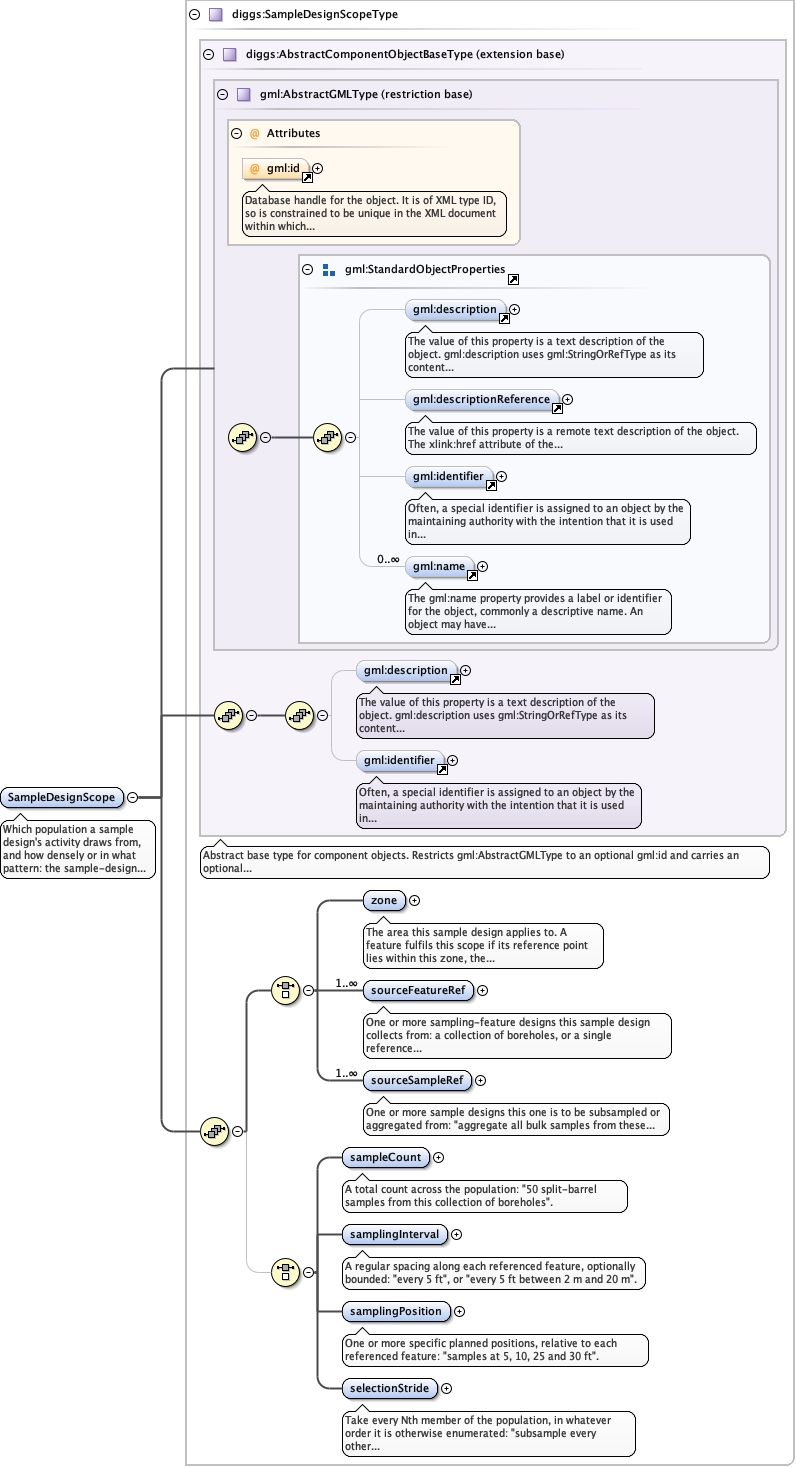
Which population a sample design's activity draws from, and how densely or in whatpattern: the sample-design counterpart of diggs:SFDesignScopeType. Two independentquestions: where from (a zone, one or more sampling-feature designs, or one or moresource samples or sample designs) and how many or what pattern (a count, aninterval, explicit positions or a stride). Population selection is not restatedhere: "all boreholes", "a specific one" and "based on zone" are whatdiggs:SFDesignScopeType states on the sampling-feature design itself, andsourceFeatureRef cites that design rather than repeating its zone, count andposition logic. zone is also available directly, for scoping straight to a regionwithout an intermediate sampling-feature design to cite. There are two populationkinds because they are different relations: a sample collected from a samplingfeature (sourceFeatureRef) is a different fact from a sample subsampled oraggregated from another sample or sample design (sourceSampleRef, typeddiggs:FractionalReferenceType so that a subsample can state what percentage of itssource it takes). The selection choice is optional and can be absent: absence meansevery member of the population, or one per referenced feature, which is the naturalreading for "aggregate all bulk samples from these three test pits".
Database handle for the object. It is of XML type ID, so is constrained to beunique in the XML document within which it occurs. An external identifier for the object inthe form of a URI may be constructed using standard XML and XPointer methods. This is doneby concatenating the URI for the document, a fragment separator, and the value of the idattribute.
Source
<element name="SampleDesignScope" type="diggs:SampleDesignScopeType"><annotation><documentation>Which population a sample design's activity draws from, and how densely or in what pattern: the sample-design counterpart of diggs:SFDesignScopeType. Two independent questions: where from (a zone, one or more sampling-feature designs, or one or more source samples or sample designs) and how many or what pattern (a count, an interval, explicit positions or a stride). Population selection is not restated here: "all boreholes", "a specific one" and "based on zone" are what diggs:SFDesignScopeType states on the sampling-feature design itself, and sourceFeatureRef cites that design rather than repeating its zone, count and position logic. zone is also available directly, for scoping straight to a region without an intermediate sampling-feature design to cite. There are two population kinds because they are different relations: a sample collected from a sampling feature (sourceFeatureRef) is a different fact from a sample subsampled or aggregated from another sample or sample design (sourceSampleRef, typed diggs:FractionalReferenceType so that a subsample can state what percentage of its source it takes). The selection choice is optional and can be absent: absence means every member of the population, or one per referenced feature, which is the natural reading for "aggregate all bulk samples from these three test pits".</documentation></annotation></element>