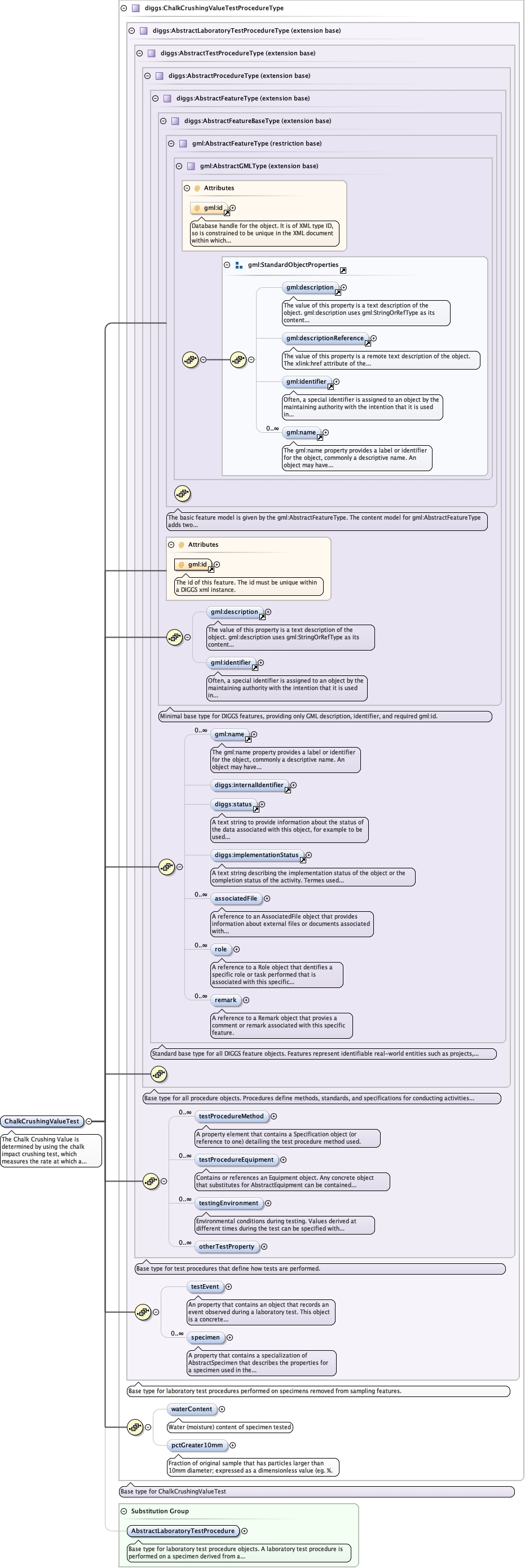
The Chalk Crushing Value is determined by using the chalk impact crushingtest, which measures the rate at which a sample of chalk lumps crushes under impactsfrom a freefalling rammer. The chalk crushing value can be used, together with thesaturation moisture content of the intact chalk lumps, to classify chalk in relationto its behaviour as a freshly placed fill material. The test procedure is describedfor a single sample of chalk lumps, but normal procedure should be to calculate themean value derived from six such tests on representative samples.
Database handle for the object. It is of XML type ID, so is constrained to beunique in the XML document within which it occurs. An external identifier for the object inthe form of a URI may be constructed using standard XML and XPointer methods. This is doneby concatenating the URI for the document, a fragment separator, and the value of the idattribute.
Source
<element name="ChalkCrushingValueTest" type="diggs:ChalkCrushingValueTestProcedureType" abstract="false" substitutionGroup="diggs:AbstractLaboratoryTestProcedure"><annotation><documentation>The Chalk Crushing Value is determined by using the chalk impact crushing test, which measures the rate at which a sample of chalk lumps crushes under impacts from a freefalling rammer. The chalk crushing value can be used, together with the saturation moisture content of the intact chalk lumps, to classify chalk in relation to its behaviour as a freshly placed fill material. The test procedure is described for a single sample of chalk lumps, but normal procedure should be to calculate the mean value derived from six such tests on representative samples.</documentation></annotation></element>