Showing:

Annotations
Attributes
Diagrams
Instances
Model
Properties
Source
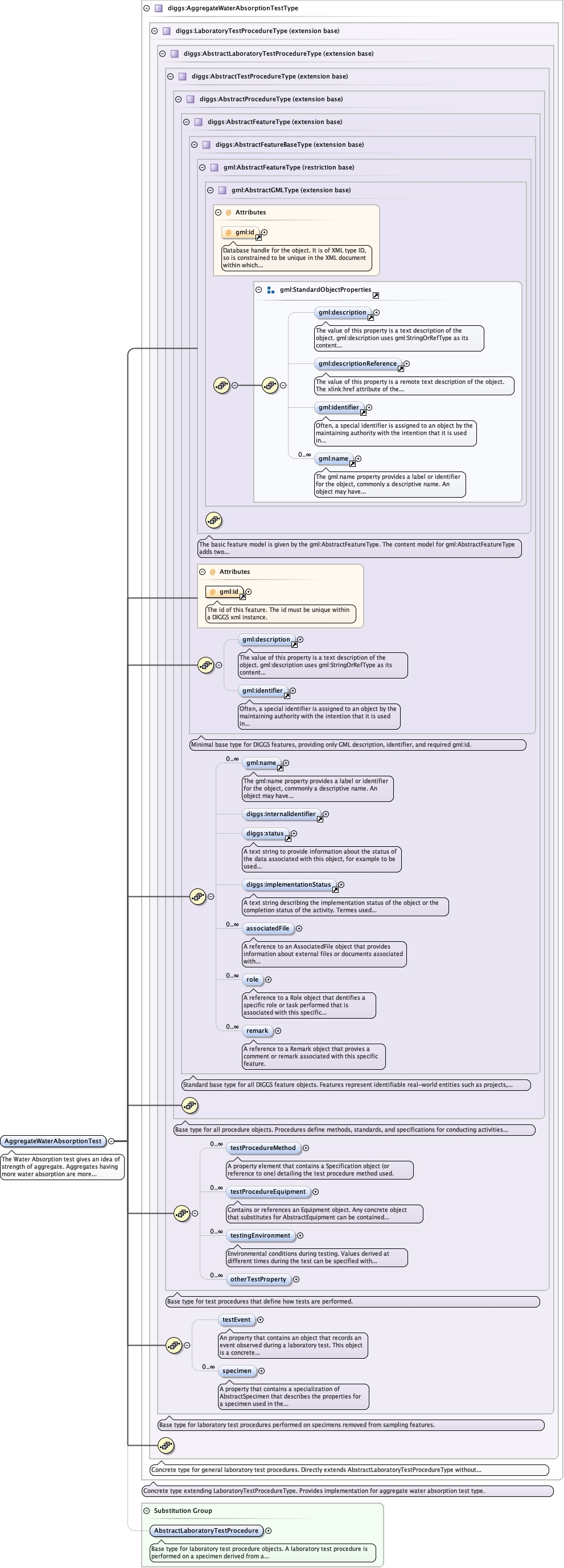
Element diggs:AggregateWaterAbsorptionTest
Namespace http://diggsml.org/schemas/3
Annotations
The Water Absorption test gives an idea of strength of aggregate.
Aggregates having more water absorption are more porous in nature and are generally
considered unsuitable unless they are found to be acceptable based on strength,
impact, and hardness tests.
Diagram
Diagramgml3_2Profile_diggs_xsd_Attribute_gml_id.tmp#idgml3_2Profile_diggs_xsd_Element_gml_description.tmp#descriptiongml3_2Profile_diggs_xsd_Element_gml_descriptionReference.tmp#descriptionReferencegml3_2Profile_diggs_xsd_Element_gml_identifier.tmp#identifiergml3_2Profile_diggs_xsd_Element_gml_name.tmp#namegml3_2Profile_diggs_xsd_Element_Group_gml_StandardObjectProperties.tmp#StandardObjectPropertiesgml3_2Profile_diggs_xsd_Complex_Type_gml_AbstractGMLType.tmp#AbstractGMLTypegml3_2Profile_diggs_xsd_Complex_Type_gml_AbstractFeatureType.tmp#AbstractFeatureTypegml3_2Profile_diggs_xsd_Attribute_gml_id.tmp#idgml3_2Profile_diggs_xsd_Element_gml_description.tmp#descriptiongml3_2Profile_diggs_xsd_Element_gml_identifier.tmp#identifierAbstractTypes_xsd_Complex_Type_diggs_AbstractFeatureBaseType.tmp#AbstractFeatureBaseTypegml3_2Profile_diggs_xsd_Element_gml_name.tmp#nameCommon_xsd_Element_diggs_internalIdentifier.tmp#internalIdentifierCommon_xsd_Element_diggs_status.tmp#statusCommon_xsd_Element_diggs_implementationStatus.tmp#implementationStatusAbstractTypes_xsd_Complex_Type_diggs_AbstractFeatureType.tmp#http___diggsml.org_schemas_3_AbstractFeatureType_associatedFileAbstractTypes_xsd_Complex_Type_diggs_AbstractFeatureType.tmp#http___diggsml.org_schemas_3_AbstractFeatureType_roleAbstractTypes_xsd_Complex_Type_diggs_AbstractFeatureType.tmp#http___diggsml.org_schemas_3_AbstractFeatureType_remarkAbstractTypes_xsd_Complex_Type_diggs_AbstractFeatureType.tmp#http___diggsml.org_schemas_3_AbstractFeatureTypeAbstractTypes_xsd_Complex_Type_diggs_AbstractProcedureType.tmp#AbstractProcedureTypeAbstractTypes_xsd_Complex_Type_diggs_AbstractTestProcedureType.tmp#AbstractTestProcedureType_testProcedureMethodAbstractTypes_xsd_Complex_Type_diggs_AbstractTestProcedureType.tmp#AbstractTestProcedureType_testProcedureEquipmentAbstractTypes_xsd_Complex_Type_diggs_AbstractTestProcedureType.tmp#AbstractTestProcedureType_testingEnvironmentAbstractTypes_xsd_Complex_Type_diggs_AbstractTestProcedureType.tmp#AbstractTestProcedureType_otherTestPropertyAbstractTypes_xsd_Complex_Type_diggs_AbstractTestProcedureType.tmp#AbstractTestProcedureTypeAbstractTypes_xsd_Complex_Type_diggs_AbstractLaboratoryTestProcedureType.tmp#AbstractLaboratoryTestProcedureType_testEventAbstractTypes_xsd_Complex_Type_diggs_AbstractLaboratoryTestProcedureType.tmp#AbstractLaboratoryTestProcedureType_specimenAbstractTypes_xsd_Complex_Type_diggs_AbstractLaboratoryTestProcedureType.tmp#AbstractLaboratoryTestProcedureTypeCommon_xsd_Complex_Type_diggs_LaboratoryTestProcedureType.tmp#LaboratoryTestProcedureTypeExtProcedures_xsd_Complex_Type_diggs_AggregateWaterAbsorptionTestType.tmp#AggregateWaterAbsorptionTestTypeAbstractTypes_xsd_Element_diggs_AbstractLaboratoryTestProcedure.tmp#AbstractLaboratoryTestProcedure
Type diggs:AggregateWaterAbsorptionTestType
Type hierarchy
Properties
content complex
abstract false
Substitution Group Affiliation
Model
Children diggs:associatedFile, diggs:implementationStatus, diggs:internalIdentifier, diggs:otherTestProperty, diggs:remark, diggs:role, diggs:specimen, diggs:status, diggs:testEvent, diggs:testProcedureEquipment, diggs:testProcedureMethod, diggs:testingEnvironment, gml:description, gml:identifier, gml:name
Instance
<diggs:AggregateWaterAbsorptionTest gml:id="" xmlns:diggs="http://diggsml.org/schemas/3" xmlns:gml="http://www.opengis.net/gml/3.2">
  <gml:description xlink:actuate="" xlink:arcrole="" xlink:href="" nilReason="" xlink:role="" xlink:show="" xlink:title="" xlink:type="simple">{0,1}</gml:description>
  <gml:identifier codeSpace="">{0,1}</gml:identifier>
  <gml:name codeSpace="">{0,unbounded}</gml:name>
  <diggs:internalIdentifier codeSpace="">{0,1}</diggs:internalIdentifier>
  <diggs:status codeSpace="">{0,1}</diggs:status>
  <diggs:implementationStatus codeSpace="">{0,1}</diggs:implementationStatus>
  <diggs:associatedFile xlink:actuate="" xlink:arcrole="" xlink:href="" nilReason="" owns="false" xlink:role="" xlink:show="" xlink:title="" xlink:type="simple">{0,unbounded}</diggs:associatedFile>
  <diggs:role>{0,unbounded}</diggs:role>
  <diggs:remark>{0,unbounded}</diggs:remark>
  <diggs:testProcedureMethod xlink:actuate="" xlink:arcrole="" xlink:href="" nilReason="" owns="false" xlink:role="" xlink:show="" xlink:title="" xlink:type="simple">{0,unbounded}</diggs:testProcedureMethod>
  <diggs:testProcedureEquipment xlink:actuate="" xlink:arcrole="" xlink:href="" nilReason="" owns="false" xlink:role="" xlink:show="" xlink:title="" xlink:type="simple">{0,unbounded}</diggs:testProcedureEquipment>
  <diggs:testingEnvironment>{0,unbounded}</diggs:testingEnvironment>
  <diggs:otherTestProperty>{0,unbounded}</diggs:otherTestProperty>
  <diggs:testEvent>{0,1}</diggs:testEvent>
  <diggs:specimen xlink:actuate="" xlink:arcrole="" xlink:href="" nilReason="" owns="false" xlink:role="" xlink:show="" xlink:title="" xlink:type="simple">{0,unbounded}</diggs:specimen>
</diggs:AggregateWaterAbsorptionTest>
Attributes
QName Type Use Annotation
gml:id ID required
Database handle for the object. It is of XML type ID, so is constrained to be
unique in the XML document within which it occurs. An external identifier for the object in
the form of a URI may be constructed using standard XML and XPointer methods. This is done
by concatenating the URI for the document, a fragment separator, and the value of the id
attribute.
Source
<element name="AggregateWaterAbsorptionTest" type="diggs:AggregateWaterAbsorptionTestType" abstract="false" substitutionGroup="diggs:AbstractLaboratoryTestProcedure">
  <annotation>
    <documentation>The Water Absorption test gives an idea of strength of aggregate. Aggregates having more water absorption are more porous in nature and are generally considered unsuitable unless they are found to be acceptable based on strength, impact, and hardness tests.</documentation>
  </annotation>
</element>