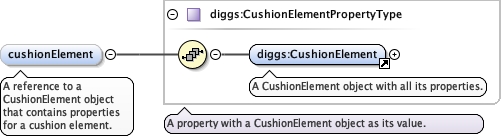
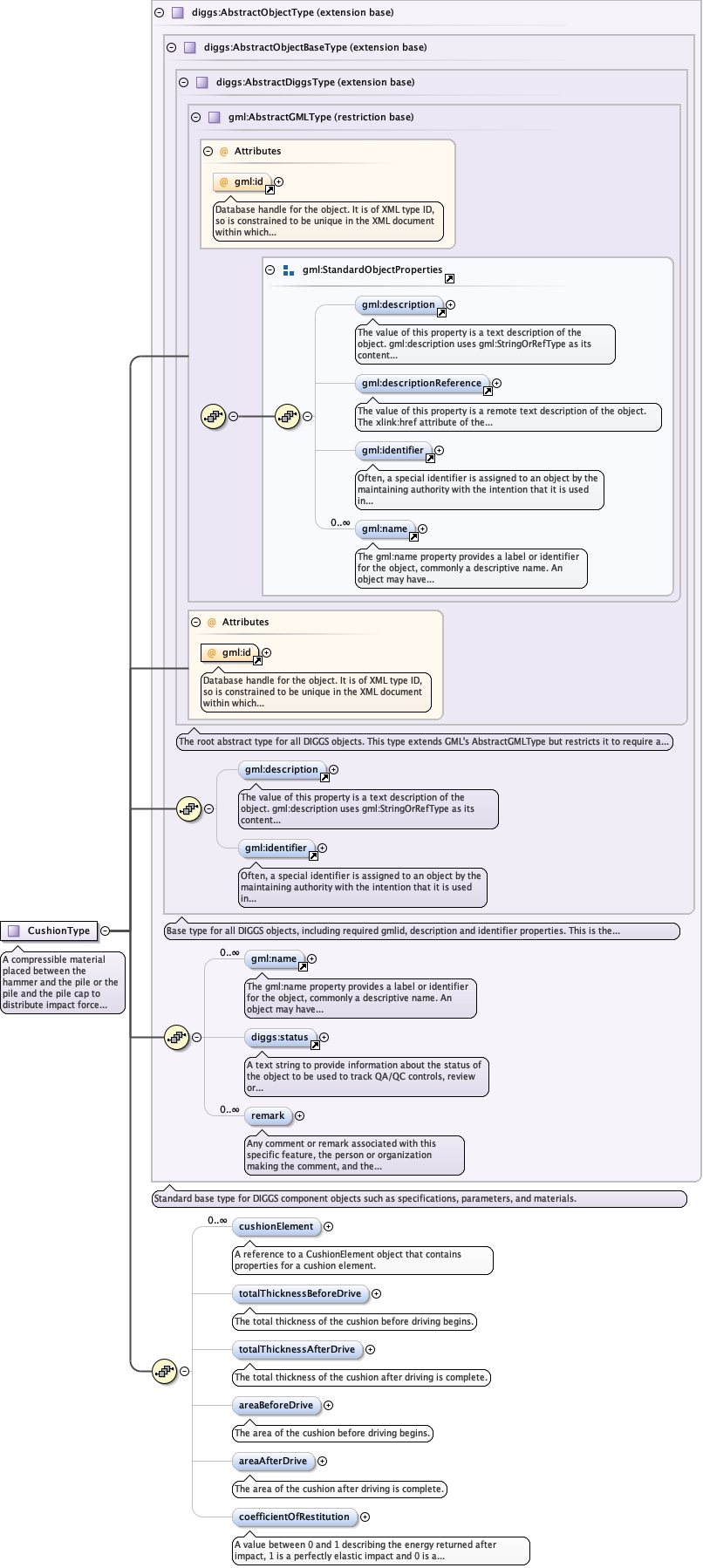
<element minOccurs="0" name="cushionElement" maxOccurs="unbounded" type="diggs:CushionElementPropertyType"><annotation><documentation>A reference to a CushionElement object that contains properties for a cushion element.</documentation></annotation></element>
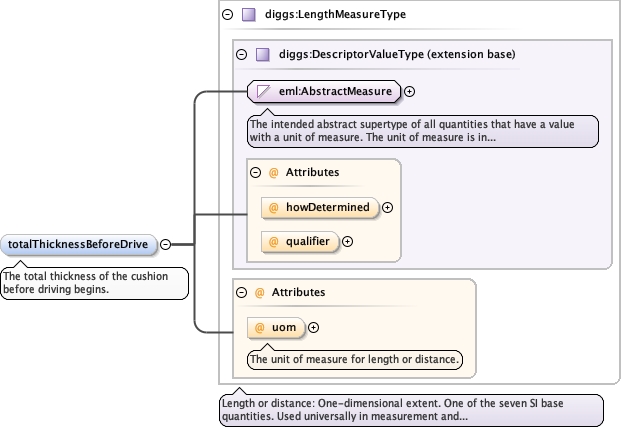
<element minOccurs="0" name="totalThicknessBeforeDrive" type="diggs:LengthMeasureType"><annotation><documentation>The total thickness of the cushion before driving begins.</documentation></annotation></element>
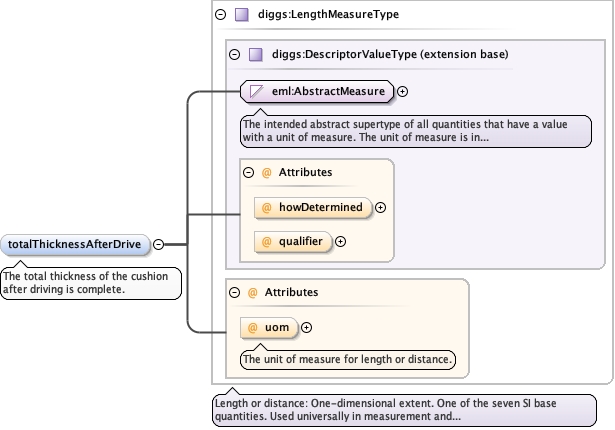
<element minOccurs="0" name="totalThicknessAfterDrive" type="diggs:LengthMeasureType"><annotation><documentation>The total thickness of the cushion after driving is complete.</documentation></annotation></element>
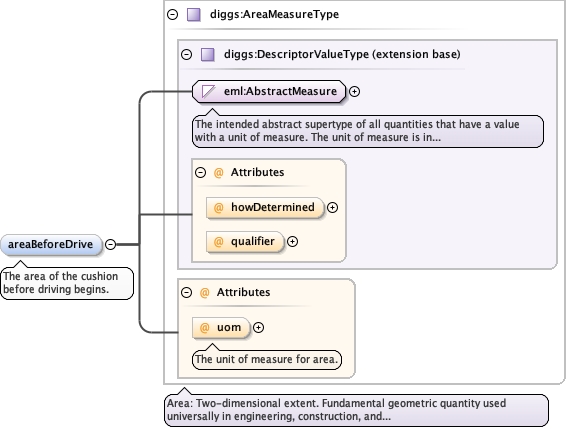
<element minOccurs="0" name="areaBeforeDrive" type="diggs:AreaMeasureType"><annotation><documentation>The area of the cushion before driving begins.</documentation></annotation></element>
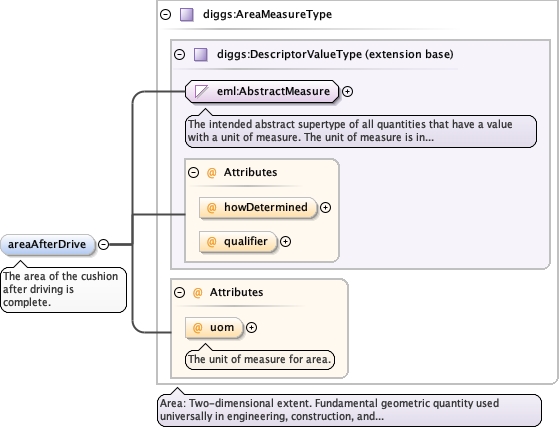
<element minOccurs="0" name="areaAfterDrive" type="diggs:AreaMeasureType"><annotation><documentation>The area of the cushion after driving is complete.</documentation></annotation></element>
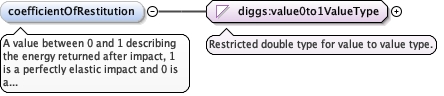
<element minOccurs="0" name="coefficientOfRestitution" type="diggs:value0to1ValueType"><annotation><documentation>A value between 0 and 1 describing the energy returned after impact, 1 is a perfectly elastic impact and 0 is a perfectly plastic impact.</documentation></annotation></element>
Complex Type diggs:CushionType
Namespace
http://diggsml.org/schemas/3
Annotations
A compressible material placed between the hammer and the pile or thepile and the pile cap to distribute impact force and reduce damage.
Database handle for the object. It is of XML type ID, so is constrained to beunique in the XML document within which it occurs. An external identifier for the object inthe form of a URI may be constructed using standard XML and XPointer methods. This is doneby concatenating the URI for the document, a fragment separator, and the value of the idattribute.
Source
<complexType mixed="false" name="CushionType"><annotation><documentation>A compressible material placed between the hammer and the pile or the pile and the pile cap to distribute impact force and reduce damage.</documentation></annotation><complexContent><extension base="diggs:AbstractObjectType"><sequence><element minOccurs="0" name="cushionElement" maxOccurs="unbounded" type="diggs:CushionElementPropertyType"><annotation><documentation>A reference to a CushionElement object that contains properties for a cushion element.</documentation></annotation></element><element minOccurs="0" name="totalThicknessBeforeDrive" type="diggs:LengthMeasureType"><annotation><documentation>The total thickness of the cushion before driving begins.</documentation></annotation></element><element minOccurs="0" name="totalThicknessAfterDrive" type="diggs:LengthMeasureType"><annotation><documentation>The total thickness of the cushion after driving is complete.</documentation></annotation></element><element minOccurs="0" name="areaBeforeDrive" type="diggs:AreaMeasureType"><annotation><documentation>The area of the cushion before driving begins.</documentation></annotation></element><element minOccurs="0" name="areaAfterDrive" type="diggs:AreaMeasureType"><annotation><documentation>The area of the cushion after driving is complete.</documentation></annotation></element><element minOccurs="0" name="coefficientOfRestitution" type="diggs:value0to1ValueType"><annotation><documentation>A value between 0 and 1 describing the energy returned after impact, 1 is a perfectly elastic impact and 0 is a perfectly plastic impact.</documentation></annotation></element></sequence></extension></complexContent></complexType>