Showing:

Annotations
Attributes
Diagrams
Instances
Model
Properties
Source
Used by
Element diggs:LithologyType / diggs:classificationCode
Namespace http://diggsml.org/schemas/2.6
Annotations
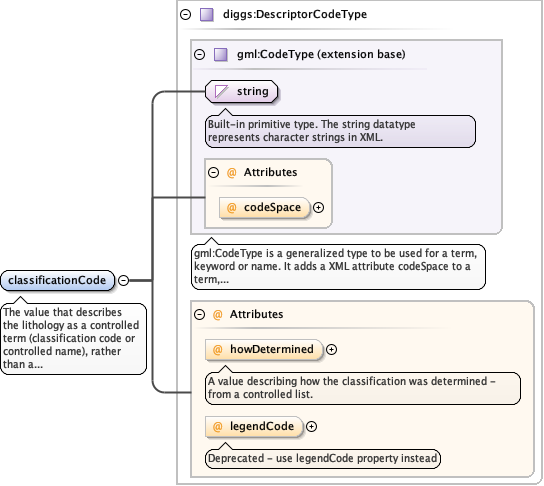
The value that describes the lithology as a controlled term (classification code or controlled name), rather than a simply descriptive one. Examples:

1) For soils described using the Unified Soil Classification, this value should be the "group name" as defined in Figures 1,2 and 3 of ASTM D 2487 or Figures 1 and 2 of ASTM D 2488, eg "Silty sand" or "Gravelly silt with sand". Where the group name is not specified, the "group symbol" should be used instead (eg. "SM" "ML").

2) For soils described using the AASHTO soil classification system, this value should be the group or subgroup classification (eg. "A-3", "A-2-6").

3) For soils classified using the USDA, Shepard (1954), or Folk classifications based on soil textures, this value would be the textural classification, eg. "sandy loam" (USDA), "sand-silt-clay" (Shepard), or "muddy Sand" (Folk, 7 class)

4) For soils classified using the British Soil Classification System, this value would be the recommended name (eg. "CLAY of very high plasticity"), or the group symbol if the standard name is not given (eg. "CV")

5) For rock, for example as defined by the American Geosciences Institute (AGI) glossary, this value would be ther rock name (eg. "dolostone", "basalt", "pebbly mudstone"). 

Either a classificationCode value or lithDescription value must be present.

The codespace attribute is mandatory and preferably is a link to the appropriate DIGGS codelist dictionary, should contain te authority code for any standard system, or a link to a dictionary of a non-standard or proprietary system. Standard codespace codes are as follows:

USCS - Unified Soil Classification System
AASHTO - AASHTO System for subgrades
USDA - US Dept. of Agriculture textural classification
BSCS - British Soil Classification System
SHEP - Shepard (1954) textural clasification
FOLK5 - Folk 5-class system for sediments
FOLK7 - Folk 7-class system for sediments
FOLK16 - Folk 16-class system for sediments
AGI - American Geosciences Institute Glossary
Diagram
Diagramgml3_2Profile_diggs_xsd_Complex_Type_gml_CodeType.tmp#CodeType_codeSpacegml3_2Profile_diggs_xsd_Complex_Type_gml_CodeType.tmp#CodeTypeKernel_xsd_Complex_Type_diggs_DescriptorCodeType.tmp#DescriptorCodeType_howDeterminedKernel_xsd_Complex_Type_diggs_DescriptorCodeType.tmp#DescriptorCodeType_legendCodeKernel_xsd_Complex_Type_diggs_DescriptorCodeType.tmp#DescriptorCodeType
Type diggs:DescriptorCodeType
Type hierarchy
Properties
content complex
minOccurs 1
maxOccurs 1
Attributes
QName Type Use Annotation
codeSpace anyURI optional
howDetermined diggs:DescriptorMethodEnumType optional
A value describing how the classification was determined -
from a controlled list.
legendCode string optional
Deprecated - use legendCode property instead
Source
<element name="classificationCode" type="diggs:DescriptorCodeType" minOccurs="1" maxOccurs="1">
  <annotation>
    <documentation>The value that describes the lithology as a controlled term (classification code or controlled name), rather than a simply descriptive one. Examples: 1) For soils described using the Unified Soil Classification, this value should be the "group name" as defined in Figures 1,2 and 3 of ASTM D 2487 or Figures 1 and 2 of ASTM D 2488, eg "Silty sand" or "Gravelly silt with sand". Where the group name is not specified, the "group symbol" should be used instead (eg. "SM" "ML"). 2) For soils described using the AASHTO soil classification system, this value should be the group or subgroup classification (eg. "A-3", "A-2-6"). 3) For soils classified using the USDA, Shepard (1954), or Folk classifications based on soil textures, this value would be the textural classification, eg. "sandy loam" (USDA), "sand-silt-clay" (Shepard), or "muddy Sand" (Folk, 7 class) 4) For soils classified using the British Soil Classification System, this value would be the recommended name (eg. "CLAY of very high plasticity"), or the group symbol if the standard name is not given (eg. "CV") 5) For rock, for example as defined by the American Geosciences Institute (AGI) glossary, this value would be ther rock name (eg. "dolostone", "basalt", "pebbly mudstone"). Either a classificationCode value or lithDescription value must be present. The codespace attribute is mandatory and preferably is a link to the appropriate DIGGS codelist dictionary, should contain te authority code for any standard system, or a link to a dictionary of a non-standard or proprietary system. Standard codespace codes are as follows: USCS - Unified Soil Classification System AASHTO - AASHTO System for subgrades USDA - US Dept. of Agriculture textural classification BSCS - British Soil Classification System SHEP - Shepard (1954) textural clasification FOLK5 - Folk 5-class system for sediments FOLK7 - Folk 7-class system for sediments FOLK16 - Folk 16-class system for sediments AGI - American Geosciences Institute Glossary</documentation>
  </annotation>
</element>
Element diggs:LithologyType / diggs:classificationSymbol
Namespace http://diggsml.org/schemas/2.6
Annotations
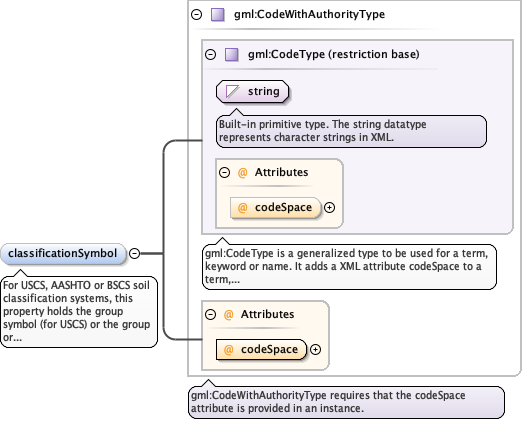
For USCS, AASHTO or BSCS soil classification systems, this property holds the group symbol (for USCS) or the group or appropriate subgroup classification (for AASHTO and BSCS). Symbology for nan-standard or proprietary classifications may also be reported here. Codespace attribute is mandatory and should preferably a link to the associated DIGGS dictionary, or be either USCS, AASHTO, or BSCS for those systems, or an authority code for non-standard systems.
Diagram
Diagramgml3_2Profile_diggs_xsd_Complex_Type_gml_CodeType.tmp#CodeType_codeSpacegml3_2Profile_diggs_xsd_Complex_Type_gml_CodeType.tmp#CodeTypegml3_2Profile_diggs_xsd_Complex_Type_gml_CodeWithAuthorityType.tmp#CodeWithAuthorityType_codeSpacegml3_2Profile_diggs_xsd_Complex_Type_gml_CodeWithAuthorityType.tmp#CodeWithAuthorityType
Type gml:CodeWithAuthorityType
Type hierarchy
Properties
content complex
minOccurs 0
maxOccurs 1
Attributes
QName Type Use
codeSpace anyURI required
Source
<element minOccurs="0" name="classificationSymbol" maxOccurs="1" type="gml:CodeWithAuthorityType">
  <annotation>
    <documentation>For USCS, AASHTO or BSCS soil classification systems, this property holds the group symbol (for USCS) or the group or appropriate subgroup classification (for AASHTO and BSCS). Symbology for nan-standard or proprietary classifications may also be reported here. Codespace attribute is mandatory and should preferably a link to the associated DIGGS dictionary, or be either USCS, AASHTO, or BSCS for those systems, or an authority code for non-standard systems.</documentation>
  </annotation>
</element>
Element diggs:LithologyType / diggs:groupIndexAASHTO
Namespace http://diggsml.org/schemas/2.6
Annotations
For soils classified using the AASHTO system, this property holds the value of the group index (GI) as defined by:

GI= (F–35)[0.2+0.005(LL– 40)}+(F–15)(PI–10)

where F is the percentage passing the 75 μm (0.075 mm) sieve, expressed as a whole number. This percentage is based only on the material passing the 75 μm sieve,
LL is the liquid limit and
PI is the plasticity index.
Diagram
Diagram
Type positiveInteger
Properties
content simple
minOccurs 0
Source
<element minOccurs="0" name="groupIndexAASHTO" type="positiveInteger">
  <annotation>
    <documentation>For soils classified using the AASHTO system, this property holds the value of the group index (GI) as defined by: GI= (F–35)[0.2+0.005(LL– 40)}+(F–15)(PI–10) where F is the percentage passing the 75 μm (0.075 mm) sieve, expressed as a whole number. This percentage is based only on the material passing the 75 μm sieve, LL is the liquid limit and PI is the plasticity index.</documentation>
  </annotation>
</element>
Element diggs:LithologyType / diggs:lithDescription
Namespace http://diggsml.org/schemas/2.6
Annotations
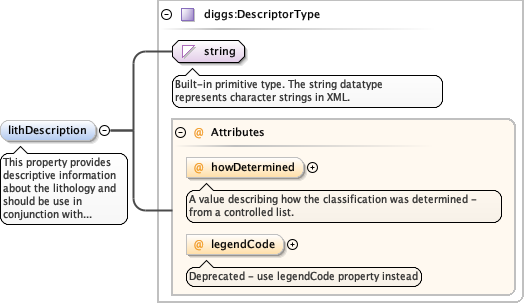
This property provides descriptive information about the lithology and should be use in conjunction with classificationCode. If the information is recorded, lithDescription include a description of color,facies, grain size disctribution, constituents and field properties, even if those properties are not specifically encoded (eg. well-graded sand (SW), fine-grained, dark grey, massive, dry, hard). 

If the lithology description does not include any controlled term that serves to classify it, then lithDescription must be used instead of classificationCode, i.e., either classificationCode or lithDescription must contain a value (although both may contain values and is preferred).
Diagram
DiagramKernel_xsd_Complex_Type_diggs_DescriptorType.tmp#DescriptorType_howDeterminedKernel_xsd_Complex_Type_diggs_DescriptorType.tmp#DescriptorType_legendCodeKernel_xsd_Complex_Type_diggs_DescriptorType.tmp#DescriptorType
Type diggs:DescriptorType
Properties
content complex
minOccurs 0
Attributes
QName Type Use Annotation
howDetermined diggs:DescriptorMethodEnumType optional
A value describing how the classification was determined -
from a controlled list.
legendCode string optional
Deprecated - use legendCode property instead
Source
<element minOccurs="0" name="lithDescription" type="diggs:DescriptorType">
  <annotation>
    <documentation>This property provides descriptive information about the lithology and should be use in conjunction with classificationCode. If the information is recorded, lithDescription include a description of color,facies, grain size disctribution, constituents and field properties, even if those properties are not specifically encoded (eg. well-graded sand (SW), fine-grained, dark grey, massive, dry, hard). If the lithology description does not include any controlled term that serves to classify it, then lithDescription must be used instead of classificationCode, i.e., either classificationCode or lithDescription must contain a value (although both may contain values and is preferred).</documentation>
  </annotation>
</element>
Element diggs:LithologyType / diggs:legendCode
Namespace http://diggsml.org/schemas/2.6
Annotations
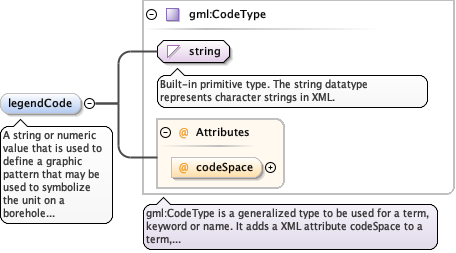
A string or numeric value that is used to define a graphic pattern that may be used to symbolize the unit on a borehole log or map.
Diagram
Diagramgml3_2Profile_diggs_xsd_Complex_Type_gml_CodeType.tmp#CodeType_codeSpacegml3_2Profile_diggs_xsd_Complex_Type_gml_CodeType.tmp#CodeType
Type gml:CodeType
Properties
content complex
minOccurs 0
Attributes
QName Type Use
codeSpace anyURI optional
Source
<element minOccurs="0" name="legendCode" type="gml:CodeType">
  <annotation>
    <documentation>A string or numeric value that is used to define a graphic pattern that may be used to symbolize the unit on a borehole log or map.</documentation>
  </annotation>
</element>
Element diggs:LithologyType / diggs:matrixType
Namespace http://diggsml.org/schemas/2.6
Annotations
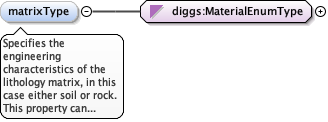
Specifies the engineering characteristics of the lithology matrix, in this case either soil or rock. This property can typically be inferred from the classificationCode, but is included here to simplify data ingestion into data systems that may store rock and soil physical property information in different objects or tables.
Diagram
DiagramKernel_xsd_Simple_Type_diggs_MaterialEnumType.tmp#MaterialEnumType
Type diggs:MaterialEnumType
Properties
content simple
minOccurs 0
Source
<element minOccurs="0" name="matrixType" type="diggs:MaterialEnumType">
  <annotation>
    <documentation>Specifies the engineering characteristics of the lithology matrix, in this case either soil or rock. This property can typically be inferred from the classificationCode, but is included here to simplify data ingestion into data systems that may store rock and soil physical property information in different objects or tables.</documentation>
  </annotation>
</element>
Element diggs:LithologyType / diggs:color
Namespace http://diggsml.org/schemas/2.6
Annotations
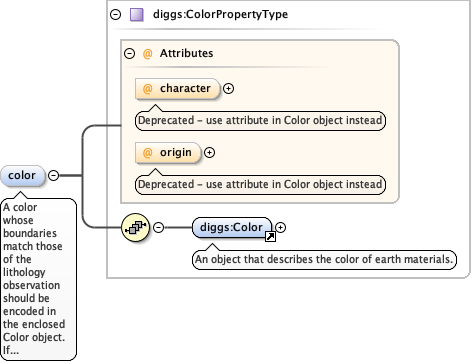
A color whose boundaries match those of the lithology observation should be encoded in the enclosed Color object. If there are depth-specific changes in color taht are significant and do not match the boundaries of the lithologyObservation, then a ColorSystem can be defined to represent those data instead of encoding separate lithologyObservations to record only changes in color. Also, ancillary color changes in color within a lithologyObservation can be added as a description only within a PlacedObservation.
Diagram
DiagramKernel_xsd_Complex_Type_diggs_ColorPropertyType.tmp#ColorPropertyType_characterKernel_xsd_Complex_Type_diggs_ColorPropertyType.tmp#ColorPropertyType_originKernel_xsd_Element_diggs_Color.tmp#ColorKernel_xsd_Complex_Type_diggs_ColorPropertyType.tmp#ColorPropertyType
Type diggs:ColorPropertyType
Properties
content complex
minOccurs 0
maxOccurs unbounded
Model
Children diggs:Color
Instance
<diggs:color character="" origin="" xmlns:diggs="http://diggsml.org/schemas/2.6">
  <diggs:Color character="" gml:id="" xml:lang="" origin="">{1,1}</diggs:Color>
</diggs:color>
Attributes
QName Type Use Annotation
character diggs:ColorCharacterEnumType optional
Deprecated - use attribute in Color object instead
origin diggs:ColorOriginEnumType optional
Deprecated - use attribute in Color object instead
Source
<element maxOccurs="unbounded" name="color" type="diggs:ColorPropertyType" minOccurs="0">
  <annotation>
    <documentation>A color whose boundaries match those of the lithology observation should be encoded in the enclosed Color object. If there are depth-specific changes in color taht are significant and do not match the boundaries of the lithologyObservation, then a ColorSystem can be defined to represent those data instead of encoding separate lithologyObservations to record only changes in color. Also, ancillary color changes in color within a lithologyObservation can be added as a description only within a PlacedObservation.</documentation>
  </annotation>
</element>
Element diggs:LithologyType / diggs:constituent
Namespace http://diggsml.org/schemas/2.6
Annotations
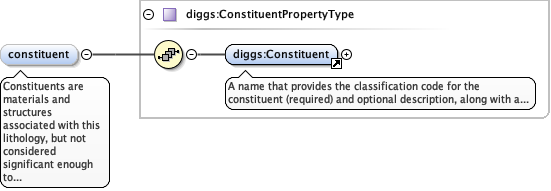
Constituents are materials and structures associated with
 this lithology, but not considered significant enough to
 record as part of a ConstituentSystem, or where location within a lithology observation is not important to preserve (except as a comment). Constituents of a lithology are descriptions that generally fall into one of the following classes:
1) types of sedimentary or physical structures, 
2) types of lithologic, mineralogic or organic accessories (eg.    presence of calcite, gas odor, etc.), 
3) types and degree of bioturbation features, 
4) types of diagenetic structures, 
5) types of physical structures produced by sampling, 
6) types of fossils, 
7) types of trace fossils, 
8) types of fractures
Diagram
DiagramKernel_xsd_Element_diggs_Constituent.tmp#ConstituentKernel_xsd_Complex_Type_diggs_ConstituentPropertyType.tmp#ConstituentPropertyType
Type diggs:ConstituentPropertyType
Properties
content complex
minOccurs 0
maxOccurs unbounded
Model
Children diggs:Constituent
Instance
<diggs:constituent xmlns:diggs="http://diggsml.org/schemas/2.6">
  <diggs:Constituent gml:id="" xml:lang="">{1,1}</diggs:Constituent>
</diggs:constituent>
Source
<element minOccurs="0" name="constituent" type="diggs:ConstituentPropertyType" maxOccurs="unbounded">
  <annotation>
    <documentation>Constituents are materials and structures associated with this lithology, but not considered significant enough to record as part of a ConstituentSystem, or where location within a lithology observation is not important to preserve (except as a comment). Constituents of a lithology are descriptions that generally fall into one of the following classes: 1) types of sedimentary or physical structures, 2) types of lithologic, mineralogic or organic accessories (eg. presence of calcite, gas odor, etc.), 3) types and degree of bioturbation features, 4) types of diagenetic structures, 5) types of physical structures produced by sampling, 6) types of fossils, 7) types of trace fossils, 8) types of fractures</documentation>
  </annotation>
</element>
Element diggs:LithologyType / diggs:facies
Namespace http://diggsml.org/schemas/2.6
Annotations
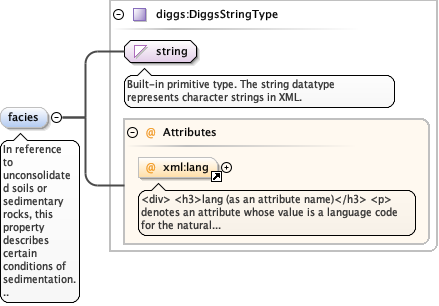
In reference to unconsolidated soils or sedimentary
rocks, this property describes certain conditions of sedimentation that reflect a particular process or depositional environment. Some examples might be alluvium, dune sand, river terrace deposits, hemipelagic sediment, etc. Facies designations do not imply any order within a stratigraphic column. Facies terms used to define informal geologic units that occur in stratigraphic order (eg. units do not repeat within a stratigraphic column) should be reported in a StratigraphySystem. 

For metamorphic rocks, this property is used to describe a set of mineral assemblages that form under similar pressures and temperatures (eg. zeolite facies, blueschist facies).
Diagram
Diagramxml_xsd_Attribute_xml_lang.tmp#langKernel_xsd_Complex_Type_diggs_DiggsStringType.tmp#DiggsStringType
Type diggs:DiggsStringType
Properties
content complex
minOccurs 0
mixed true
Attributes
QName Type Use Annotation
xml:lang union of(xs:language, restriction of xs:string) optional
<div>
  <h3>lang (as an attribute name)</h3>
  <p>denotes an attribute whose value is a language code for the natural language of the content of any element; its value is inherited. This name is reserved by virtue of its definition in the XML specification.</p>
</div>
<div>
  <h4>Notes</h4>
  <p>Attempting to install the relevant ISO 2- and 3-letter codes as the enumerated possible values is probably never going to be a realistic possibility.</p>
  <p>See BCP 47 at
    <a href="http://www.rfc-editor.org/rfc/bcp/bcp47.txt">http://www.rfc-editor.org/rfc/bcp/bcp47.txt</a>and the IANA language subtag registry at
    <a href="http://www.iana.org/assignments/language-subtag-registry">http://www.iana.org/assignments/language-subtag-registry</a>for further information.</p>
  <p>The union allows for the 'un-declaration' of xml:lang with the empty string.</p>
</div>
Source
<element minOccurs="0" name="facies" type="diggs:DiggsStringType">
  <annotation>
    <documentation>In reference to unconsolidated soils or sedimentary rocks, this property describes certain conditions of sedimentation that reflect a particular process or depositional environment. Some examples might be alluvium, dune sand, river terrace deposits, hemipelagic sediment, etc. Facies designations do not imply any order within a stratigraphic column. Facies terms used to define informal geologic units that occur in stratigraphic order (eg. units do not repeat within a stratigraphic column) should be reported in a StratigraphySystem. For metamorphic rocks, this property is used to describe a set of mineral assemblages that form under similar pressures and temperatures (eg. zeolite facies, blueschist facies).</documentation>
  </annotation>
</element>
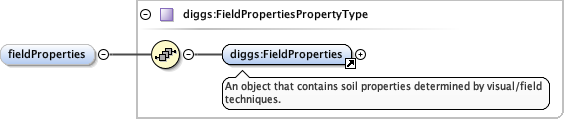
Element diggs:LithologyType / diggs:fieldProperties
Namespace http://diggsml.org/schemas/2.6
Diagram
DiagramKernel_xsd_Element_diggs_FieldProperties.tmp#FieldPropertiesKernel_xsd_Complex_Type_diggs_FieldPropertiesPropertyType.tmp#FieldPropertiesPropertyType
Type diggs:FieldPropertiesPropertyType
Properties
content complex
minOccurs 0
Model
Children diggs:FieldProperties
Instance
<diggs:fieldProperties xmlns:diggs="http://diggsml.org/schemas/2.6">
  <diggs:FieldProperties gml:id="" xml:lang="">{1,1}</diggs:FieldProperties>
</diggs:fieldProperties>
Source
<element minOccurs="0" name="fieldProperties" type="diggs:FieldPropertiesPropertyType"/>
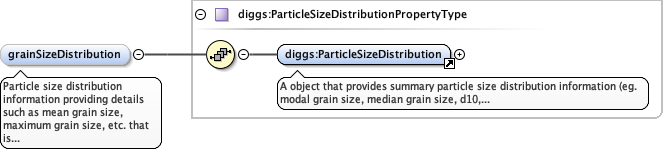
Element diggs:LithologyType / diggs:grainSizeDistribution
Namespace http://diggsml.org/schemas/2.6
Annotations
Particle size distribution information providing details such as mean grain size, maximum grain size, etc. that is attributable a Lithology
Diagram
DiagramKernel_xsd_Element_diggs_ParticleSizeDistribution.tmp#ParticleSizeDistributionKernel_xsd_Complex_Type_diggs_ParticleSizeDistributionPropertyType.tmp#ParticleSizeDistributionPropertyType
Type diggs:ParticleSizeDistributionPropertyType
Properties
content complex
minOccurs 0
Model
Children diggs:ParticleSizeDistribution
Instance
<diggs:grainSizeDistribution xmlns:diggs="http://diggsml.org/schemas/2.6">
  <diggs:ParticleSizeDistribution howDetermined="" gml:id="" xml:lang="">{1,1}</diggs:ParticleSizeDistribution>
</diggs:grainSizeDistribution>
Source
<element minOccurs="0" name="grainSizeDistribution" type="diggs:ParticleSizeDistributionPropertyType">
  <annotation>
    <documentation>Particle size distribution information providing details such as mean grain size, maximum grain size, etc. that is attributable a Lithology</documentation>
  </annotation>
</element>
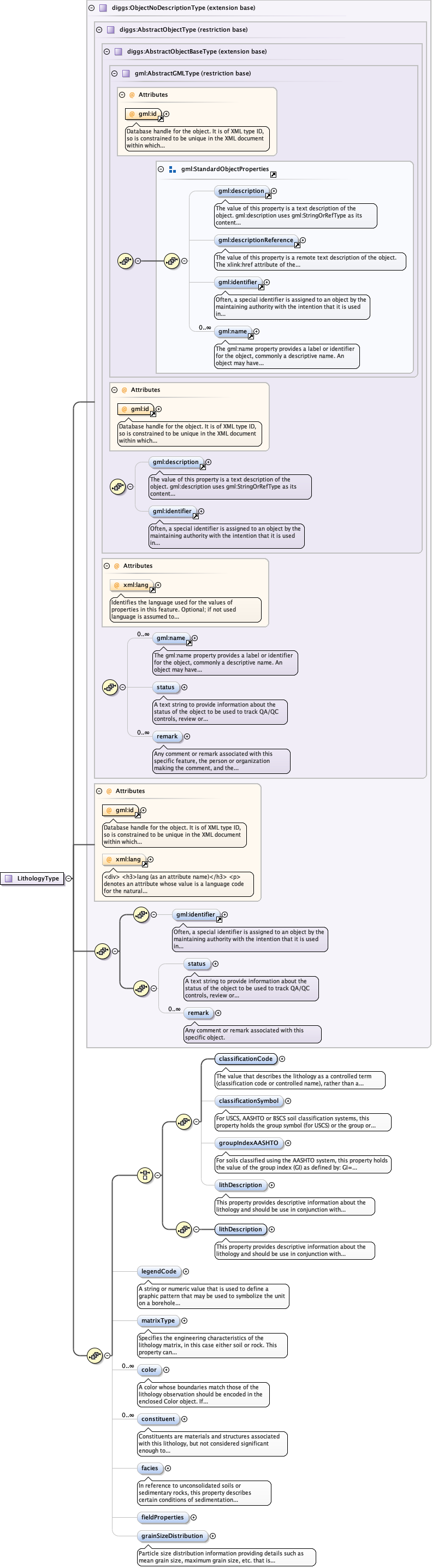
Complex Type diggs:LithologyType
Namespace http://diggsml.org/schemas/2.6
Annotations
Diagram
Diagramgml3_2Profile_diggs_xsd_Attribute_gml_id.tmp#idgml3_2Profile_diggs_xsd_Element_gml_description.tmp#descriptiongml3_2Profile_diggs_xsd_Element_gml_descriptionReference.tmp#descriptionReferencegml3_2Profile_diggs_xsd_Element_gml_identifier.tmp#identifiergml3_2Profile_diggs_xsd_Element_gml_name.tmp#namegml3_2Profile_diggs_xsd_Element_Group_gml_StandardObjectProperties.tmp#StandardObjectPropertiesgml3_2Profile_diggs_xsd_Complex_Type_gml_AbstractGMLType.tmp#AbstractGMLTypegml3_2Profile_diggs_xsd_Attribute_gml_id.tmp#idgml3_2Profile_diggs_xsd_Element_gml_description.tmp#descriptiongml3_2Profile_diggs_xsd_Element_gml_identifier.tmp#identifierKernel_xsd_Complex_Type_diggs_AbstractObjectBaseType.tmp#AbstractObjectBaseTypexml_xsd_Attribute_xml_lang.tmp#langgml3_2Profile_diggs_xsd_Element_gml_name.tmp#nameKernel_xsd_Complex_Type_diggs_AbstractObjectType.tmp#AbstractObjectType_statusKernel_xsd_Complex_Type_diggs_AbstractObjectType.tmp#AbstractObjectType_remarkKernel_xsd_Complex_Type_diggs_AbstractObjectType.tmp#AbstractObjectTypegml3_2Profile_diggs_xsd_Attribute_gml_id.tmp#idxml_xsd_Attribute_xml_lang.tmp#langgml3_2Profile_diggs_xsd_Element_gml_identifier.tmp#identifierKernel_xsd_Complex_Type_diggs_ObjectNoDescriptionType.tmp#ObjectNoDescriptionType_statusKernel_xsd_Complex_Type_diggs_ObjectNoDescriptionType.tmp#ObjectNoDescriptionType_remarkKernel_xsd_Complex_Type_diggs_ObjectNoDescriptionType.tmp#ObjectNoDescriptionTypeKernel_xsd_Complex_Type_diggs_LithologyType.tmp#LithologyType_classificationCodeKernel_xsd_Complex_Type_diggs_LithologyType.tmp#LithologyType_classificationSymbolKernel_xsd_Complex_Type_diggs_LithologyType.tmp#LithologyType_groupIndexAASHTOKernel_xsd_Complex_Type_diggs_LithologyType.tmp#LithologyType_lithDescriptionKernel_xsd_Complex_Type_diggs_LithologyType.tmp#LithologyType_legendCodeKernel_xsd_Complex_Type_diggs_LithologyType.tmp#LithologyType_matrixTypeKernel_xsd_Complex_Type_diggs_LithologyType.tmp#LithologyType_colorKernel_xsd_Complex_Type_diggs_LithologyType.tmp#LithologyType_constituentKernel_xsd_Complex_Type_diggs_LithologyType.tmp#LithologyType_faciesKernel_xsd_Complex_Type_diggs_LithologyType.tmp#LithologyType_fieldPropertiesKernel_xsd_Complex_Type_diggs_LithologyType.tmp#LithologyType_grainSizeDistribution
Type extension of diggs:ObjectNoDescriptionType
Type hierarchy
Properties
mixed false
Used by
Element diggs:Lithology
Model
Children diggs:classificationCode, diggs:classificationSymbol, diggs:color, diggs:constituent, diggs:facies, diggs:fieldProperties, diggs:grainSizeDistribution, diggs:groupIndexAASHTO, diggs:legendCode, diggs:lithDescription, diggs:matrixType, diggs:remark, diggs:status, gml:identifier
Attributes
QName Type Use Annotation
gml:id ID required
Database handle for the object. It is of XML type ID, so is constrained to be
unique in the XML document within which it occurs. An external identifier for the object in
the form of a URI may be constructed using standard XML and XPointer methods. This is done
by concatenating the URI for the document, a fragment separator, and the value of the id
attribute.
xml:lang union of(xs:language, restriction of xs:string) optional
<div>
  <h3>lang (as an attribute name)</h3>
  <p>denotes an attribute whose value is a language code for the natural language of the content of any element; its value is inherited. This name is reserved by virtue of its definition in the XML specification.</p>
</div>
<div>
  <h4>Notes</h4>
  <p>Attempting to install the relevant ISO 2- and 3-letter codes as the enumerated possible values is probably never going to be a realistic possibility.</p>
  <p>See BCP 47 at
    <a href="http://www.rfc-editor.org/rfc/bcp/bcp47.txt">http://www.rfc-editor.org/rfc/bcp/bcp47.txt</a>and the IANA language subtag registry at
    <a href="http://www.iana.org/assignments/language-subtag-registry">http://www.iana.org/assignments/language-subtag-registry</a>for further information.</p>
  <p>The union allows for the 'un-declaration' of xml:lang with the empty string.</p>
</div>
Source
<complexType name="LithologyType" mixed="false">
  <annotation>
    <documentation/>
  </annotation>
  <complexContent>
    <extension base="diggs:ObjectNoDescriptionType">
      <sequence>
        <choice>
          <sequence>
            <element name="classificationCode" type="diggs:DescriptorCodeType" minOccurs="1" maxOccurs="1">
              <annotation>
                <documentation>The value that describes the lithology as a controlled term (classification code or controlled name), rather than a simply descriptive one. Examples: 1) For soils described using the Unified Soil Classification, this value should be the "group name" as defined in Figures 1,2 and 3 of ASTM D 2487 or Figures 1 and 2 of ASTM D 2488, eg "Silty sand" or "Gravelly silt with sand". Where the group name is not specified, the "group symbol" should be used instead (eg. "SM" "ML"). 2) For soils described using the AASHTO soil classification system, this value should be the group or subgroup classification (eg. "A-3", "A-2-6"). 3) For soils classified using the USDA, Shepard (1954), or Folk classifications based on soil textures, this value would be the textural classification, eg. "sandy loam" (USDA), "sand-silt-clay" (Shepard), or "muddy Sand" (Folk, 7 class) 4) For soils classified using the British Soil Classification System, this value would be the recommended name (eg. "CLAY of very high plasticity"), or the group symbol if the standard name is not given (eg. "CV") 5) For rock, for example as defined by the American Geosciences Institute (AGI) glossary, this value would be ther rock name (eg. "dolostone", "basalt", "pebbly mudstone"). Either a classificationCode value or lithDescription value must be present. The codespace attribute is mandatory and preferably is a link to the appropriate DIGGS codelist dictionary, should contain te authority code for any standard system, or a link to a dictionary of a non-standard or proprietary system. Standard codespace codes are as follows: USCS - Unified Soil Classification System AASHTO - AASHTO System for subgrades USDA - US Dept. of Agriculture textural classification BSCS - British Soil Classification System SHEP - Shepard (1954) textural clasification FOLK5 - Folk 5-class system for sediments FOLK7 - Folk 7-class system for sediments FOLK16 - Folk 16-class system for sediments AGI - American Geosciences Institute Glossary</documentation>
              </annotation>
            </element>
            <element minOccurs="0" name="classificationSymbol" maxOccurs="1" type="gml:CodeWithAuthorityType">
              <annotation>
                <documentation>For USCS, AASHTO or BSCS soil classification systems, this property holds the group symbol (for USCS) or the group or appropriate subgroup classification (for AASHTO and BSCS). Symbology for nan-standard or proprietary classifications may also be reported here. Codespace attribute is mandatory and should preferably a link to the associated DIGGS dictionary, or be either USCS, AASHTO, or BSCS for those systems, or an authority code for non-standard systems.</documentation>
              </annotation>
            </element>
            <element minOccurs="0" name="groupIndexAASHTO" type="positiveInteger">
              <annotation>
                <documentation>For soils classified using the AASHTO system, this property holds the value of the group index (GI) as defined by: GI= (F–35)[0.2+0.005(LL– 40)}+(F–15)(PI–10) where F is the percentage passing the 75 μm (0.075 mm) sieve, expressed as a whole number. This percentage is based only on the material passing the 75 μm sieve, LL is the liquid limit and PI is the plasticity index.</documentation>
              </annotation>
            </element>
            <element minOccurs="0" name="lithDescription" type="diggs:DescriptorType">
              <annotation>
                <documentation>This property provides descriptive information about the lithology and should be use in conjunction with classificationCode. If the information is recorded, lithDescription include a description of color,facies, grain size disctribution, constituents and field properties, even if those properties are not specifically encoded (eg. well-graded sand (SW), fine-grained, dark grey, massive, dry, hard). If the lithology description does not include any controlled term that serves to classify it, then lithDescription must be used instead of classificationCode, i.e., either classificationCode or lithDescription must contain a value (although both may contain values and is preferred).</documentation>
              </annotation>
            </element>
          </sequence>
          <sequence>
            <element minOccurs="1" name="lithDescription" type="diggs:DescriptorType">
              <annotation>
                <documentation>This property provides descriptive information about the lithology and should be use in conjunction with classificationCode. If the information is recorded, lithDescription include a description of color,facies, grain size disctribution, constituents and field properties, even if those properties are not specifically encoded (eg. well-graded sand (SW), fine-grained, dark grey, massive, dry, hard). If the lithology description does not include any controlled term that serves to classify it, then lithDescription must be used instead of classificationCode, i.e., either classificationCode or lithDescription must contain a value (although both may contain values and is preferred).</documentation>
              </annotation>
            </element>
          </sequence>
        </choice>
        <element minOccurs="0" name="legendCode" type="gml:CodeType">
          <annotation>
            <documentation>A string or numeric value that is used to define a graphic pattern that may be used to symbolize the unit on a borehole log or map.</documentation>
          </annotation>
        </element>
        <element minOccurs="0" name="matrixType" type="diggs:MaterialEnumType">
          <annotation>
            <documentation>Specifies the engineering characteristics of the lithology matrix, in this case either soil or rock. This property can typically be inferred from the classificationCode, but is included here to simplify data ingestion into data systems that may store rock and soil physical property information in different objects or tables.</documentation>
          </annotation>
        </element>
        <element maxOccurs="unbounded" name="color" type="diggs:ColorPropertyType" minOccurs="0">
          <annotation>
            <documentation>A color whose boundaries match those of the lithology observation should be encoded in the enclosed Color object. If there are depth-specific changes in color taht are significant and do not match the boundaries of the lithologyObservation, then a ColorSystem can be defined to represent those data instead of encoding separate lithologyObservations to record only changes in color. Also, ancillary color changes in color within a lithologyObservation can be added as a description only within a PlacedObservation.</documentation>
          </annotation>
        </element>
        <element minOccurs="0" name="constituent" type="diggs:ConstituentPropertyType" maxOccurs="unbounded">
          <annotation>
            <documentation>Constituents are materials and structures associated with this lithology, but not considered significant enough to record as part of a ConstituentSystem, or where location within a lithology observation is not important to preserve (except as a comment). Constituents of a lithology are descriptions that generally fall into one of the following classes: 1) types of sedimentary or physical structures, 2) types of lithologic, mineralogic or organic accessories (eg. presence of calcite, gas odor, etc.), 3) types and degree of bioturbation features, 4) types of diagenetic structures, 5) types of physical structures produced by sampling, 6) types of fossils, 7) types of trace fossils, 8) types of fractures</documentation>
          </annotation>
        </element>
        <element minOccurs="0" name="facies" type="diggs:DiggsStringType">
          <annotation>
            <documentation>In reference to unconsolidated soils or sedimentary rocks, this property describes certain conditions of sedimentation that reflect a particular process or depositional environment. Some examples might be alluvium, dune sand, river terrace deposits, hemipelagic sediment, etc. Facies designations do not imply any order within a stratigraphic column. Facies terms used to define informal geologic units that occur in stratigraphic order (eg. units do not repeat within a stratigraphic column) should be reported in a StratigraphySystem. For metamorphic rocks, this property is used to describe a set of mineral assemblages that form under similar pressures and temperatures (eg. zeolite facies, blueschist facies).</documentation>
          </annotation>
        </element>
        <element minOccurs="0" name="fieldProperties" type="diggs:FieldPropertiesPropertyType"/>
        <element minOccurs="0" name="grainSizeDistribution" type="diggs:ParticleSizeDistributionPropertyType">
          <annotation>
            <documentation>Particle size distribution information providing details such as mean grain size, maximum grain size, etc. that is attributable a Lithology</documentation>
          </annotation>
        </element>
      </sequence>
    </extension>
  </complexContent>
</complexType>