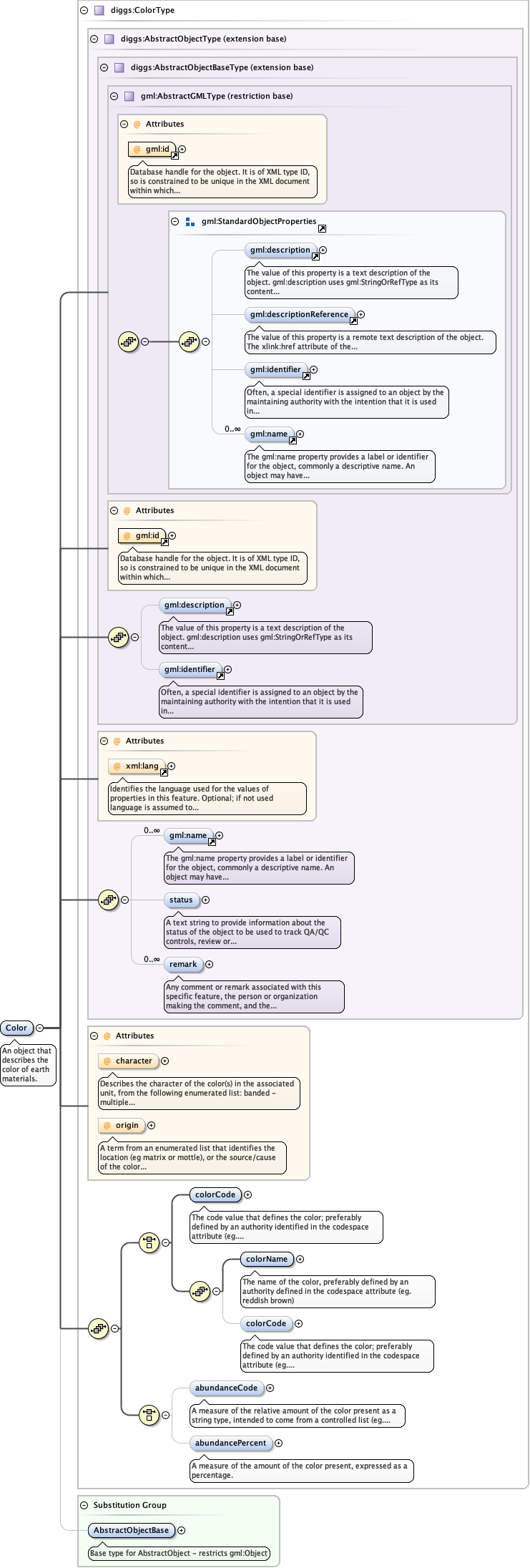
Describes the character of the color(s) in the associated unit, from the following enumerated list:banded - multiple colors occur in horizontal layers within the unitmottled - unit consists of a pattern of irregular spots, blotches or patches of a different color than the unit matrix colormulticalored - unit consists of multiple colors where there is no description of the pattern or character of the various colorsuniform - unit consists of a single colorvariegated - a multicolored unit containing spots, streaks, or blotches of multiple colors
Database handle for the object. It is of XML type ID, so is constrained to beunique in the XML document within which it occurs. An external identifier for the object inthe form of a URI may be constructed using standard XML and XPointer methods. This is doneby concatenating the URI for the document, a fragment separator, and the value of the idattribute.
A term from an enumerated list that identifies the location (eg matrix or mottle), or the source/cause of the color described. Defined terms are:matrix - the color of the soil or rock matrixmottle - the color of soil mottlesclay depletion - color caused by depletion of clayiron depletion - color caused by depletion of ironiron Fe2 mass - color caused by masses of reduced ironiron Fe3 mass - color caused by masses of oxidized ironiron-manganese mass - color caused by masses of iron and manganesejarosite mass - color caused by masses of jarositemanganese mass - color caused by masses of manganeseironstone module - color caused by ironstone nodulesiron-manganese nodule - color caused by iron-manganese nodulesjarosite nodule - color caused by jarosite nodulesplinthite - color caused by plinthite(s) (an iron-rich, humus-poor mixture of clay with quartz and other minerals).iron-manganese concretion - color caused by iron-manganese concretionsmanganese coat or film - color caused by manganese coats or filmsdisseminated carbonate - color caused by disseminated calcium carbonatedisseminated salts - color caused by disseminated unspecified saltsdisseminated gypsum - color caused by disseminated gypsumbarite mass - color caused by masses of baritegypsum mass - color caused by masses of gypsumcarbonate mass - color caused by masses of calcium carbonatesalt mass - color caused by masses of unspecified saltclay body - color caused by included bodies of claysilica mass - color caused by masses of silicagypsum crystal clusters - color caused by crystal clusters of gypsumcarbonate nodule - color caused by nodules of carbonatedurinode (SiO2) nodule - color caused by nodules of SiO2gibbsite (Al1O3) nodule - color caused by nodules of Al2O3opal nodule - color caused by nodules of opalortstein nodule - color caused by hardpans cemented with iron and organic mattercarbonate concretion - color caused by concretions of calcium carbonategibbsite concretion - color caused by concretions of gibbsitesilica concretion - color caused by concretions of silicatitanium oxide - color caused by concretions of titanium oxidebarite crystals - color caused by crystals of baritecalcite crystals - color caused by calcite crystalsgypsum crystals - color caused by gypsum crystalssalt crystals - color caused by salt crystalssatin spar crystals - color caused by crystals of satin spar gypsumselenite crystals - color caused by crystals of selenite gypsum
<div><h3>lang (as an attribute name)</h3><p>denotes an attribute whose value is a language code for the natural language of the content of any element; its value is inherited. This name is reserved by virtue of its definition in the XML specification.</p></div><div><h4>Notes</h4><p>Attempting to install the relevant ISO 2- and 3-letter codes as the enumerated possible values is probably never going to be a realistic possibility.</p><p>See BCP 47 at<a href="http://www.rfc-editor.org/rfc/bcp/bcp47.txt">http://www.rfc-editor.org/rfc/bcp/bcp47.txt</a>and the IANA language subtag registry at<a href="http://www.iana.org/assignments/language-subtag-registry">http://www.iana.org/assignments/language-subtag-registry</a>for further information.</p><p>The union allows for the 'un-declaration' of xml:lang with the empty string.</p></div>
Source
<element name="Color" substitutionGroup="diggs:AbstractObjectBase" type="diggs:ColorType"><annotation><documentation>An object that describes the color of earth materials.</documentation></annotation></element>