Showing:

Annotations
Attributes
Diagrams
Instances
Model
Properties
Source
Element gml:Ring
Namespace http://www.opengis.net/gml/3.2
Annotations
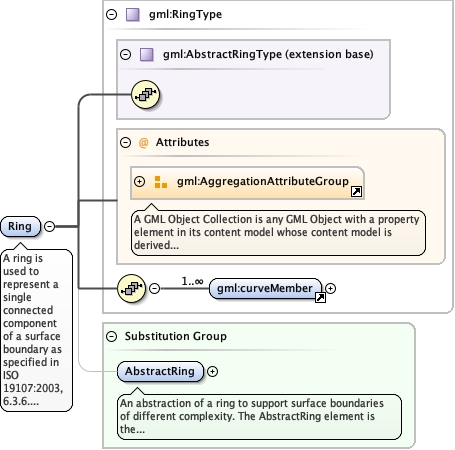
A ring is used to represent a single connected component of a surface boundary
as specified in ISO 19107:2003, 6.3.6. Every gml:curveMember references or contains one
curve, i.e. any element which is substitutable for gml:AbstractCurve. In the context of a
ring, the curves describe the boundary of the surface. The sequence of curves shall be
contiguous and connected in a cycle. If provided, the aggregationType attribute shall have
the value “sequence”.
Diagram
Diagramgml3_2Profile_diggs_xsd_Complex_Type_gml_AbstractRingType.tmp#AbstractRingTypegml3_2Profile_diggs_xsd_Attribute_Group_gml_AggregationAttributeGroup.tmp#AggregationAttributeGroupgml3_2Profile_diggs_xsd_Element_gml_curveMember.tmp#curveMembergml3_2Profile_diggs_xsd_Complex_Type_gml_RingType.tmp#RingTypegml3_2Profile_diggs_xsd_Element_gml_AbstractRing.tmp#AbstractRing
Type gml:RingType
Type hierarchy
Properties
content complex
Substitution Group Affiliation
Model
Children gml:curveMember
Instance
<gml:Ring aggregationType="" xmlns:gml="http://www.opengis.net/gml/3.2">
  <gml:curveMember xlink:actuate="" xlink:arcrole="" xlink:href="" nilReason="" owns="false" xlink:role="" xlink:show="" xlink:title="" xlink:type="simple">{1,unbounded}</gml:curveMember>
</gml:Ring>
Attributes
QName Type Use
aggregationType gml:AggregationType optional
Source
<element name="Ring" type="gml:RingType" substitutionGroup="gml:AbstractRing">
  <annotation>
    <documentation>A ring is used to represent a single connected component of a surface boundary as specified in ISO 19107:2003, 6.3.6. Every gml:curveMember references or contains one curve, i.e. any element which is substitutable for gml:AbstractCurve. In the context of a ring, the curves describe the boundary of the surface. The sequence of curves shall be contiguous and connected in a cycle. If provided, the aggregationType attribute shall have the value “sequence”.</documentation>
  </annotation>
</element>