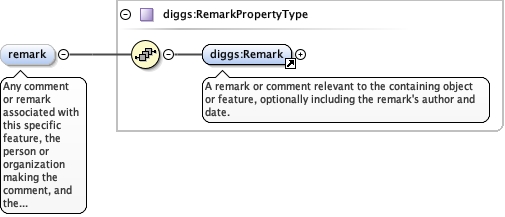
Any comment or remark associated with this specificfeature, the person or organization making the comment, and the timecomment was made.Any comment or remark associated with this specificfeature, the person or organization making the comment, and the timecomment was made.
<element name="remark" type="diggs:RemarkPropertyType" minOccurs="0" maxOccurs="unbounded"><annotation><documentation>Any comment or remark associated with this specific feature, the person or organization making the comment, and the time comment was made.Any comment or remark associated with this specific feature, the person or organization making the comment, and the time comment was made.</documentation></annotation></element>
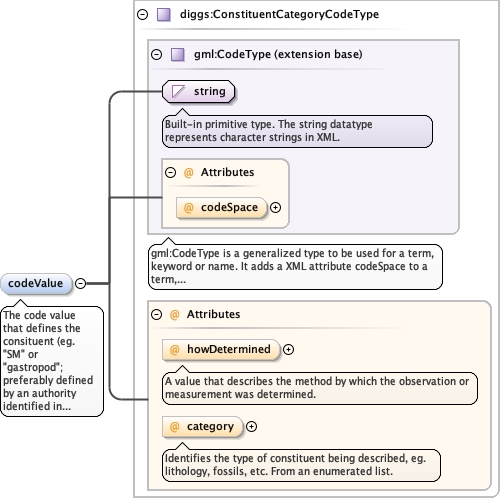
A value that describes the method by which the observation or measurementwas determined.
Source
<element name="codeValue" type="diggs:ConstituentCategoryCodeType" minOccurs="0"><annotation><documentation>The code value that defines the consituent (eg. "SM" or "gastropod"; preferably defined by an authority identified in the codespace attribute</documentation></annotation></element>
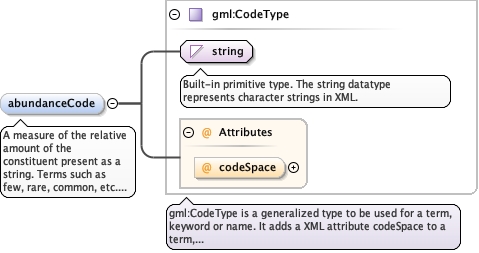
A measure of the relative amount of the constituent present as a string. Terms such as few, rare, common, etc. represent relative abundance as a range of percentages that are specific to different standards bodies, so the use of these terms should reference a codelist dictionary using the codeSpace attribute.. Specific percentage estimates should use the abundancePercent and/or maxAbundancePercent properties.
<element name="abundanceCode" type="gml:CodeType" minOccurs="0"><annotation><documentation>A measure of the relative amount of the constituent present as a string. Terms such as few, rare, common, etc. represent relative abundance as a range of percentages that are specific to different standards bodies, so the use of these terms should reference a codelist dictionary using the codeSpace attribute.. Specific percentage estimates should use the abundancePercent and/or maxAbundancePercent properties.</documentation></annotation></element>
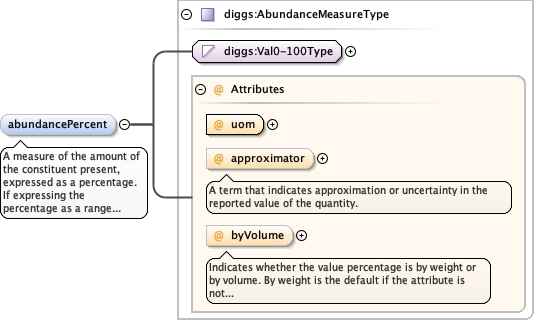
A measure of the amount of the constituent present, expressed as a percentage. If expressing the percentage as a range - eg. 30-50%, this property should report the lower estimate and maxAbuncancePercentage should be used to report the upper estimate.
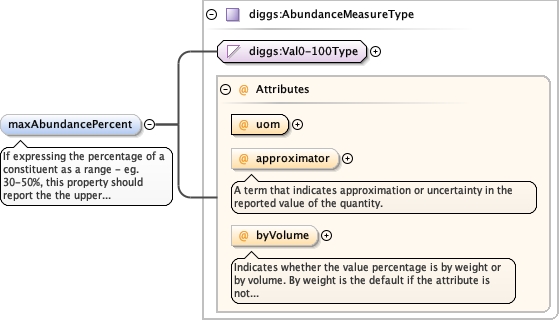
Indicates whether the value percentage is by weight or by volume. By weight is the default if the attribute is not present. True indicates that the percentage is by volume.
<element name="abundancePercent" type="diggs:AbundanceMeasureType" minOccurs="0"><annotation><documentation>A measure of the amount of the constituent present, expressed as a percentage. If expressing the percentage as a range - eg. 30-50%, this property should report the lower estimate and maxAbuncancePercentage should be used to report the upper estimate.</documentation></annotation></element>
Indicates whether the value percentage is by weight or by volume. By weight is the default if the attribute is not present. True indicates that the percentage is by volume.
<element name="maxAbundancePercent" type="diggs:AbundanceMeasureType" minOccurs="0"><annotation><documentation>If expressing the percentage of a constituent as a range - eg. 30-50%, this property should report the the upper estimate.</documentation></annotation></element>
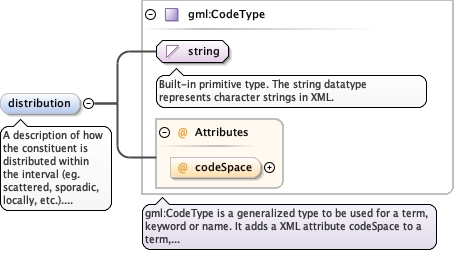
A description of how the constituent is distributedwithin the interval (eg. scattered, sporadic, locally, etc.).Intended to come from a controlled list
<element name="distribution" type="gml:CodeType" minOccurs="0"><annotation><documentation>A description of how the constituent is distributed within the interval (eg. scattered, sporadic, locally, etc.). Intended to come from a controlled list</documentation></annotation></element>
Database handle for the object. It is of XML type ID, so is constrained to beunique in the XML document within which it occurs. An external identifier for the object inthe form of a URI may be constructed using standard XML and XPointer methods. This is doneby concatenating the URI for the document, a fragment separator, and the value of the idattribute.
A positive integer value that identifies the relative significance or importance of the constituent, with 1 signifying the highest rank. Using this attribute eliminates possible ambiguity when using abundanceCode to infer significance.
Source
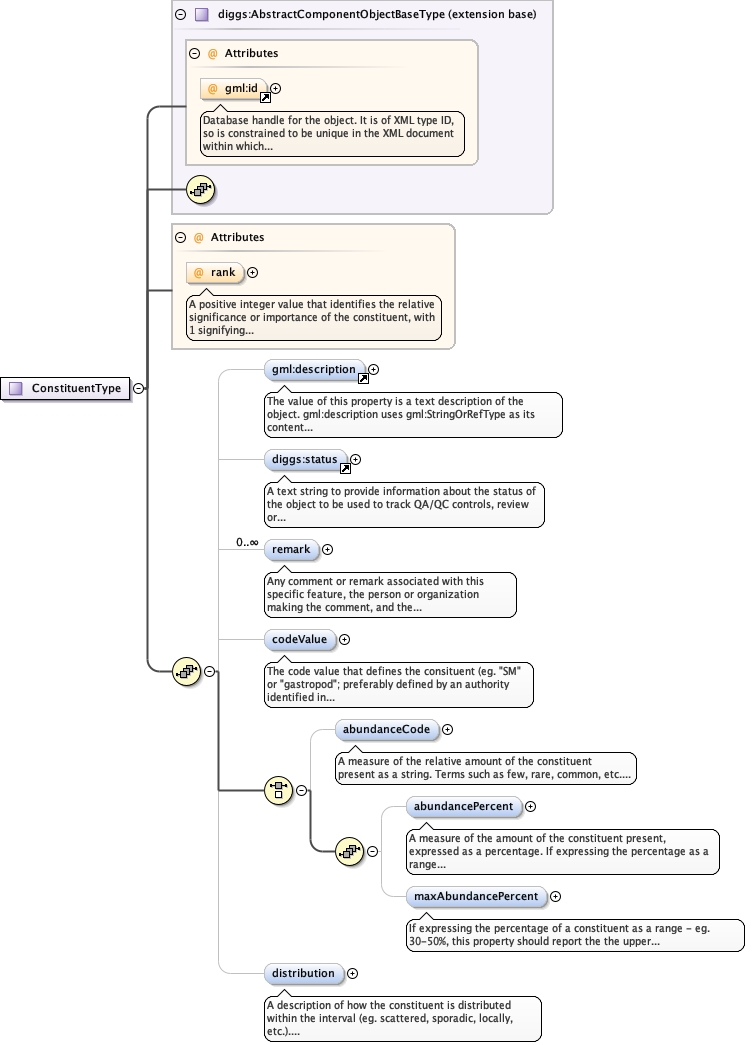
<complexType name="ConstituentType"><complexContent><extension base="diggs:AbstractComponentObjectBaseType"><sequence><element ref="gml:description" minOccurs="0"/><element minOccurs="0" ref="diggs:status"><annotation><documentation>A text string to provide information about the status of the object to be used to track QA/QC controls, review or release status, etc. The values used are intended to come from a controlled list of terms maintained by an organization.</documentation></annotation></element><element name="remark" type="diggs:RemarkPropertyType" minOccurs="0" maxOccurs="unbounded"><annotation><documentation>Any comment or remark associated with this specific feature, the person or organization making the comment, and the time comment was made.Any comment or remark associated with this specific feature, the person or organization making the comment, and the time comment was made.</documentation></annotation></element><element name="codeValue" type="diggs:ConstituentCategoryCodeType" minOccurs="0"><annotation><documentation>The code value that defines the consituent (eg. "SM" or "gastropod"; preferably defined by an authority identified in the codespace attribute</documentation></annotation></element><choice><element name="abundanceCode" type="gml:CodeType" minOccurs="0"><annotation><documentation>A measure of the relative amount of the constituent present as a string. Terms such as few, rare, common, etc. represent relative abundance as a range of percentages that are specific to different standards bodies, so the use of these terms should reference a codelist dictionary using the codeSpace attribute.. Specific percentage estimates should use the abundancePercent and/or maxAbundancePercent properties.</documentation></annotation></element><sequence><element name="abundancePercent" type="diggs:AbundanceMeasureType" minOccurs="0"><annotation><documentation>A measure of the amount of the constituent present, expressed as a percentage. If expressing the percentage as a range - eg. 30-50%, this property should report the lower estimate and maxAbuncancePercentage should be used to report the upper estimate.</documentation></annotation></element><element name="maxAbundancePercent" type="diggs:AbundanceMeasureType" minOccurs="0"><annotation><documentation>If expressing the percentage of a constituent as a range - eg. 30-50%, this property should report the the upper estimate.</documentation></annotation></element></sequence></choice><element name="distribution" type="gml:CodeType" minOccurs="0"><annotation><documentation>A description of how the constituent is distributed within the interval (eg. scattered, sporadic, locally, etc.). Intended to come from a controlled list</documentation></annotation></element></sequence><attribute name="rank" type="positiveInteger" use="optional"><annotation><documentation>A positive integer value that identifies the relative significance or importance of the constituent, with 1 signifying the highest rank. Using this attribute eliminates possible ambiguity when using abundanceCode to infer significance.</documentation></annotation></attribute></extension></complexContent></complexType>
A positive integer value that identifies the relative significance or importance of the constituent, with 1 signifying the highest rank. Using this attribute eliminates possible ambiguity when using abundanceCode to infer significance.
<attribute name="rank" type="positiveInteger" use="optional"><annotation><documentation>A positive integer value that identifies the relative significance or importance of the constituent, with 1 signifying the highest rank. Using this attribute eliminates possible ambiguity when using abundanceCode to infer significance.</documentation></annotation></attribute>