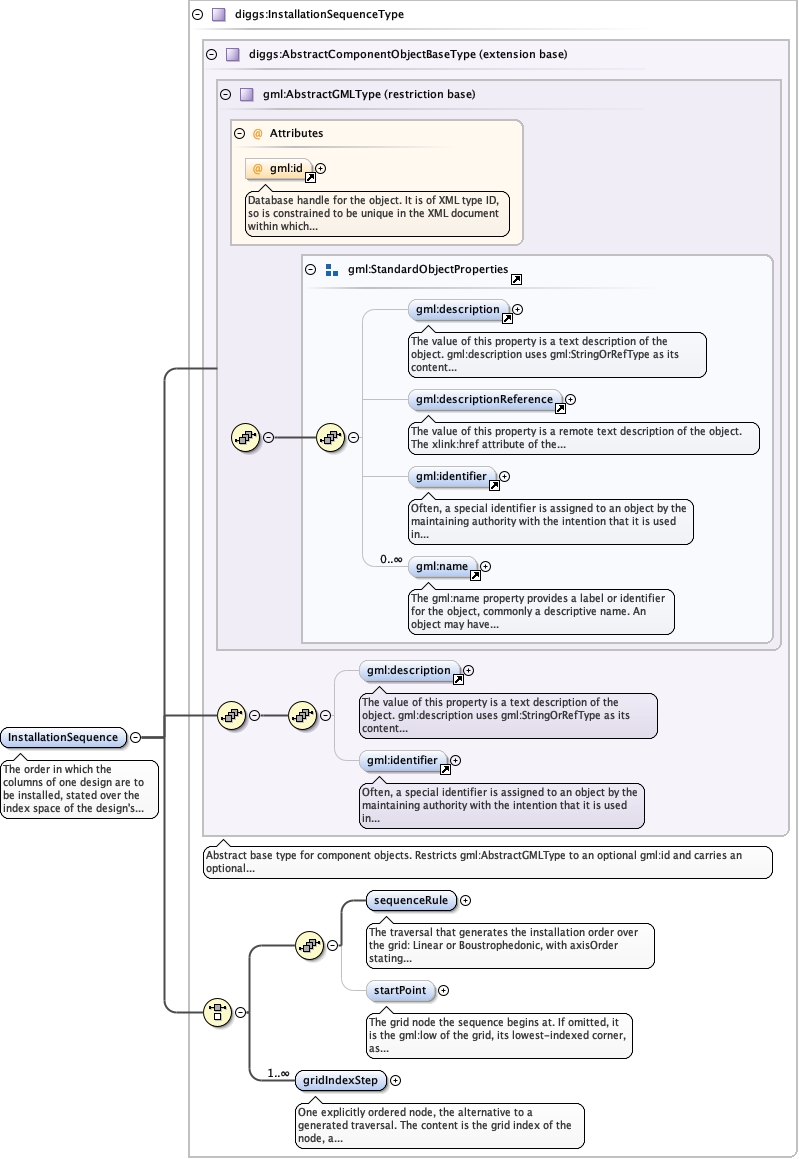
The order in which the columns of one design are to be installed, stated over theindex space of the design's plannedPositions grid. It indexes the grid, not a set ofobjects, so an installation order can be given without any planned position objectexisting. State the order in exactly one of two ways: sequenceRule with an optionalstartPoint gives a generated traversal, compact and right for regular layouts; oneor more gridIndexStep entries, each a grid index with its own sequenceNumber, givean explicit order and account for every node of the grid. The order is local to thedesign: numbers run 1 to n over its own nodes. Order between designs (primary,secondary and tertiary passes, or one column type first) and out-of-order nodes arestated by a diggs:DesignProductionSequence. Minimum spacing to fresh concrete andminimum age before adjacent installation are requirements, not an order; usediggs:ClearanceConstraint.
Database handle for the object. It is of XML type ID, so is constrained to beunique in the XML document within which it occurs. An external identifier for the object inthe form of a URI may be constructed using standard XML and XPointer methods. This is doneby concatenating the URI for the document, a fragment separator, and the value of the idattribute.
Source
<element name="InstallationSequence" type="diggs:InstallationSequenceType"><annotation><documentation>The order in which the columns of one design are to be installed, stated over the index space of the design's plannedPositions grid. It indexes the grid, not a set of objects, so an installation order can be given without any planned position object existing. State the order in exactly one of two ways: sequenceRule with an optional startPoint gives a generated traversal, compact and right for regular layouts; one or more gridIndexStep entries, each a grid index with its own sequenceNumber, give an explicit order and account for every node of the grid. The order is local to the design: numbers run 1 to n over its own nodes. Order between designs (primary, secondary and tertiary passes, or one column type first) and out-of-order nodes are stated by a diggs:DesignProductionSequence. Minimum spacing to fresh concrete and minimum age before adjacent installation are requirements, not an order; use diggs:ClearanceConstraint.</documentation></annotation></element>