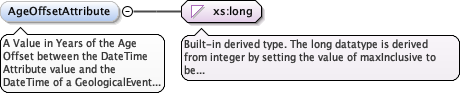
A Value in Years of the Age Offset between the DateTime Attribute value and the DateTime of a GeologicalEvent Occurrence. This value must be POSITIVE when it represents a Geological Event in The past.
Diagram
Type
xs:long
Properties
content
simple
minOccurs
0
maxOccurs
1
Source
<xs:element name="AgeOffsetAttribute" type="xs:long" minOccurs="0" maxOccurs="1"><xs:annotation><xs:documentation>A Value in Years of the Age Offset between the DateTime Attribute value and the DateTime of a GeologicalEvent Occurrence. This value must be POSITIVE when it represents a Geological Event in The past.</xs:documentation></xs:annotation></xs:element>
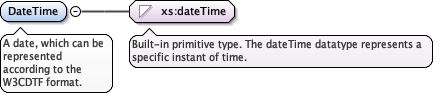
A date, which can be represented according to the W3CDTF format.
Diagram
Type
xs:dateTime
Properties
content
simple
minOccurs
1
maxOccurs
1
Source
<xs:element name="DateTime" type="xs:dateTime" minOccurs="1" maxOccurs="1"><xs:annotation><xs:documentation>A date, which can be represented according to the W3CDTF format.</xs:documentation></xs:annotation></xs:element>
Complex Type eml:GeologicTime
Namespace
http://www.energistics.org/energyml/data/commonv2
Annotations
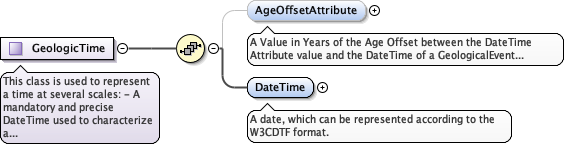
This class is used to represent a time at several scales:

	- A mandatory and precise DateTime used to characterize a TimeStep in a TimeSeries


	- An optional Age Offset (corresponding to a geological event occurrence) in  years. This age offset must be positive when it represents a GeologicalEvent occurrence in the past. This Age Offset is not required to be positive, to allow for the case of simulating future geological events.


When geological time is used to represent a geological event cccurrence, the DateTime must be set by the software writer at a date no earlier than 01/01/1950. Any DateTime (even the creation DateTime of the instance) can be set in this attribute field.
<xs:complexType name="GeologicTime"><xs:annotation><xs:documentation>This class is used to represent a time at several scales: - A mandatory and precise DateTime used to characterize a TimeStep in a TimeSeries - An optional Age Offset (corresponding to a geological event occurrence) in years. This age offset must be positive when it represents a GeologicalEvent occurrence in the past. This Age Offset is not required to be positive, to allow for the case of simulating future geological events. When geological time is used to represent a geological event cccurrence, the DateTime must be set by the software writer at a date no earlier than 01/01/1950. Any DateTime (even the creation DateTime of the instance) can be set in this attribute field.</xs:documentation></xs:annotation><xs:sequence><xs:element name="AgeOffsetAttribute" type="xs:long" minOccurs="0" maxOccurs="1"><xs:annotation><xs:documentation>A Value in Years of the Age Offset between the DateTime Attribute value and the DateTime of a GeologicalEvent Occurrence. This value must be POSITIVE when it represents a Geological Event in The past.</xs:documentation></xs:annotation></xs:element><xs:element name="DateTime" type="xs:dateTime" minOccurs="1" maxOccurs="1"><xs:annotation><xs:documentation>A date, which can be represented according to the W3CDTF format.</xs:documentation></xs:annotation></xs:element></xs:sequence></xs:complexType>