Showing:

Annotations
Attributes
Diagrams
Instances
Model
Properties
Source
Used by
Element diggs:LinearReferencingMethod
Namespace http://diggsml.org/schemas/3
Annotations
Implementation of ISO 19148:2021 §6.2 Linear Referencing Method.
                
Defines a linear referencing method - the specific procedure or 
algorithm for determining positions along linear features.
                
Per ISO 19148 §6.2: A linear referencing method is a method for 
specifying a position along a linear element using a distance 
measure from a specified origin.
                
Methods may optionally support lateral offset, making them suitable 
for 2D positioning (distance along + perpendicular offset).
                
DIGGS LR methods establish:
= Method name
- How measurements are computed (absolute, relative, interpolative)
- Units of measure for distances
- Direction conventions (positive direction)
- Whether lateral offsets are supported
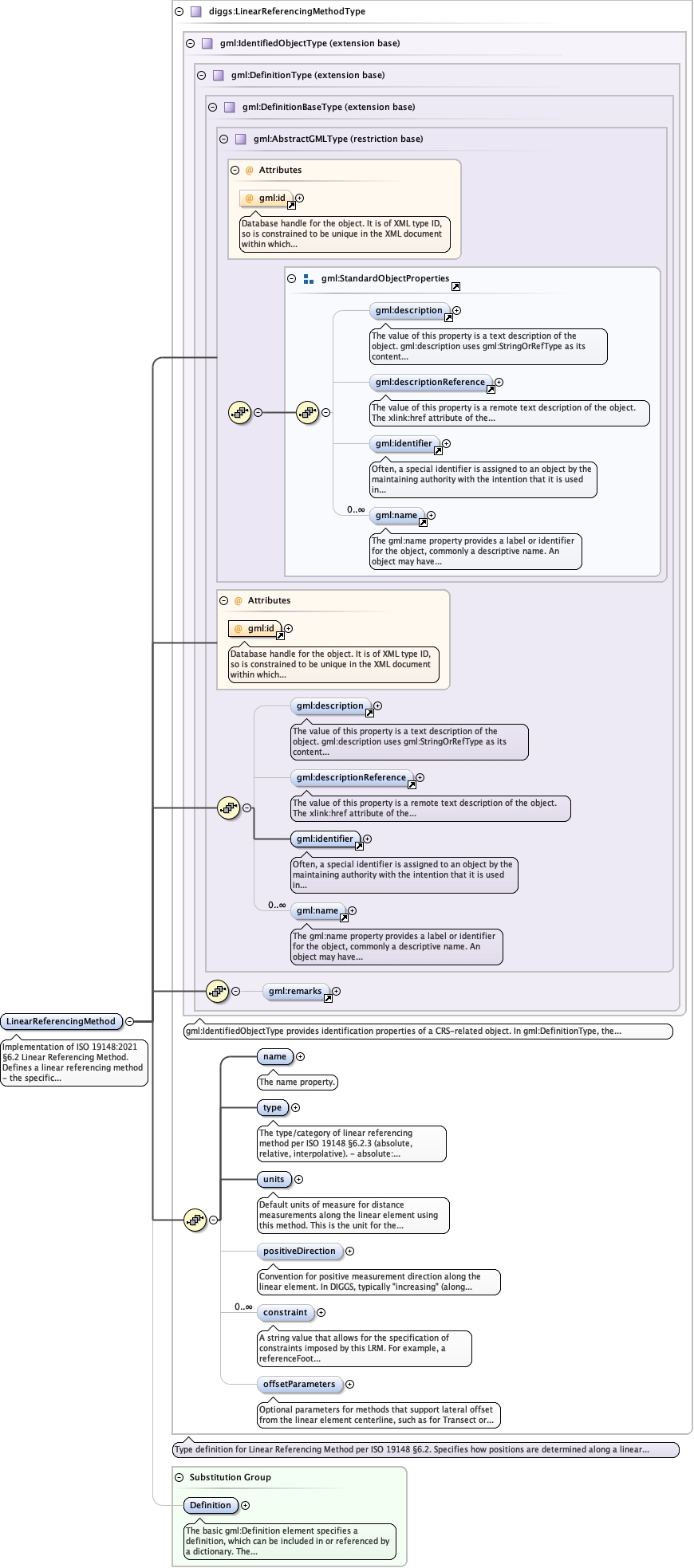
Diagram
Diagramgml3_2Profile_diggs_xsd_Attribute_gml_id.tmp#idgml3_2Profile_diggs_xsd_Element_gml_description.tmp#descriptiongml3_2Profile_diggs_xsd_Element_gml_descriptionReference.tmp#descriptionReferencegml3_2Profile_diggs_xsd_Element_gml_identifier.tmp#identifiergml3_2Profile_diggs_xsd_Element_gml_name.tmp#namegml3_2Profile_diggs_xsd_Element_Group_gml_StandardObjectProperties.tmp#StandardObjectPropertiesgml3_2Profile_diggs_xsd_Complex_Type_gml_AbstractGMLType.tmp#AbstractGMLTypegml3_2Profile_diggs_xsd_Attribute_gml_id.tmp#idgml3_2Profile_diggs_xsd_Element_gml_description.tmp#descriptiongml3_2Profile_diggs_xsd_Element_gml_descriptionReference.tmp#descriptionReferencegml3_2Profile_diggs_xsd_Element_gml_identifier.tmp#identifiergml3_2Profile_diggs_xsd_Element_gml_name.tmp#namegml3_2Profile_diggs_xsd_Complex_Type_gml_DefinitionBaseType.tmp#DefinitionBaseTypegml3_2Profile_diggs_xsd_Element_gml_remarks.tmp#remarksgml3_2Profile_diggs_xsd_Complex_Type_gml_DefinitionType.tmp#DefinitionTypegml3_2Profile_diggs_xsd_Complex_Type_gml_IdentifiedObjectType.tmp#IdentifiedObjectTypeLinearReferencing_xsd_Complex_Type_diggs_LinearReferencingMethodType.tmp#LinearReferencingMethodType_nameLinearReferencing_xsd_Complex_Type_diggs_LinearReferencingMethodType.tmp#LinearReferencingMethodType_typeLinearReferencing_xsd_Complex_Type_diggs_LinearReferencingMethodType.tmp#LinearReferencingMethodType_unitsLinearReferencing_xsd_Complex_Type_diggs_LinearReferencingMethodType.tmp#LinearReferencingMethodType_positiveDirectionLinearReferencing_xsd_Complex_Type_diggs_LinearReferencingMethodType.tmp#LinearReferencingMethodType_constraintLinearReferencing_xsd_Complex_Type_diggs_LinearReferencingMethodType.tmp#LinearReferencingMethodType_offsetParametersLinearReferencing_xsd_Complex_Type_diggs_LinearReferencingMethodType.tmp#LinearReferencingMethodTypegml3_2Profile_diggs_xsd_Element_gml_Definition.tmp#Definition
Type diggs:LinearReferencingMethodType
Type hierarchy
Properties
content complex
Substitution Group Affiliation
Used by
Model
Children diggs:constraint, diggs:name, diggs:offsetParameters, diggs:positiveDirection, diggs:type, diggs:units, gml:description, gml:descriptionReference, gml:identifier, gml:name, gml:remarks
Instance
<diggs:LinearReferencingMethod gml:id="" xmlns:diggs="http://diggsml.org/schemas/3" xmlns:gml="http://www.opengis.net/gml/3.2">
  <gml:description xlink:actuate="" xlink:arcrole="" xlink:href="" nilReason="" xlink:role="" xlink:show="" xlink:title="" xlink:type="simple">{0,1}</gml:description>
  <gml:descriptionReference xlink:actuate="" xlink:arcrole="" xlink:href="" nilReason="" owns="false" xlink:role="" xlink:show="" xlink:title="" xlink:type="simple">{0,1}</gml:descriptionReference>
  <gml:identifier codeSpace="">{1,1}</gml:identifier>
  <gml:name codeSpace="">{0,unbounded}</gml:name>
  <gml:remarks>{0,1}</gml:remarks>
  <diggs:name>{1,1}</diggs:name>
  <diggs:type>{1,1}</diggs:type>
  <diggs:units>{1,1}</diggs:units>
  <diggs:positiveDirection>{0,1}</diggs:positiveDirection>
  <diggs:constraint>{0,unbounded}</diggs:constraint>
  <diggs:offsetParameters xlink:actuate="" xlink:arcrole="" xlink:href="" nilReason="" xlink:role="" xlink:show="" xlink:title="" xlink:type="simple">{0,1}</diggs:offsetParameters>
</diggs:LinearReferencingMethod>
Attributes
QName Type Use Annotation
gml:id ID required
Database handle for the object. It is of XML type ID, so is constrained to be
unique in the XML document within which it occurs. An external identifier for the object in
the form of a URI may be constructed using standard XML and XPointer methods. This is done
by concatenating the URI for the document, a fragment separator, and the value of the id
attribute.
Source
<element name="LinearReferencingMethod" type="diggs:LinearReferencingMethodType" substitutionGroup="gml:Definition">
  <annotation>
    <documentation>Implementation of ISO 19148:2021 §6.2 Linear Referencing Method. Defines a linear referencing method - the specific procedure or algorithm for determining positions along linear features. Per ISO 19148 §6.2: A linear referencing method is a method for specifying a position along a linear element using a distance measure from a specified origin. Methods may optionally support lateral offset, making them suitable for 2D positioning (distance along + perpendicular offset). DIGGS LR methods establish: = Method name - How measurements are computed (absolute, relative, interpolative) - Units of measure for distances - Direction conventions (positive direction) - Whether lateral offsets are supported</documentation>
  </annotation>
</element>