Namespace
http://diggsml.org/schemas/3
Annotations
Diagram
Type
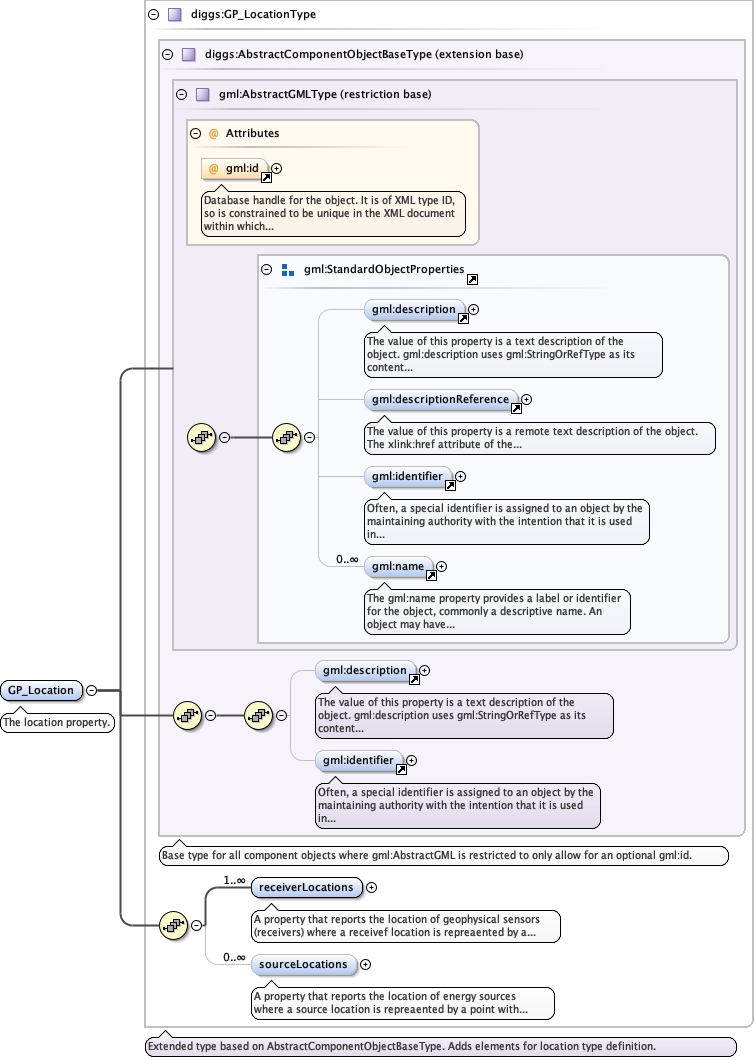
diggs:GP_LocationType
Type hierarchy
Properties
Used by
Model
Children
diggs:receiverLocations , diggs:sourceLocations , gml:description , gml:identifier
Instance
<diggs:GP_Location gml:id= "" xmlns:diggs= "http://diggsml.org/schemas/3" xmlns:gml= "http://www.opengis.net/gml/3.2" >
<gml:description xlink:actuate= "" xlink:arcrole= "" xlink:href= "" nilReason= "" xlink:role= "" xlink:show= "" xlink:title= "" xlink:type= "simple" > {0,1} </gml:description>
<gml:identifier codeSpace= "" > {0,1} </gml:identifier>
<diggs:receiverLocations xlink:actuate= "" xlink:arcrole= "" xlink:href= "" nilReason= "" owns= "false" xlink:role= "" xlink:show= "" xlink:title= "" xlink:type= "simple" > {1,unbounded} </diggs:receiverLocations>
<diggs:sourceLocations xlink:actuate= "" xlink:arcrole= "" xlink:href= "" nilReason= "" owns= "false" xlink:role= "" xlink:show= "" xlink:title= "" xlink:type= "simple" > {0,unbounded} </diggs:sourceLocations>
</diggs:GP_Location>
Attributes
QName
Type
Use
Annotation
gml:id
ID
optional
Database handle for the object. It is of XML type ID, so is constrained to be
unique in the XML document within which it occurs. An external identifier for the object in
the form of a URI may be constructed using standard XML and XPointer methods. This is done
by concatenating the URI for the document, a fragment separator, and the value of the id
attribute.
Source
<element name= "GP_Location" type= "diggs:GP_LocationType" >
<annotation >
<documentation > The location property. </documentation>
</annotation>
</element>