Showing:

Annotations
Attributes
Diagrams
Instances
Model
Properties
Source
Element diggs:PlanarObservationRepresentation
Namespace http://diggsml.org/schemas/3
Annotations
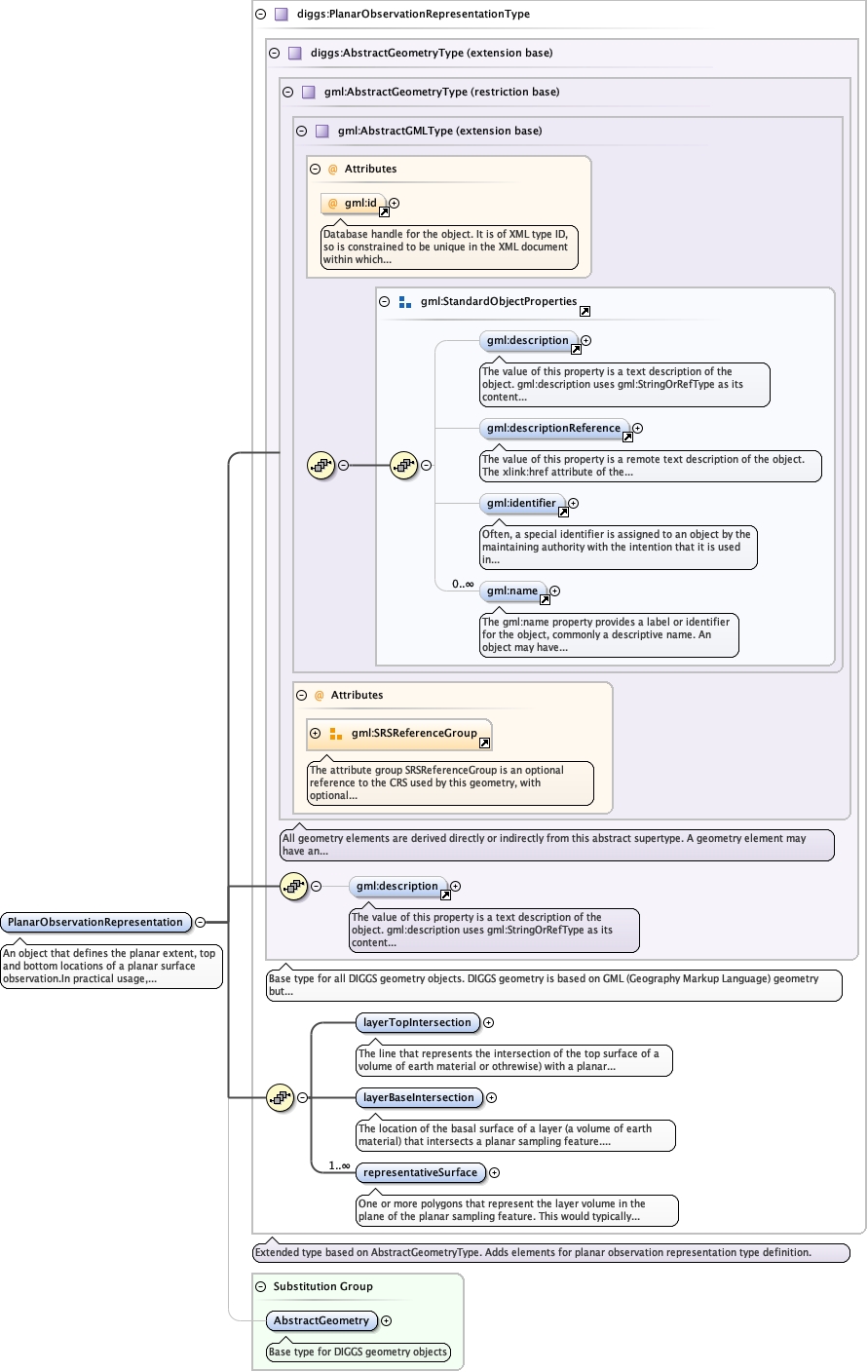
An object that defines the planar extent, top and bottom locations of a planar surface observation.In practical usage, the PlanarSurfaceRepresentation incorporates the geometries of the top and bottom surfaces of a volume of earth material where they contact a planar surface, such as a geologic contact or stratigraphic boundary and the area (as a surface) between the two contacts.
Diagram
Diagramgml3_2Profile_diggs_xsd_Attribute_gml_id.tmp#idgml3_2Profile_diggs_xsd_Element_gml_description.tmp#descriptiongml3_2Profile_diggs_xsd_Element_gml_descriptionReference.tmp#descriptionReferencegml3_2Profile_diggs_xsd_Element_gml_identifier.tmp#identifiergml3_2Profile_diggs_xsd_Element_gml_name.tmp#namegml3_2Profile_diggs_xsd_Element_Group_gml_StandardObjectProperties.tmp#StandardObjectPropertiesgml3_2Profile_diggs_xsd_Complex_Type_gml_AbstractGMLType.tmp#AbstractGMLTypegml3_2Profile_diggs_xsd_Attribute_Group_gml_SRSReferenceGroup.tmp#SRSReferenceGroupgml3_2Profile_diggs_xsd_Complex_Type_gml_AbstractGeometryType.tmp#AbstractGeometryTypegml3_2Profile_diggs_xsd_Element_gml_description.tmp#descriptionCore_xsd_Complex_Type_diggs_AbstractGeometryType.tmp#http___diggsml.org_schemas_3_AbstractGeometryTypeExtSamplingFeatures_xsd_Complex_Type_diggs_PlanarObservationRepresentationType.tmp#PlanarObservationRepresentationType_layerTopIntersectionExtSamplingFeatures_xsd_Complex_Type_diggs_PlanarObservationRepresentationType.tmp#PlanarObservationRepresentationType_layerBaseIntersectionExtSamplingFeatures_xsd_Complex_Type_diggs_PlanarObservationRepresentationType.tmp#PlanarObservationRepresentationType_representativeSurfaceExtSamplingFeatures_xsd_Complex_Type_diggs_PlanarObservationRepresentationType.tmp#PlanarObservationRepresentationTypeCore_xsd_Element_diggs_AbstractGeometry.tmp#http___diggsml.org_schemas_3_AbstractGeometry
Type diggs:PlanarObservationRepresentationType
Type hierarchy
Properties
content complex
Substitution Group Affiliation
Model
Children diggs:layerBaseIntersection, diggs:layerTopIntersection, diggs:representativeSurface, gml:description
Instance
<diggs:PlanarObservationRepresentation axisLabels="" gml:id="" srsDimension="" srsName="" uomLabels="" xmlns:diggs="http://diggsml.org/schemas/3" xmlns:gml="http://www.opengis.net/gml/3.2">
  <gml:description xlink:actuate="" xlink:arcrole="" xlink:href="" nilReason="" xlink:role="" xlink:show="" xlink:title="" xlink:type="simple">{0,1}</gml:description>
  <diggs:layerTopIntersection xlink:actuate="" xlink:role="" xlink:arcrole="" xlink:show="" xlink:title="" xlink:href="" xlink:type="simple" nilReason="" owns="false">{1,1}</diggs:layerTopIntersection>
  <diggs:layerBaseIntersection xlink:actuate="" xlink:role="" xlink:arcrole="" xlink:show="" xlink:title="" xlink:href="" xlink:type="simple" nilReason="" owns="false">{1,1}</diggs:layerBaseIntersection>
  <diggs:representativeSurface xlink:actuate="" xlink:role="" xlink:arcrole="" xlink:show="" xlink:title="" xlink:href="" xlink:type="simple" nilReason="" owns="false">{1,unbounded}</diggs:representativeSurface>
</diggs:PlanarObservationRepresentation>
Attributes
QName Type Use Annotation
axisLabels gml:NCNameList optional
gml:id ID optional
Database handle for the object. It is of XML type ID, so is constrained to be
unique in the XML document within which it occurs. An external identifier for the object in
the form of a URI may be constructed using standard XML and XPointer methods. This is done
by concatenating the URI for the document, a fragment separator, and the value of the id
attribute.
srsDimension positiveInteger optional
srsName anyURI optional
uomLabels gml:NCNameList optional
Source
<element name="PlanarObservationRepresentation" substitutionGroup="diggs:AbstractGeometry" type="diggs:PlanarObservationRepresentationType">
  <annotation>
    <documentation>An object that defines the planar extent, top and bottom locations of a planar surface observation.In practical usage, the PlanarSurfaceRepresentation incorporates the geometries of the top and bottom surfaces of a volume of earth material where they contact a planar surface, such as a geologic contact or stratigraphic boundary and the area (as a surface) between the two contacts.</documentation>
  </annotation>
</element>