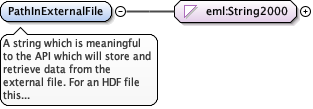
A string which is meaningful to the API which will store and retrieve data from the external file.For an HDF file this is the path of the referenced dataset in the external file. The separator between groups and final dataset is a slash '/' in an hdf file.For a LAS file this could be the list of mnemonics in the ~A block.For a SEG-Y file this could be a list of trace headers.
<xs:element name="PathInExternalFile" type="eml:String2000" minOccurs="1" maxOccurs="1"><xs:annotation><xs:documentation>A string which is meaningful to the API which will store and retrieve data from the external file. For an HDF file this is the path of the referenced dataset in the external file. The separator between groups and final dataset is a slash '/' in an hdf file. For a LAS file this could be the list of mnemonics in the ~A block. For a SEG-Y file this could be a list of trace headers.</xs:documentation></xs:annotation></xs:element>
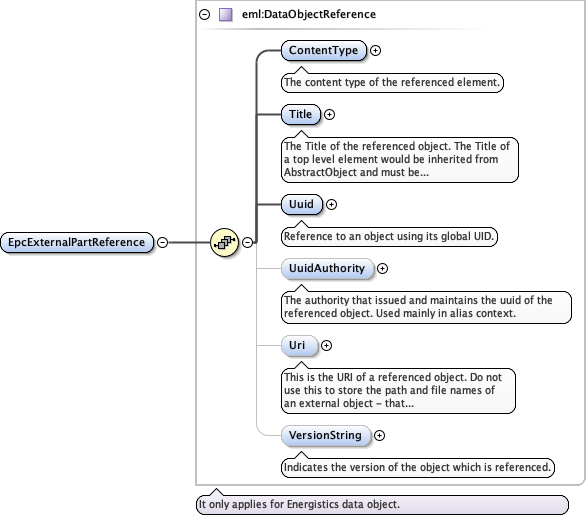
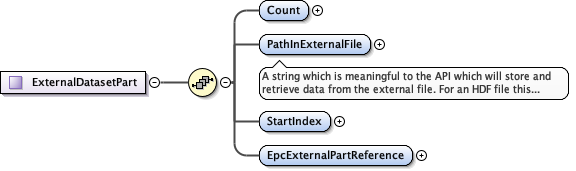
<xs:complexType name="ExternalDatasetPart"><xs:sequence><xs:element name="Count" type="eml:PositiveLong" minOccurs="1" maxOccurs="1"/><xs:element name="PathInExternalFile" type="eml:String2000" minOccurs="1" maxOccurs="1"><xs:annotation><xs:documentation>A string which is meaningful to the API which will store and retrieve data from the external file. For an HDF file this is the path of the referenced dataset in the external file. The separator between groups and final dataset is a slash '/' in an hdf file. For a LAS file this could be the list of mnemonics in the ~A block. For a SEG-Y file this could be a list of trace headers.</xs:documentation></xs:annotation></xs:element><xs:element name="StartIndex" type="eml:NonNegativeLong" minOccurs="1" maxOccurs="1"/><xs:element name="EpcExternalPartReference" type="eml:DataObjectReference" minOccurs="1" maxOccurs="1"/></xs:sequence></xs:complexType>