Sensor data is recorded into downhole memory of a tool, rather than transmitting in "real time" to surface.
enumeration
processed
Results of calculations based on measurements
enumeration
real time
Measurements at the actual time.
Source
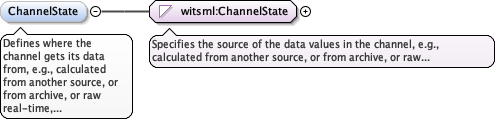
<xs:element name="ChannelState" type="witsml:ChannelState" minOccurs="0" maxOccurs="1"><xs:annotation><xs:documentation>Defines where the channel gets its data from, e.g., calculated from another source, or from archive, or raw real-time, etc.</xs:documentation></xs:annotation></xs:element>
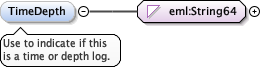
<xs:element name="TimeDepth" type="eml:String64" minOccurs="0" maxOccurs="1"><xs:annotation><xs:documentation>Use to indicate if this is a time or depth log.</xs:documentation></xs:annotation></xs:element>
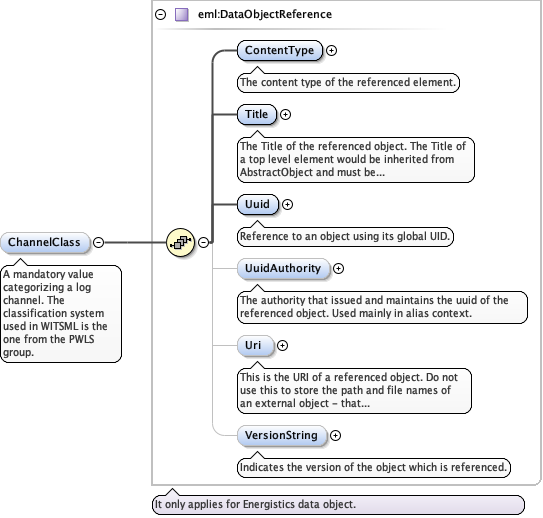
<xs:element name="ChannelClass" type="eml:DataObjectReference" minOccurs="0" maxOccurs="1"><xs:annotation><xs:documentation>A mandatory value categorizing a log channel. The classification system used in WITSML is the one from the PWLS group.</xs:documentation></xs:annotation></xs:element>
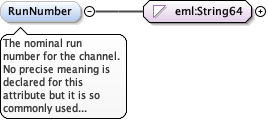
The nominal run number for the channel. No precise meaning is declared for this attribute but it is so commonly used that it must be included. The value here should match a bit run number for LWD data and a wireline run number for logging data.
<xs:element name="RunNumber" type="eml:String64" minOccurs="0" maxOccurs="1"><xs:annotation><xs:documentation>The nominal run number for the channel. No precise meaning is declared for this attribute but it is so commonly used that it must be included. The value here should match a bit run number for LWD data and a wireline run number for logging data.</xs:documentation></xs:annotation></xs:element>
The nominal pass number for the channel. No precise meaning is declared for this attribute but it is so commonly used that it must be included. The value here should match a wireline pass number for logging data.
<xs:element name="PassNumber" type="eml:String64" minOccurs="0" maxOccurs="1"><xs:annotation><xs:documentation>The nominal pass number for the channel. No precise meaning is declared for this attribute but it is so commonly used that it must be included. The value here should match a wireline pass number for logging data.</xs:documentation></xs:annotation></xs:element>
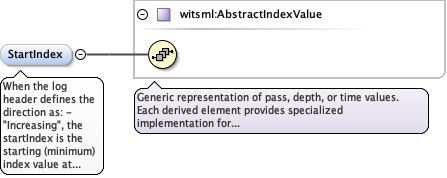
When the log header defines the direction as: - "Increasing", the startIndex is the starting (minimum) index value at which the first non-null data point is located. - "Decreasing", the startIndex is the starting (maximum) index value at which the first non-null data point is located.
<xs:element name="StartIndex" type="witsml:AbstractIndexValue" minOccurs="0" maxOccurs="1"><xs:annotation><xs:documentation>When the log header defines the direction as: - "Increasing", the startIndex is the starting (minimum) index value at which the first non-null data point is located. - "Decreasing", the startIndex is the starting (maximum) index value at which the first non-null data point is located.</xs:documentation></xs:annotation></xs:element>
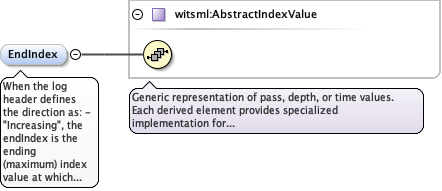
When the log header defines the direction as: - "Increasing", the endIndex is the ending (maximum) index value at which the last non-null data point is located. - “Decreasing”, the endIndex is the ending (minimum) index value at which the last non-null data point is located.
<xs:element name="EndIndex" type="witsml:AbstractIndexValue" minOccurs="0" maxOccurs="1"><xs:annotation><xs:documentation>When the log header defines the direction as: - "Increasing", the endIndex is the ending (maximum) index value at which the last non-null data point is located. - “Decreasing”, the endIndex is the ending (minimum) index value at which the last non-null data point is located.</xs:documentation></xs:annotation></xs:element>
<xs:element name="LoggingCompanyName" type="eml:String64" minOccurs="0" maxOccurs="1"><xs:annotation><xs:documentation>Name of the logging company.</xs:documentation></xs:annotation></xs:element>
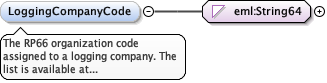
The RP66 organization code assigned to a logging company. The list is available at http://www.energistics.org/geosciences/geology-standards/rp66-organization-codes
<xs:element name="LoggingCompanyCode" type="eml:String64" minOccurs="0" maxOccurs="1"><xs:annotation><xs:documentation>The RP66 organization code assigned to a logging company. The list is available at http://www.energistics.org/geosciences/geology-standards/rp66-organization-codes</xs:documentation></xs:annotation></xs:element>
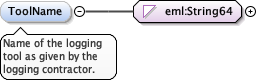
<xs:element name="ToolName" type="eml:String64" minOccurs="0" maxOccurs="1"><xs:annotation><xs:documentation>Name of the logging tool as given by the logging contractor.</xs:documentation></xs:annotation></xs:element>
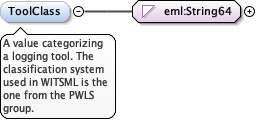
<xs:element name="ToolClass" type="eml:String64" minOccurs="0" maxOccurs="1"><xs:annotation><xs:documentation>A value categorizing a logging tool. The classification system used in WITSML is the one from the PWLS group.</xs:documentation></xs:annotation></xs:element>
Derived by splicing values from two or more other channels.
enumeration
sampled
Derived by sampling values from one or more other channels.
enumeration
model
Based on some modeled results of values in another one or more channels.
Source
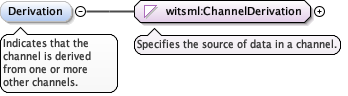
<xs:element name="Derivation" type="witsml:ChannelDerivation" minOccurs="0" maxOccurs="1"><xs:annotation><xs:documentation>Indicates that the channel is derived from one or more other channels.</xs:documentation></xs:annotation></xs:element>
The log is a result of computed analyses from various sources.
enumeration
distributed
The log is derived from various different systems.
enumeration
LWD
The data of the log is a result of logging-while-drilling.
enumeration
mixed
The data is derived from multiple logging methods.
enumeration
MWD
The data of the log is a result of measurement-while-drilling.
enumeration
surface
The data is recorded on the surface or in real time.
enumeration
wireline
The data is derived as a function of wellbore depth.
Source
<xs:element name="LoggingMethod" type="witsml:LoggingMethod" minOccurs="0" maxOccurs="1"><xs:annotation><xs:documentation>Defines where the log channel gets its data from: LWD, MWD, wireline; or whether it is computed, etc.</xs:documentation></xs:annotation></xs:element>
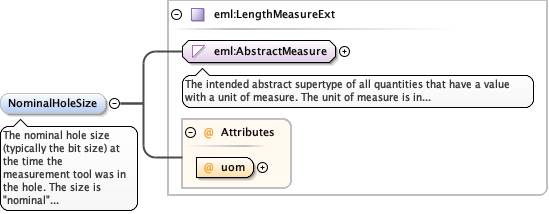
The nominal hole size (typically the bit size) at the time the measurement tool was in the hole. The size is "nominal" to indicate that this is not the result of a caliper reading or other direct measurement of the hole size, but is just a name used to refer to the diameter.When more than one diameter holes are being drilled at the same time (e.g., where a reamer is behind the bit), this diameter is the one that was seen by the sensor that produced a particular log channel.
<xs:element name="NominalHoleSize" type="eml:LengthMeasureExt" minOccurs="0" maxOccurs="1"><xs:annotation><xs:documentation>The nominal hole size (typically the bit size) at the time the measurement tool was in the hole. The size is "nominal" to indicate that this is not the result of a caliper reading or other direct measurement of the hole size, but is just a name used to refer to the diameter. When more than one diameter holes are being drilled at the same time (e.g., where a reamer is behind the bit), this diameter is the one that was seen by the sensor that produced a particular log channel.</xs:documentation></xs:annotation></xs:element>
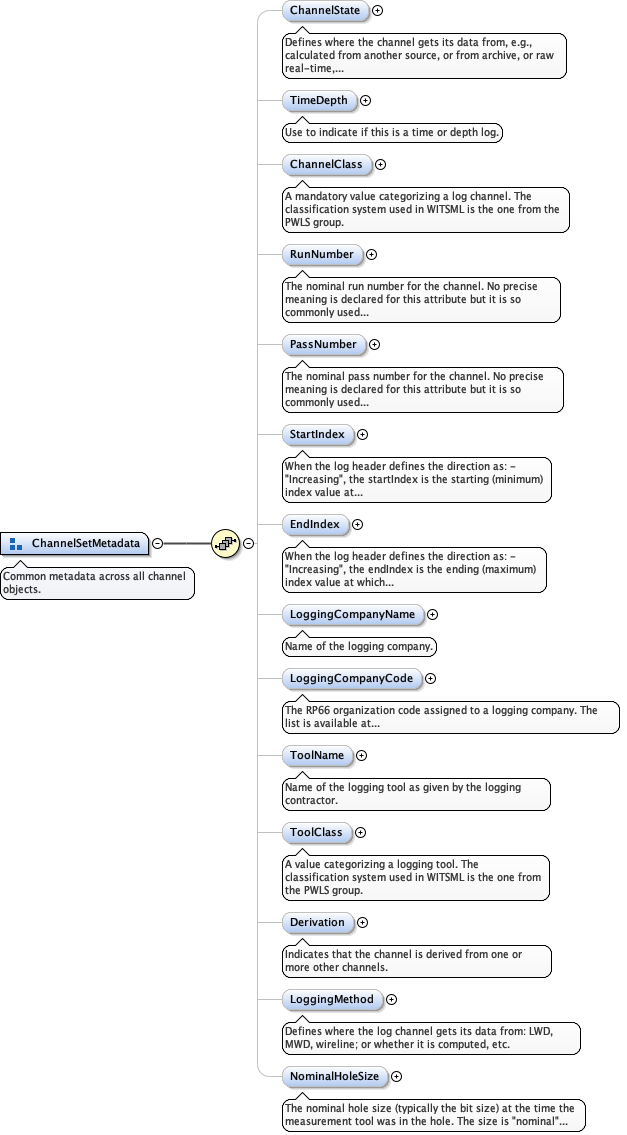
<xs:group name="ChannelSetMetadata"><xs:annotation><xs:documentation>Common metadata across all channel objects.</xs:documentation></xs:annotation><xs:sequence><xs:element name="ChannelState" type="witsml:ChannelState" minOccurs="0" maxOccurs="1"><xs:annotation><xs:documentation>Defines where the channel gets its data from, e.g., calculated from another source, or from archive, or raw real-time, etc.</xs:documentation></xs:annotation></xs:element><xs:element name="TimeDepth" type="eml:String64" minOccurs="0" maxOccurs="1"><xs:annotation><xs:documentation>Use to indicate if this is a time or depth log.</xs:documentation></xs:annotation></xs:element><xs:element name="ChannelClass" type="eml:DataObjectReference" minOccurs="0" maxOccurs="1"><xs:annotation><xs:documentation>A mandatory value categorizing a log channel. The classification system used in WITSML is the one from the PWLS group.</xs:documentation></xs:annotation></xs:element><xs:element name="RunNumber" type="eml:String64" minOccurs="0" maxOccurs="1"><xs:annotation><xs:documentation>The nominal run number for the channel. No precise meaning is declared for this attribute but it is so commonly used that it must be included. The value here should match a bit run number for LWD data and a wireline run number for logging data.</xs:documentation></xs:annotation></xs:element><xs:element name="PassNumber" type="eml:String64" minOccurs="0" maxOccurs="1"><xs:annotation><xs:documentation>The nominal pass number for the channel. No precise meaning is declared for this attribute but it is so commonly used that it must be included. The value here should match a wireline pass number for logging data.</xs:documentation></xs:annotation></xs:element><xs:element name="StartIndex" type="witsml:AbstractIndexValue" minOccurs="0" maxOccurs="1"><xs:annotation><xs:documentation>When the log header defines the direction as: - "Increasing", the startIndex is the starting (minimum) index value at which the first non-null data point is located. - "Decreasing", the startIndex is the starting (maximum) index value at which the first non-null data point is located.</xs:documentation></xs:annotation></xs:element><xs:element name="EndIndex" type="witsml:AbstractIndexValue" minOccurs="0" maxOccurs="1"><xs:annotation><xs:documentation>When the log header defines the direction as: - "Increasing", the endIndex is the ending (maximum) index value at which the last non-null data point is located. - “Decreasing”, the endIndex is the ending (minimum) index value at which the last non-null data point is located.</xs:documentation></xs:annotation></xs:element><xs:element name="LoggingCompanyName" type="eml:String64" minOccurs="0" maxOccurs="1"><xs:annotation><xs:documentation>Name of the logging company.</xs:documentation></xs:annotation></xs:element><xs:element name="LoggingCompanyCode" type="eml:String64" minOccurs="0" maxOccurs="1"><xs:annotation><xs:documentation>The RP66 organization code assigned to a logging company. The list is available at http://www.energistics.org/geosciences/geology-standards/rp66-organization-codes</xs:documentation></xs:annotation></xs:element><xs:element name="ToolName" type="eml:String64" minOccurs="0" maxOccurs="1"><xs:annotation><xs:documentation>Name of the logging tool as given by the logging contractor.</xs:documentation></xs:annotation></xs:element><xs:element name="ToolClass" type="eml:String64" minOccurs="0" maxOccurs="1"><xs:annotation><xs:documentation>A value categorizing a logging tool. The classification system used in WITSML is the one from the PWLS group.</xs:documentation></xs:annotation></xs:element><xs:element name="Derivation" type="witsml:ChannelDerivation" minOccurs="0" maxOccurs="1"><xs:annotation><xs:documentation>Indicates that the channel is derived from one or more other channels.</xs:documentation></xs:annotation></xs:element><xs:element name="LoggingMethod" type="witsml:LoggingMethod" minOccurs="0" maxOccurs="1"><xs:annotation><xs:documentation>Defines where the log channel gets its data from: LWD, MWD, wireline; or whether it is computed, etc.</xs:documentation></xs:annotation></xs:element><xs:element name="NominalHoleSize" type="eml:LengthMeasureExt" minOccurs="0" maxOccurs="1"><xs:annotation><xs:documentation>The nominal hole size (typically the bit size) at the time the measurement tool was in the hole. The size is "nominal" to indicate that this is not the result of a caliper reading or other direct measurement of the hole size, but is just a name used to refer to the diameter. When more than one diameter holes are being drilled at the same time (e.g., where a reamer is behind the bit), this diameter is the one that was seen by the sensor that produced a particular log channel.</xs:documentation></xs:annotation></xs:element></xs:sequence></xs:group>