Showing:

Annotations
Diagrams
Facets
Instances
Model
Properties
Source
Element witsml:ObjectContext / witsml:ObjectReference
Namespace http://www.energistics.org/energyml/data/witsmlv2
Annotations
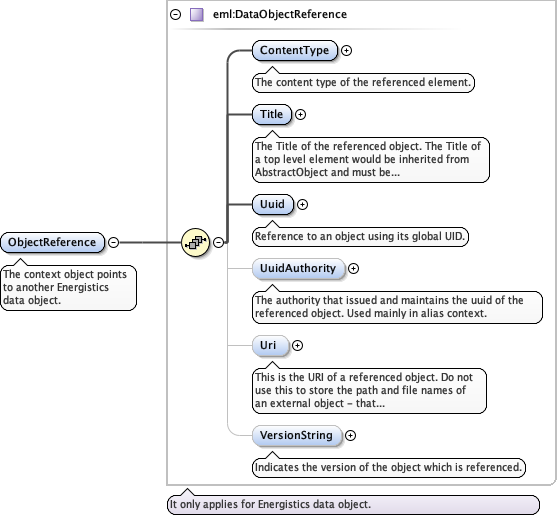
The context object points to another Energistics data object.
Diagram
DiagramObjectReference_xsd_Complex_Type_eml_DataObjectReference.tmp#DataObjectReference_ContentTypeObjectReference_xsd_Complex_Type_eml_DataObjectReference.tmp#DataObjectReference_TitleObjectReference_xsd_Complex_Type_eml_DataObjectReference.tmp#DataObjectReference_UuidObjectReference_xsd_Complex_Type_eml_DataObjectReference.tmp#DataObjectReference_UuidAuthorityObjectReference_xsd_Complex_Type_eml_DataObjectReference.tmp#DataObjectReference_UriObjectReference_xsd_Complex_Type_eml_DataObjectReference.tmp#DataObjectReference_VersionStringObjectReference_xsd_Complex_Type_eml_DataObjectReference.tmp#DataObjectReference
Type eml:DataObjectReference
Properties
content complex
minOccurs 1
maxOccurs 1
Model
Children eml:ContentType, eml:Title, eml:Uri, eml:Uuid, eml:UuidAuthority, eml:VersionString
Instance
<witsml:ObjectReference xmlns:witsml="http://www.energistics.org/energyml/data/witsmlv2" xmlns:eml="http://www.energistics.org/energyml/data/commonv2">
  <eml:ContentType>{1,1}</eml:ContentType>
  <eml:Title>{1,1}</eml:Title>
  <eml:Uuid>{1,1}</eml:Uuid>
  <eml:UuidAuthority>{0,1}</eml:UuidAuthority>
  <eml:Uri>{0,1}</eml:Uri>
  <eml:VersionString>{0,1}</eml:VersionString>
</witsml:ObjectReference>
Source
<xs:element name="ObjectReference" type="eml:DataObjectReference" minOccurs="1" maxOccurs="1">
  <xs:annotation>
    <xs:documentation>The context object points to another Energistics data object.</xs:documentation>
  </xs:annotation>
</xs:element>
Element witsml:ObjectContext / witsml:SubObjectReference
Namespace http://www.energistics.org/energyml/data/witsmlv2
Annotations
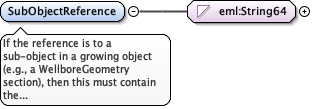
If the reference is to a sub-object in a growing object  (e.g., a WellboreGeometry section), then this must contain the UID of the growing part.
Diagram
DiagramBaseTypes_xsd_Simple_Type_eml_String64.tmp#String64
Type eml:String64
Type hierarchy
Properties
content simple
minOccurs 1
maxOccurs 1
Facets
maxLength 64
Source
<xs:element name="SubObjectReference" type="eml:String64" minOccurs="1" maxOccurs="1">
  <xs:annotation>
    <xs:documentation>If the reference is to a sub-object in a growing object (e.g., a WellboreGeometry section), then this must contain the UID of the growing part.</xs:documentation>
  </xs:annotation>
</xs:element>
Complex Type witsml:ObjectContext
Namespace http://www.energistics.org/energyml/data/witsmlv2
Annotations
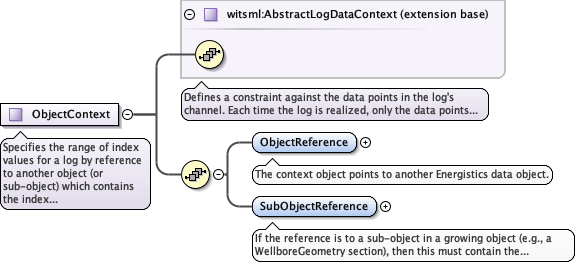
Specifies the range of index values for a log by reference to another object (or sub-object) which contains the index range as part of its data.
Diagram
DiagramLog_xsd_Complex_Type_witsml_AbstractLogDataContext.tmp#AbstractLogDataContextLog_xsd_Complex_Type_witsml_ObjectContext.tmp#ObjectContext_ObjectReferenceLog_xsd_Complex_Type_witsml_ObjectContext.tmp#ObjectContext_SubObjectReference
Type extension of witsml:AbstractLogDataContext
Type hierarchy
Model
Children witsml:ObjectReference, witsml:SubObjectReference
Source
<xs:complexType name="ObjectContext">
  <xs:annotation>
    <xs:documentation>Specifies the range of index values for a log by reference to another object (or sub-object) which contains the index range as part of its data.</xs:documentation>
  </xs:annotation>
  <xs:complexContent>
    <xs:extension base="witsml:AbstractLogDataContext">
      <xs:sequence>
        <xs:element name="ObjectReference" type="eml:DataObjectReference" minOccurs="1" maxOccurs="1">
          <xs:annotation>
            <xs:documentation>The context object points to another Energistics data object.</xs:documentation>
          </xs:annotation>
        </xs:element>
        <xs:element name="SubObjectReference" type="eml:String64" minOccurs="1" maxOccurs="1">
          <xs:annotation>
            <xs:documentation>If the reference is to a sub-object in a growing object (e.g., a WellboreGeometry section), then this must contain the UID of the growing part.</xs:documentation>
          </xs:annotation>
        </xs:element>
      </xs:sequence>
    </xs:extension>
  </xs:complexContent>
</xs:complexType>