Showing:

Annotations
Attributes
Diagrams
Facets
Instances
Model
Properties
Source
Used by
Element witsml:Channel / witsml:Mnemonic
Namespace http://www.energistics.org/energyml/data/witsmlv2
Annotations
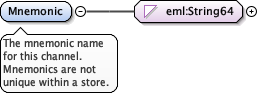
The mnemonic name for this channel. Mnemonics are not unique within a store.
Diagram
DiagramBaseTypes_xsd_Simple_Type_eml_String64.tmp#String64
Type eml:String64
Type hierarchy
Properties
content simple
minOccurs 1
maxOccurs 1
Facets
maxLength 64
Source
<xs:element name="Mnemonic" type="eml:String64" minOccurs="1" maxOccurs="1">
  <xs:annotation>
    <xs:documentation>The mnemonic name for this channel. Mnemonics are not unique within a store.</xs:documentation>
  </xs:annotation>
</xs:element>
Element witsml:Channel / witsml:DataType
Namespace http://www.energistics.org/energyml/data/witsmlv2
Annotations
The underlying ETP data type of the value.
Diagram
DiagramLog_xsd_Simple_Type_witsml_EtpDataType.tmp#EtpDataType
Type witsml:EtpDataType
Type hierarchy
Properties
content simple
minOccurs 1
maxOccurs 1
Facets
maxLength 64
enumeration boolean
True or false values.
enumeration bytes
Integer data value (nominally a one-byte value). The value must conform to the format of the xsd:dateTime data type (minInclusive=-128 and maxInclusive=127).
enumeration double
Double-precision floating-point value (nominally an 8-byte value). The value must conform to the format of the xsd:double data type.
enumeration float
Single-precision floating-point value (nominally a 4-byte value). The value must conform to the format of the xsd:float data type
enumeration int
Integer data value (nominally a 4-byte value). The value must conform to the format of the xsd:int data type.
enumeration long
Long integer data value (nominally an 8-byte value). The value must conform to the format of the xsd:long data type.
enumeration null
No value or the value is null.
enumeration string
Character string data. The value must conform to the format of the xsd:string data type. The maximum length of a value is determined by individual servers.
enumeration vector
An array of doubles.
Source
<xs:element name="DataType" type="witsml:EtpDataType" minOccurs="1" maxOccurs="1">
  <xs:annotation>
    <xs:documentation>The underlying ETP data type of the value.</xs:documentation>
  </xs:annotation>
</xs:element>
Element witsml:Channel / witsml:Uom
Namespace http://www.energistics.org/energyml/data/witsmlv2
Annotations
The underlying unit of measure of the value.
Diagram
DiagramCommonEnumerations_xsd_Simple_Type_eml_UnitOfMeasureExt.tmp#UnitOfMeasureExt
Type eml:UnitOfMeasureExt
Properties
content simple
minOccurs 1
maxOccurs 1
Source
<xs:element name="Uom" type="eml:UnitOfMeasureExt" minOccurs="1" maxOccurs="1">
  <xs:annotation>
    <xs:documentation>The underlying unit of measure of the value.</xs:documentation>
  </xs:annotation>
</xs:element>
Element witsml:Channel / witsml:GrowingStatus
Namespace http://www.energistics.org/energyml/data/witsmlv2
Annotations
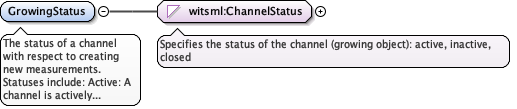
The status of a channel with respect to creating new measurements. Statuses include: 
Active: A channel is actively producing data points. 
Inactive: A channel is offline or not currently producing, but may begin producing again in the future. 
Closed: A channel will never produce points again. The rules for when a channel is to be closed will vary some for different kinds of channels. For example, time-based surface channels may remain open for the entire life of the drilling operation, whereas depth-based wireline channels are closed at the end of the wireline job
Diagram
DiagramLog_xsd_Simple_Type_witsml_ChannelStatus.tmp#ChannelStatus
Type witsml:ChannelStatus
Type hierarchy
Properties
content simple
minOccurs 1
maxOccurs 1
Facets
maxLength 64
enumeration active
Actively producing data points.
enumeration closed
Closed and will never produce new data points.
enumeration inactive
Currently inactive but may produce data points in the future.
Source
<xs:element name="GrowingStatus" type="witsml:ChannelStatus" minOccurs="1" maxOccurs="1">
  <xs:annotation>
    <xs:documentation>The status of a channel with respect to creating new measurements. Statuses include: Active: A channel is actively producing data points. Inactive: A channel is offline or not currently producing, but may begin producing again in the future. Closed: A channel will never produce points again. The rules for when a channel is to be closed will vary some for different kinds of channels. For example, time-based surface channels may remain open for the entire life of the drilling operation, whereas depth-based wireline channels are closed at the end of the wireline job</xs:documentation>
  </xs:annotation>
</xs:element>
Element witsml:Channel / witsml:Source
Namespace http://www.energistics.org/energyml/data/witsmlv2
Annotations
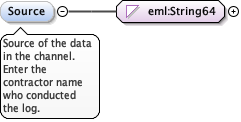
Source of the data in the channel. Enter the contractor name who conducted the log.
Diagram
DiagramBaseTypes_xsd_Simple_Type_eml_String64.tmp#String64
Type eml:String64
Type hierarchy
Properties
content simple
minOccurs 0
maxOccurs 1
Facets
maxLength 64
Source
<xs:element name="Source" type="eml:String64" minOccurs="0" maxOccurs="1">
  <xs:annotation>
    <xs:documentation>Source of the data in the channel. Enter the contractor name who conducted the log.</xs:documentation>
  </xs:annotation>
</xs:element>
Element witsml:Channel / witsml:Wellbore
Namespace http://www.energistics.org/energyml/data/witsmlv2
Diagram
DiagramObjectReference_xsd_Complex_Type_eml_DataObjectReference.tmp#DataObjectReference_ContentTypeObjectReference_xsd_Complex_Type_eml_DataObjectReference.tmp#DataObjectReference_TitleObjectReference_xsd_Complex_Type_eml_DataObjectReference.tmp#DataObjectReference_UuidObjectReference_xsd_Complex_Type_eml_DataObjectReference.tmp#DataObjectReference_UuidAuthorityObjectReference_xsd_Complex_Type_eml_DataObjectReference.tmp#DataObjectReference_UriObjectReference_xsd_Complex_Type_eml_DataObjectReference.tmp#DataObjectReference_VersionStringObjectReference_xsd_Complex_Type_eml_DataObjectReference.tmp#DataObjectReference
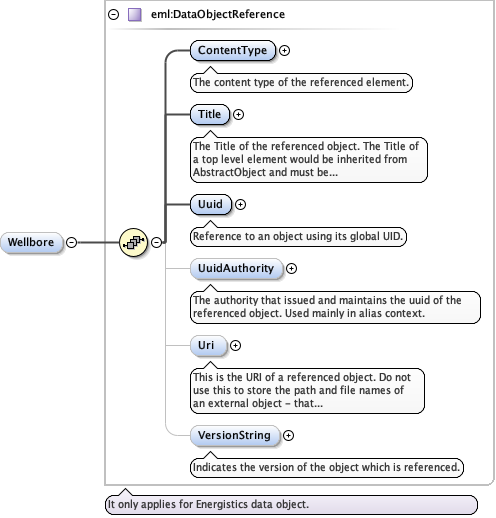
Type eml:DataObjectReference
Properties
content complex
minOccurs 0
maxOccurs 1
Model
Children eml:ContentType, eml:Title, eml:Uri, eml:Uuid, eml:UuidAuthority, eml:VersionString
Instance
<witsml:Wellbore xmlns:witsml="http://www.energistics.org/energyml/data/witsmlv2" xmlns:eml="http://www.energistics.org/energyml/data/commonv2">
  <eml:ContentType>{1,1}</eml:ContentType>
  <eml:Title>{1,1}</eml:Title>
  <eml:Uuid>{1,1}</eml:Uuid>
  <eml:UuidAuthority>{0,1}</eml:UuidAuthority>
  <eml:Uri>{0,1}</eml:Uri>
  <eml:VersionString>{0,1}</eml:VersionString>
</witsml:Wellbore>
Source
<xs:element name="Wellbore" type="eml:DataObjectReference" minOccurs="0" maxOccurs="1"/>
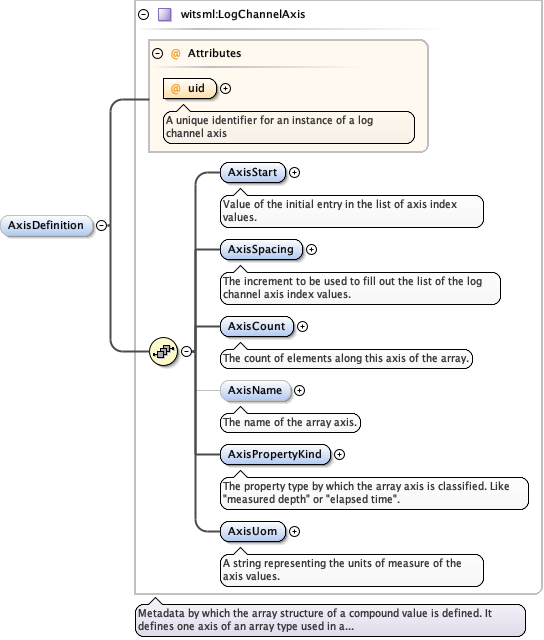
Element witsml:Channel / witsml:AxisDefinition
Namespace http://www.energistics.org/energyml/data/witsmlv2
Diagram
DiagramLog_xsd_Complex_Type_witsml_LogChannelAxis.tmp#LogChannelAxis_uidLog_xsd_Complex_Type_witsml_LogChannelAxis.tmp#LogChannelAxis_AxisStartLog_xsd_Complex_Type_witsml_LogChannelAxis.tmp#LogChannelAxis_AxisSpacingLog_xsd_Complex_Type_witsml_LogChannelAxis.tmp#LogChannelAxis_AxisCountLog_xsd_Complex_Type_witsml_LogChannelAxis.tmp#LogChannelAxis_AxisNameLog_xsd_Complex_Type_witsml_LogChannelAxis.tmp#LogChannelAxis_AxisPropertyKindLog_xsd_Complex_Type_witsml_LogChannelAxis.tmp#LogChannelAxis_AxisUomLog_xsd_Complex_Type_witsml_LogChannelAxis.tmp#LogChannelAxis
Type witsml:LogChannelAxis
Properties
content complex
minOccurs 0
maxOccurs unbounded
Model
Children witsml:AxisCount, witsml:AxisName, witsml:AxisPropertyKind, witsml:AxisSpacing, witsml:AxisStart, witsml:AxisUom
Instance
<witsml:AxisDefinition uid="" xmlns:witsml="http://www.energistics.org/energyml/data/witsmlv2">
  <witsml:AxisStart>{1,1}</witsml:AxisStart>
  <witsml:AxisSpacing>{1,1}</witsml:AxisSpacing>
  <witsml:AxisCount>{1,1}</witsml:AxisCount>
  <witsml:AxisName>{0,1}</witsml:AxisName>
  <witsml:AxisPropertyKind>{1,1}</witsml:AxisPropertyKind>
  <witsml:AxisUom>{1,1}</witsml:AxisUom>
</witsml:AxisDefinition>
Attributes
QName Type Use Annotation
uid eml:String64 required
A unique identifier for an instance of a log channel axis
Source
<xs:element name="AxisDefinition" type="witsml:LogChannelAxis" minOccurs="0" maxOccurs="unbounded"/>
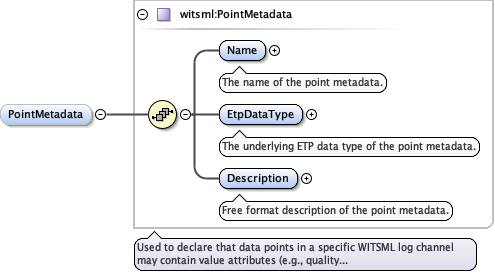
Element witsml:Channel / witsml:PointMetadata
Namespace http://www.energistics.org/energyml/data/witsmlv2
Diagram
DiagramLog_xsd_Complex_Type_witsml_PointMetadata.tmp#PointMetadata_NameLog_xsd_Complex_Type_witsml_PointMetadata.tmp#PointMetadata_EtpDataTypeLog_xsd_Complex_Type_witsml_PointMetadata.tmp#PointMetadata_DescriptionLog_xsd_Complex_Type_witsml_PointMetadata.tmp#PointMetadata
Type witsml:PointMetadata
Properties
content complex
minOccurs 0
maxOccurs unbounded
Model
Children witsml:Description, witsml:EtpDataType, witsml:Name
Instance
<witsml:PointMetadata xmlns:witsml="http://www.energistics.org/energyml/data/witsmlv2">
  <witsml:Name>{1,1}</witsml:Name>
  <witsml:EtpDataType>{1,1}</witsml:EtpDataType>
  <witsml:Description>{1,1}</witsml:Description>
</witsml:PointMetadata>
Source
<xs:element name="PointMetadata" type="witsml:PointMetadata" minOccurs="0" maxOccurs="unbounded"/>
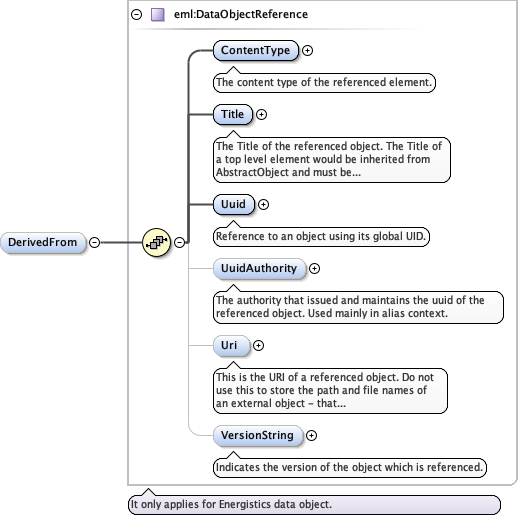
Element witsml:Channel / witsml:DerivedFrom
Namespace http://www.energistics.org/energyml/data/witsmlv2
Diagram
DiagramObjectReference_xsd_Complex_Type_eml_DataObjectReference.tmp#DataObjectReference_ContentTypeObjectReference_xsd_Complex_Type_eml_DataObjectReference.tmp#DataObjectReference_TitleObjectReference_xsd_Complex_Type_eml_DataObjectReference.tmp#DataObjectReference_UuidObjectReference_xsd_Complex_Type_eml_DataObjectReference.tmp#DataObjectReference_UuidAuthorityObjectReference_xsd_Complex_Type_eml_DataObjectReference.tmp#DataObjectReference_UriObjectReference_xsd_Complex_Type_eml_DataObjectReference.tmp#DataObjectReference_VersionStringObjectReference_xsd_Complex_Type_eml_DataObjectReference.tmp#DataObjectReference
Type eml:DataObjectReference
Properties
content complex
minOccurs 0
maxOccurs unbounded
Model
Children eml:ContentType, eml:Title, eml:Uri, eml:Uuid, eml:UuidAuthority, eml:VersionString
Instance
<witsml:DerivedFrom xmlns:witsml="http://www.energistics.org/energyml/data/witsmlv2" xmlns:eml="http://www.energistics.org/energyml/data/commonv2">
  <eml:ContentType>{1,1}</eml:ContentType>
  <eml:Title>{1,1}</eml:Title>
  <eml:Uuid>{1,1}</eml:Uuid>
  <eml:UuidAuthority>{0,1}</eml:UuidAuthority>
  <eml:Uri>{0,1}</eml:Uri>
  <eml:VersionString>{0,1}</eml:VersionString>
</witsml:DerivedFrom>
Source
<xs:element name="DerivedFrom" type="eml:DataObjectReference" minOccurs="0" maxOccurs="unbounded"/>
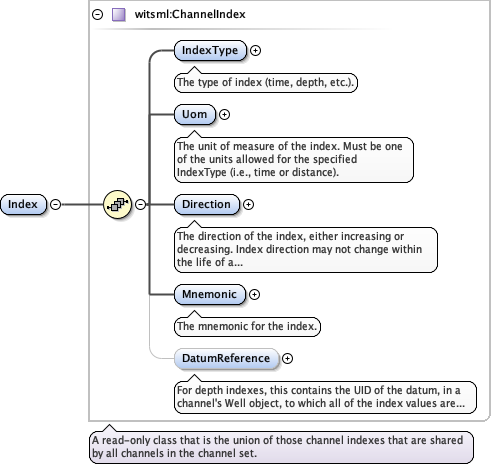
Element witsml:Channel / witsml:Index
Namespace http://www.energistics.org/energyml/data/witsmlv2
Diagram
DiagramLog_xsd_Complex_Type_witsml_ChannelIndex.tmp#ChannelIndex_IndexTypeLog_xsd_Complex_Type_witsml_ChannelIndex.tmp#ChannelIndex_UomLog_xsd_Complex_Type_witsml_ChannelIndex.tmp#ChannelIndex_DirectionLog_xsd_Complex_Type_witsml_ChannelIndex.tmp#ChannelIndex_MnemonicLog_xsd_Complex_Type_witsml_ChannelIndex.tmp#ChannelIndex_DatumReferenceLog_xsd_Complex_Type_witsml_ChannelIndex.tmp#ChannelIndex
Type witsml:ChannelIndex
Properties
content complex
minOccurs 1
maxOccurs unbounded
Model
Children witsml:DatumReference, witsml:Direction, witsml:IndexType, witsml:Mnemonic, witsml:Uom
Instance
<witsml:Index xmlns:witsml="http://www.energistics.org/energyml/data/witsmlv2">
  <witsml:IndexType>{1,1}</witsml:IndexType>
  <witsml:Uom>{1,1}</witsml:Uom>
  <witsml:Direction>{1,1}</witsml:Direction>
  <witsml:Mnemonic>{1,1}</witsml:Mnemonic>
  <witsml:DatumReference>{0,1}</witsml:DatumReference>
</witsml:Index>
Source
<xs:element name="Index" type="witsml:ChannelIndex" minOccurs="1" maxOccurs="unbounded"/>
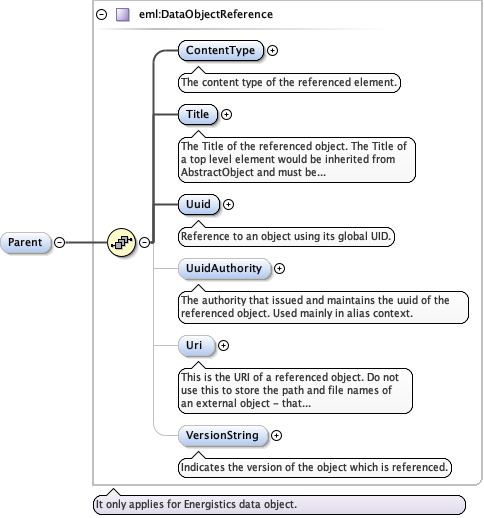
Element witsml:Channel / witsml:Parent
Namespace http://www.energistics.org/energyml/data/witsmlv2
Diagram
DiagramObjectReference_xsd_Complex_Type_eml_DataObjectReference.tmp#DataObjectReference_ContentTypeObjectReference_xsd_Complex_Type_eml_DataObjectReference.tmp#DataObjectReference_TitleObjectReference_xsd_Complex_Type_eml_DataObjectReference.tmp#DataObjectReference_UuidObjectReference_xsd_Complex_Type_eml_DataObjectReference.tmp#DataObjectReference_UuidAuthorityObjectReference_xsd_Complex_Type_eml_DataObjectReference.tmp#DataObjectReference_UriObjectReference_xsd_Complex_Type_eml_DataObjectReference.tmp#DataObjectReference_VersionStringObjectReference_xsd_Complex_Type_eml_DataObjectReference.tmp#DataObjectReference
Type eml:DataObjectReference
Properties
content complex
minOccurs 0
maxOccurs 1
Model
Children eml:ContentType, eml:Title, eml:Uri, eml:Uuid, eml:UuidAuthority, eml:VersionString
Instance
<witsml:Parent xmlns:witsml="http://www.energistics.org/energyml/data/witsmlv2" xmlns:eml="http://www.energistics.org/energyml/data/commonv2">
  <eml:ContentType>{1,1}</eml:ContentType>
  <eml:Title>{1,1}</eml:Title>
  <eml:Uuid>{1,1}</eml:Uuid>
  <eml:UuidAuthority>{0,1}</eml:UuidAuthority>
  <eml:Uri>{0,1}</eml:Uri>
  <eml:VersionString>{0,1}</eml:VersionString>
</witsml:Parent>
Source
<xs:element name="Parent" type="eml:DataObjectReference" minOccurs="0" maxOccurs="1"/>
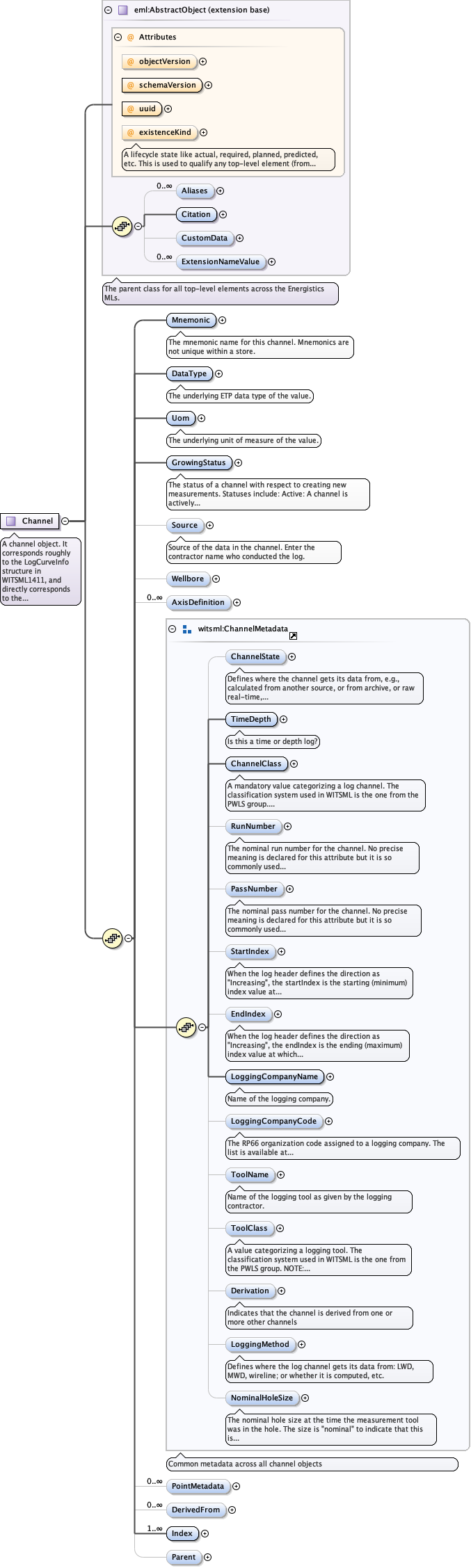
Complex Type witsml:Channel
Namespace http://www.energistics.org/energyml/data/witsmlv2
Annotations
A channel object. It corresponds roughly to the LogCurveInfo structure in WITSML1411, and directly corresponds to the ChannelMetadataRecord structure in ETP. In historian terminology, a channel corresponds directly to a tag.
Channels are the fundamental unit of organization for WITSML logs.
Diagram
DiagramAbstract_xsd_Complex_Type_eml_AbstractObject.tmp#http___www.energistics.org_energyml_data_commonv2_AbstractObject_objectVersionAbstract_xsd_Complex_Type_eml_AbstractObject.tmp#http___www.energistics.org_energyml_data_commonv2_AbstractObject_schemaVersionAbstract_xsd_Complex_Type_eml_AbstractObject.tmp#http___www.energistics.org_energyml_data_commonv2_AbstractObject_uuidAbstract_xsd_Complex_Type_eml_AbstractObject.tmp#http___www.energistics.org_energyml_data_commonv2_AbstractObject_existenceKindAbstract_xsd_Complex_Type_eml_AbstractObject.tmp#http___www.energistics.org_energyml_data_commonv2_AbstractObject_AliasesAbstract_xsd_Complex_Type_eml_AbstractObject.tmp#http___www.energistics.org_energyml_data_commonv2_AbstractObject_CitationAbstract_xsd_Complex_Type_eml_AbstractObject.tmp#http___www.energistics.org_energyml_data_commonv2_AbstractObject_CustomDataAbstract_xsd_Complex_Type_eml_AbstractObject.tmp#http___www.energistics.org_energyml_data_commonv2_AbstractObject_ExtensionNameValueAbstract_xsd_Complex_Type_eml_AbstractObject.tmp#http___www.energistics.org_energyml_data_commonv2_AbstractObjectLog_xsd_Complex_Type_witsml_Channel.tmp#http___www.energistics.org_energyml_data_witsmlv2_Channel_MnemonicLog_xsd_Complex_Type_witsml_Channel.tmp#http___www.energistics.org_energyml_data_witsmlv2_Channel_DataTypeLog_xsd_Complex_Type_witsml_Channel.tmp#http___www.energistics.org_energyml_data_witsmlv2_Channel_UomLog_xsd_Complex_Type_witsml_Channel.tmp#http___www.energistics.org_energyml_data_witsmlv2_Channel_GrowingStatusLog_xsd_Complex_Type_witsml_Channel.tmp#http___www.energistics.org_energyml_data_witsmlv2_Channel_SourceLog_xsd_Complex_Type_witsml_Channel.tmp#http___www.energistics.org_energyml_data_witsmlv2_Channel_WellboreLog_xsd_Complex_Type_witsml_Channel.tmp#http___www.energistics.org_energyml_data_witsmlv2_Channel_AxisDefinitionLog_xsd_Element_Group_witsml_ChannelMetadata.tmp#ChannelMetadata_ChannelStateLog_xsd_Element_Group_witsml_ChannelMetadata.tmp#ChannelMetadata_TimeDepthLog_xsd_Element_Group_witsml_ChannelMetadata.tmp#ChannelMetadata_ChannelClassLog_xsd_Element_Group_witsml_ChannelMetadata.tmp#ChannelMetadata_RunNumberLog_xsd_Element_Group_witsml_ChannelMetadata.tmp#ChannelMetadata_PassNumberLog_xsd_Element_Group_witsml_ChannelMetadata.tmp#ChannelMetadata_StartIndexLog_xsd_Element_Group_witsml_ChannelMetadata.tmp#ChannelMetadata_EndIndexLog_xsd_Element_Group_witsml_ChannelMetadata.tmp#ChannelMetadata_LoggingCompanyNameLog_xsd_Element_Group_witsml_ChannelMetadata.tmp#ChannelMetadata_LoggingCompanyCodeLog_xsd_Element_Group_witsml_ChannelMetadata.tmp#ChannelMetadata_ToolNameLog_xsd_Element_Group_witsml_ChannelMetadata.tmp#ChannelMetadata_ToolClassLog_xsd_Element_Group_witsml_ChannelMetadata.tmp#ChannelMetadata_DerivationLog_xsd_Element_Group_witsml_ChannelMetadata.tmp#ChannelMetadata_LoggingMethodLog_xsd_Element_Group_witsml_ChannelMetadata.tmp#ChannelMetadata_NominalHoleSizeLog_xsd_Element_Group_witsml_ChannelMetadata.tmp#ChannelMetadataLog_xsd_Complex_Type_witsml_Channel.tmp#http___www.energistics.org_energyml_data_witsmlv2_Channel_PointMetadataLog_xsd_Complex_Type_witsml_Channel.tmp#http___www.energistics.org_energyml_data_witsmlv2_Channel_DerivedFromLog_xsd_Complex_Type_witsml_Channel.tmp#http___www.energistics.org_energyml_data_witsmlv2_Channel_IndexLog_xsd_Complex_Type_witsml_Channel.tmp#http___www.energistics.org_energyml_data_witsmlv2_Channel_Parent
Type extension of eml:AbstractObject
Type hierarchy
Used by
Model
Children eml:Aliases, eml:Citation, eml:CustomData, eml:ExtensionNameValue, witsml:AxisDefinition, witsml:ChannelClass, witsml:ChannelState, witsml:DataType, witsml:Derivation, witsml:DerivedFrom, witsml:EndIndex, witsml:GrowingStatus, witsml:Index, witsml:LoggingCompanyCode, witsml:LoggingCompanyName, witsml:LoggingMethod, witsml:Mnemonic, witsml:NominalHoleSize, witsml:Parent, witsml:PassNumber, witsml:PointMetadata, witsml:RunNumber, witsml:Source, witsml:StartIndex, witsml:TimeDepth, witsml:ToolClass, witsml:ToolName, witsml:Uom, witsml:Wellbore
Attributes
QName Type Use Annotation
existenceKind eml:ExistenceKind optional
A lifecycle state like actual, required, planned, predicted, etc. This is used to qualify any top-level element (from Epicentre 2.1).
objectVersion eml:String64 optional
schemaVersion eml:String64 required
uuid eml:UuidString required
Source
<xs:complexType name="Channel">
  <xs:annotation>
    <xs:documentation>A channel object. It corresponds roughly to the LogCurveInfo structure in WITSML1411, and directly corresponds to the ChannelMetadataRecord structure in ETP. In historian terminology, a channel corresponds directly to a tag. Channels are the fundamental unit of organization for WITSML logs.</xs:documentation>
  </xs:annotation>
  <xs:complexContent>
    <xs:extension base="eml:AbstractObject">
      <xs:sequence>
        <xs:element name="Mnemonic" type="eml:String64" minOccurs="1" maxOccurs="1">
          <xs:annotation>
            <xs:documentation>The mnemonic name for this channel. Mnemonics are not unique within a store.</xs:documentation>
          </xs:annotation>
        </xs:element>
        <xs:element name="DataType" type="witsml:EtpDataType" minOccurs="1" maxOccurs="1">
          <xs:annotation>
            <xs:documentation>The underlying ETP data type of the value.</xs:documentation>
          </xs:annotation>
        </xs:element>
        <xs:element name="Uom" type="eml:UnitOfMeasureExt" minOccurs="1" maxOccurs="1">
          <xs:annotation>
            <xs:documentation>The underlying unit of measure of the value.</xs:documentation>
          </xs:annotation>
        </xs:element>
        <xs:element name="GrowingStatus" type="witsml:ChannelStatus" minOccurs="1" maxOccurs="1">
          <xs:annotation>
            <xs:documentation>The status of a channel with respect to creating new measurements. Statuses include: Active: A channel is actively producing data points. Inactive: A channel is offline or not currently producing, but may begin producing again in the future. Closed: A channel will never produce points again. The rules for when a channel is to be closed will vary some for different kinds of channels. For example, time-based surface channels may remain open for the entire life of the drilling operation, whereas depth-based wireline channels are closed at the end of the wireline job</xs:documentation>
          </xs:annotation>
        </xs:element>
        <xs:element name="Source" type="eml:String64" minOccurs="0" maxOccurs="1">
          <xs:annotation>
            <xs:documentation>Source of the data in the channel. Enter the contractor name who conducted the log.</xs:documentation>
          </xs:annotation>
        </xs:element>
        <xs:element name="Wellbore" type="eml:DataObjectReference" minOccurs="0" maxOccurs="1"/>
        <xs:element name="AxisDefinition" type="witsml:LogChannelAxis" minOccurs="0" maxOccurs="unbounded"/>
        <xs:group ref="witsml:ChannelMetadata" minOccurs="1" maxOccurs="1"/>
        <xs:element name="PointMetadata" type="witsml:PointMetadata" minOccurs="0" maxOccurs="unbounded"/>
        <xs:element name="DerivedFrom" type="eml:DataObjectReference" minOccurs="0" maxOccurs="unbounded"/>
        <xs:element name="Index" type="witsml:ChannelIndex" minOccurs="1" maxOccurs="unbounded"/>
        <xs:element name="Parent" type="eml:DataObjectReference" minOccurs="0" maxOccurs="1"/>
      </xs:sequence>
    </xs:extension>
  </xs:complexContent>
</xs:complexType>