Showing:

Annotations
Attributes
Diagrams
Instances
Model
Properties
Source
Used by
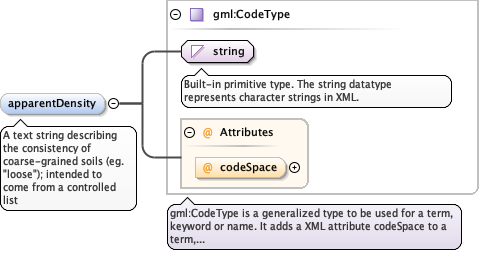
Element diggs:FieldPropertiesType / diggs:apparentDensity
Namespace http://diggsml.org/schemas/2.6
Annotations
A text string describing the consistency of
coarse-grained soils (eg. "loose"); intended to come from a
controlled list
Diagram
Diagramgml3_2Profile_diggs_xsd_Complex_Type_gml_CodeType.tmp#CodeType_codeSpacegml3_2Profile_diggs_xsd_Complex_Type_gml_CodeType.tmp#CodeType
Type gml:CodeType
Properties
content complex
minOccurs 0
Attributes
QName Type Use
codeSpace anyURI optional
Source
<element name="apparentDensity" type="gml:CodeType" minOccurs="0">
  <annotation>
    <documentation>A text string describing the consistency of coarse-grained soils (eg. "loose"); intended to come from a controlled list</documentation>
  </annotation>
</element>
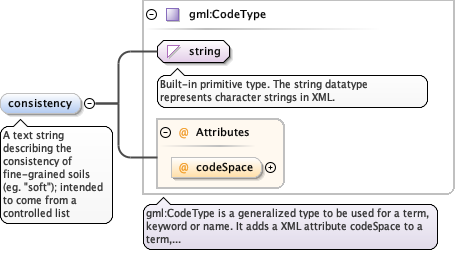
Element diggs:FieldPropertiesType / diggs:consistency
Namespace http://diggsml.org/schemas/2.6
Annotations
A text string describing the consistency of
fine-grained soils (eg. "soft"); intended to come from a
controlled list
Diagram
Diagramgml3_2Profile_diggs_xsd_Complex_Type_gml_CodeType.tmp#CodeType_codeSpacegml3_2Profile_diggs_xsd_Complex_Type_gml_CodeType.tmp#CodeType
Type gml:CodeType
Properties
content complex
minOccurs 0
Attributes
QName Type Use
codeSpace anyURI optional
Source
<element name="consistency" type="gml:CodeType" minOccurs="0">
  <annotation>
    <documentation>A text string describing the consistency of fine-grained soils (eg. "soft"); intended to come from a controlled list</documentation>
  </annotation>
</element>
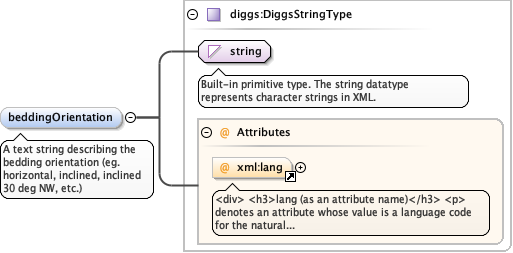
Element diggs:FieldPropertiesType / diggs:beddingOrientation
Namespace http://diggsml.org/schemas/2.6
Annotations
A text string describing the bedding orientation (eg.
horizontal, inclined, inclined 30 deg NW, etc.)
Diagram
Diagramxml_xsd_Attribute_xml_lang.tmp#langKernel_xsd_Complex_Type_diggs_DiggsStringType.tmp#DiggsStringType
Type diggs:DiggsStringType
Properties
content complex
minOccurs 0
mixed true
Attributes
QName Type Use Annotation
xml:lang union of(xs:language, restriction of xs:string) optional
<div>
  <h3>lang (as an attribute name)</h3>
  <p>denotes an attribute whose value is a language code for the natural language of the content of any element; its value is inherited. This name is reserved by virtue of its definition in the XML specification.</p>
</div>
<div>
  <h4>Notes</h4>
  <p>Attempting to install the relevant ISO 2- and 3-letter codes as the enumerated possible values is probably never going to be a realistic possibility.</p>
  <p>See BCP 47 at
    <a href="http://www.rfc-editor.org/rfc/bcp/bcp47.txt">http://www.rfc-editor.org/rfc/bcp/bcp47.txt</a>and the IANA language subtag registry at
    <a href="http://www.iana.org/assignments/language-subtag-registry">http://www.iana.org/assignments/language-subtag-registry</a>for further information.</p>
  <p>The union allows for the 'un-declaration' of xml:lang with the empty string.</p>
</div>
Source
<element name="beddingOrientation" type="diggs:DiggsStringType" minOccurs="0">
  <annotation>
    <documentation>A text string describing the bedding orientation (eg. horizontal, inclined, inclined 30 deg NW, etc.)</documentation>
  </annotation>
</element>
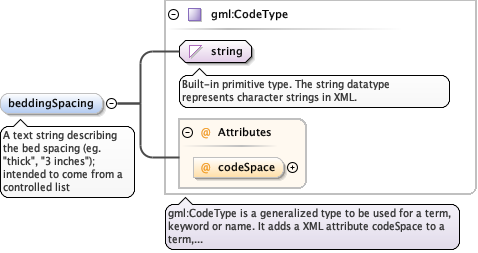
Element diggs:FieldPropertiesType / diggs:beddingSpacing
Namespace http://diggsml.org/schemas/2.6
Annotations
A text string describing the bed spacing (eg. "thick", "3
inches"); intended to come from a controlled list
Diagram
Diagramgml3_2Profile_diggs_xsd_Complex_Type_gml_CodeType.tmp#CodeType_codeSpacegml3_2Profile_diggs_xsd_Complex_Type_gml_CodeType.tmp#CodeType
Type gml:CodeType
Properties
content complex
minOccurs 0
Attributes
QName Type Use
codeSpace anyURI optional
Source
<element name="beddingSpacing" type="gml:CodeType" minOccurs="0">
  <annotation>
    <documentation>A text string describing the bed spacing (eg. "thick", "3 inches"); intended to come from a controlled list</documentation>
  </annotation>
</element>
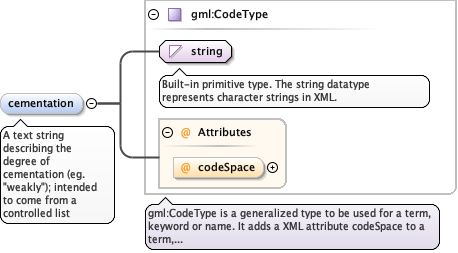
Element diggs:FieldPropertiesType / diggs:cementation
Namespace http://diggsml.org/schemas/2.6
Annotations
A text string describing the degree of cementation (eg.
"weakly"); intended to come from a controlled list
Diagram
Diagramgml3_2Profile_diggs_xsd_Complex_Type_gml_CodeType.tmp#CodeType_codeSpacegml3_2Profile_diggs_xsd_Complex_Type_gml_CodeType.tmp#CodeType
Type gml:CodeType
Properties
content complex
minOccurs 0
Attributes
QName Type Use
codeSpace anyURI optional
Source
<element name="cementation" type="gml:CodeType" minOccurs="0">
  <annotation>
    <documentation>A text string describing the degree of cementation (eg. "weakly"); intended to come from a controlled list</documentation>
  </annotation>
</element>
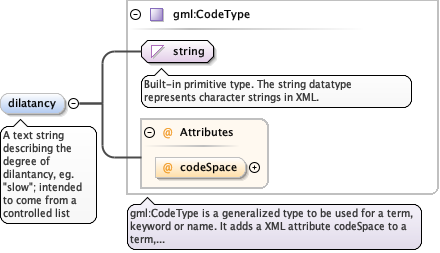
Element diggs:FieldPropertiesType / diggs:dilatancy
Namespace http://diggsml.org/schemas/2.6
Annotations
A text string describing the degree of dilantancy, eg.
"slow"; intended to come from a controlled list
Diagram
Diagramgml3_2Profile_diggs_xsd_Complex_Type_gml_CodeType.tmp#CodeType_codeSpacegml3_2Profile_diggs_xsd_Complex_Type_gml_CodeType.tmp#CodeType
Type gml:CodeType
Properties
content complex
minOccurs 0
Attributes
QName Type Use
codeSpace anyURI optional
Source
<element name="dilatancy" type="gml:CodeType" minOccurs="0">
  <annotation>
    <documentation>A text string describing the degree of dilantancy, eg. "slow"; intended to come from a controlled list</documentation>
  </annotation>
</element>
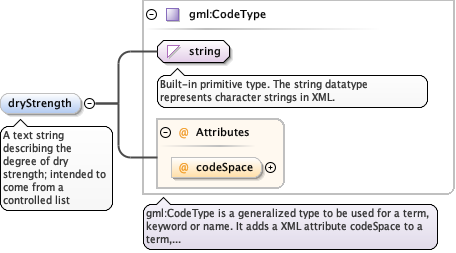
Element diggs:FieldPropertiesType / diggs:dryStrength
Namespace http://diggsml.org/schemas/2.6
Annotations
A text string describing the degree of dry strength;
intended to come from a controlled list
Diagram
Diagramgml3_2Profile_diggs_xsd_Complex_Type_gml_CodeType.tmp#CodeType_codeSpacegml3_2Profile_diggs_xsd_Complex_Type_gml_CodeType.tmp#CodeType
Type gml:CodeType
Properties
content complex
minOccurs 0
Attributes
QName Type Use
codeSpace anyURI optional
Source
<element name="dryStrength" type="gml:CodeType" minOccurs="0">
  <annotation>
    <documentation>A text string describing the degree of dry strength; intended to come from a controlled list</documentation>
  </annotation>
</element>
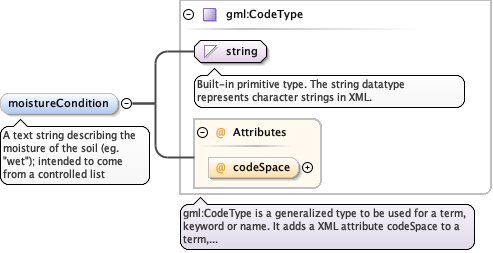
Element diggs:FieldPropertiesType / diggs:moistureCondition
Namespace http://diggsml.org/schemas/2.6
Annotations
A text string describing the moisture of the soil (eg.
"wet"); intended to come from a controlled list
Diagram
Diagramgml3_2Profile_diggs_xsd_Complex_Type_gml_CodeType.tmp#CodeType_codeSpacegml3_2Profile_diggs_xsd_Complex_Type_gml_CodeType.tmp#CodeType
Type gml:CodeType
Properties
content complex
minOccurs 0
Attributes
QName Type Use
codeSpace anyURI optional
Source
<element name="moistureCondition" type="gml:CodeType" minOccurs="0">
  <annotation>
    <documentation>A text string describing the moisture of the soil (eg. "wet"); intended to come from a controlled list</documentation>
  </annotation>
</element>
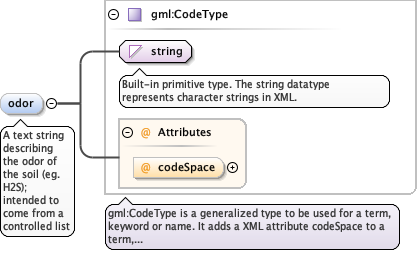
Element diggs:FieldPropertiesType / diggs:odor
Namespace http://diggsml.org/schemas/2.6
Annotations
A text string describing the odor of the soil (eg. H2S);
intended to come from a controlled list
Diagram
Diagramgml3_2Profile_diggs_xsd_Complex_Type_gml_CodeType.tmp#CodeType_codeSpacegml3_2Profile_diggs_xsd_Complex_Type_gml_CodeType.tmp#CodeType
Type gml:CodeType
Properties
content complex
minOccurs 0
Attributes
QName Type Use
codeSpace anyURI optional
Source
<element name="odor" type="gml:CodeType" minOccurs="0">
  <annotation>
    <documentation>A text string describing the odor of the soil (eg. H2S); intended to come from a controlled list</documentation>
  </annotation>
</element>
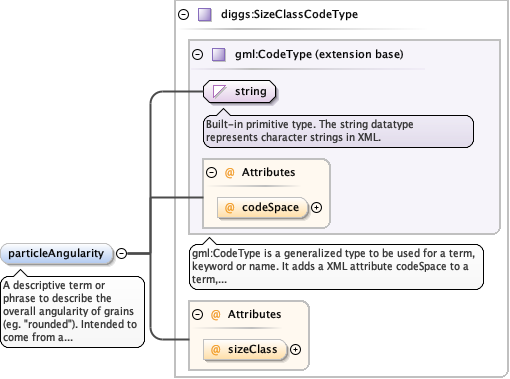
Element diggs:FieldPropertiesType / diggs:particleAngularity
Namespace http://diggsml.org/schemas/2.6
Annotations
A descriptive term or phrase to describe the overall
angularity of grains (eg. "rounded"). Intended to come from a
controlled list.
Diagram
Diagramgml3_2Profile_diggs_xsd_Complex_Type_gml_CodeType.tmp#CodeType_codeSpacegml3_2Profile_diggs_xsd_Complex_Type_gml_CodeType.tmp#CodeTypeKernel_xsd_Complex_Type_diggs_SizeClassCodeType.tmp#SizeClassCodeType_sizeClassKernel_xsd_Complex_Type_diggs_SizeClassCodeType.tmp#SizeClassCodeType
Type diggs:SizeClassCodeType
Type hierarchy
Properties
content complex
minOccurs 0
maxOccurs unbounded
Attributes
QName Type Use
codeSpace anyURI optional
sizeClass diggs:SizeClassEnumExtType optional
Source
<element minOccurs="0" name="particleAngularity" type="diggs:SizeClassCodeType" maxOccurs="unbounded">
  <annotation>
    <documentation>A descriptive term or phrase to describe the overall angularity of grains (eg. "rounded"). Intended to come from a controlled list.</documentation>
  </annotation>
</element>
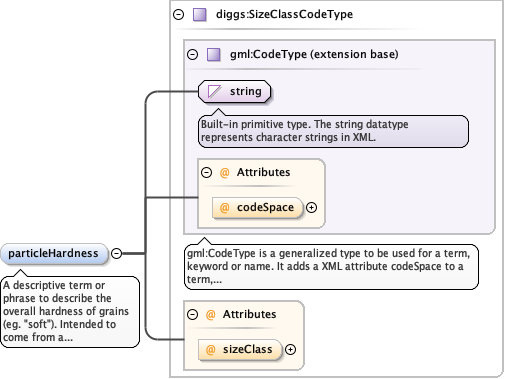
Element diggs:FieldPropertiesType / diggs:particleHardness
Namespace http://diggsml.org/schemas/2.6
Annotations
A descriptive term or phrase to describe the overall
hardness of grains (eg. "soft"). Intended to come from a
controlled list.
Diagram
Diagramgml3_2Profile_diggs_xsd_Complex_Type_gml_CodeType.tmp#CodeType_codeSpacegml3_2Profile_diggs_xsd_Complex_Type_gml_CodeType.tmp#CodeTypeKernel_xsd_Complex_Type_diggs_SizeClassCodeType.tmp#SizeClassCodeType_sizeClassKernel_xsd_Complex_Type_diggs_SizeClassCodeType.tmp#SizeClassCodeType
Type diggs:SizeClassCodeType
Type hierarchy
Properties
content complex
minOccurs 0
maxOccurs unbounded
Attributes
QName Type Use
codeSpace anyURI optional
sizeClass diggs:SizeClassEnumExtType optional
Source
<element minOccurs="0" name="particleHardness" type="diggs:SizeClassCodeType" maxOccurs="unbounded">
  <annotation>
    <documentation>A descriptive term or phrase to describe the overall hardness of grains (eg. "soft"). Intended to come from a controlled list.</documentation>
  </annotation>
</element>
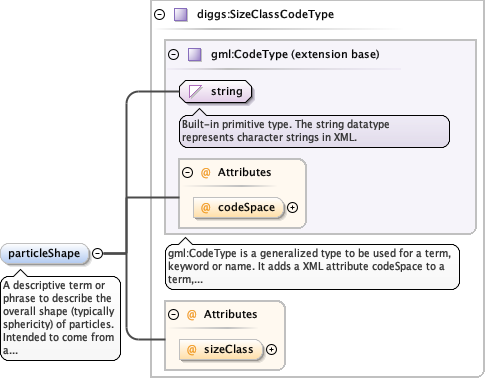
Element diggs:FieldPropertiesType / diggs:particleShape
Namespace http://diggsml.org/schemas/2.6
Annotations
A descriptive term or phrase to describe the overall
shape (typically sphericity) of particles. Intended to come from a
controlled list.
Diagram
Diagramgml3_2Profile_diggs_xsd_Complex_Type_gml_CodeType.tmp#CodeType_codeSpacegml3_2Profile_diggs_xsd_Complex_Type_gml_CodeType.tmp#CodeTypeKernel_xsd_Complex_Type_diggs_SizeClassCodeType.tmp#SizeClassCodeType_sizeClassKernel_xsd_Complex_Type_diggs_SizeClassCodeType.tmp#SizeClassCodeType
Type diggs:SizeClassCodeType
Type hierarchy
Properties
content complex
minOccurs 0
maxOccurs unbounded
Attributes
QName Type Use
codeSpace anyURI optional
sizeClass diggs:SizeClassEnumExtType optional
Source
<element minOccurs="0" name="particleShape" type="diggs:SizeClassCodeType" maxOccurs="unbounded">
  <annotation>
    <documentation>A descriptive term or phrase to describe the overall shape (typically sphericity) of particles. Intended to come from a controlled list.</documentation>
  </annotation>
</element>
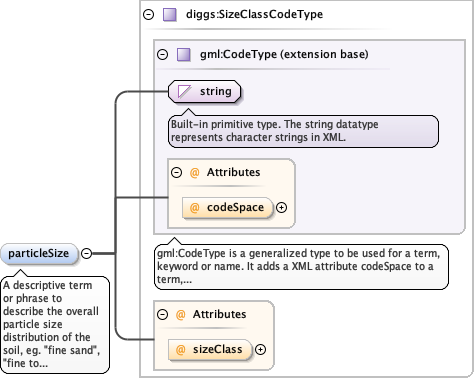
Element diggs:FieldPropertiesType / diggs:particleSize
Namespace http://diggsml.org/schemas/2.6
Annotations
A descriptive term or phrase to describe the overall
particle size distribution of the soil, eg. "fine sand", "fine to
coarse". "silt and very fine sand". Intended to come from a
controlled list.
Diagram
Diagramgml3_2Profile_diggs_xsd_Complex_Type_gml_CodeType.tmp#CodeType_codeSpacegml3_2Profile_diggs_xsd_Complex_Type_gml_CodeType.tmp#CodeTypeKernel_xsd_Complex_Type_diggs_SizeClassCodeType.tmp#SizeClassCodeType_sizeClassKernel_xsd_Complex_Type_diggs_SizeClassCodeType.tmp#SizeClassCodeType
Type diggs:SizeClassCodeType
Type hierarchy
Properties
content complex
minOccurs 0
maxOccurs unbounded
Attributes
QName Type Use
codeSpace anyURI optional
sizeClass diggs:SizeClassEnumExtType optional
Source
<element minOccurs="0" name="particleSize" type="diggs:SizeClassCodeType" maxOccurs="unbounded">
  <annotation>
    <documentation>A descriptive term or phrase to describe the overall particle size distribution of the soil, eg. "fine sand", "fine to coarse". "silt and very fine sand". Intended to come from a controlled list.</documentation>
  </annotation>
</element>
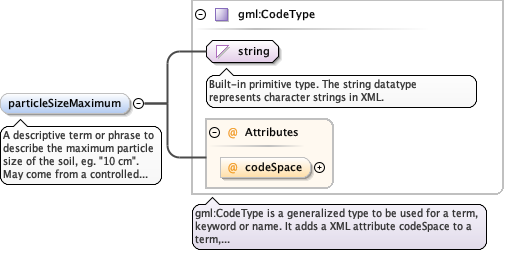
Element diggs:FieldPropertiesType / diggs:particleSizeMaximum
Namespace http://diggsml.org/schemas/2.6
Annotations
A descriptive term or phrase to describe the maximum particle size of the soil, eg. "10 cm". May come from a controlled list.
Diagram
Diagramgml3_2Profile_diggs_xsd_Complex_Type_gml_CodeType.tmp#CodeType_codeSpacegml3_2Profile_diggs_xsd_Complex_Type_gml_CodeType.tmp#CodeType
Type gml:CodeType
Properties
content complex
minOccurs 0
Attributes
QName Type Use
codeSpace anyURI optional
Source
<element minOccurs="0" name="particleSizeMaximum" type="gml:CodeType">
  <annotation>
    <documentation>A descriptive term or phrase to describe the maximum particle size of the soil, eg. "10 cm". May come from a controlled list.</documentation>
  </annotation>
</element>
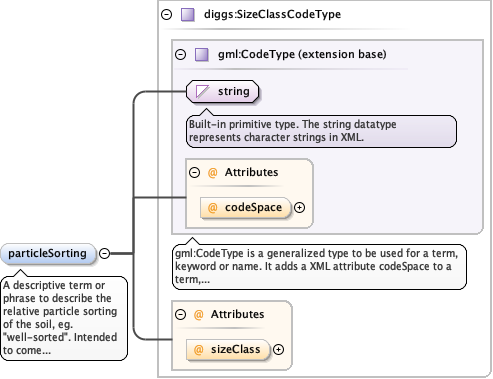
Element diggs:FieldPropertiesType / diggs:particleSorting
Namespace http://diggsml.org/schemas/2.6
Annotations
A descriptive term or phrase to describe the relative
particle sorting of the soil, eg. "well-sorted". Intended to come
from a controlled list.
Diagram
Diagramgml3_2Profile_diggs_xsd_Complex_Type_gml_CodeType.tmp#CodeType_codeSpacegml3_2Profile_diggs_xsd_Complex_Type_gml_CodeType.tmp#CodeTypeKernel_xsd_Complex_Type_diggs_SizeClassCodeType.tmp#SizeClassCodeType_sizeClassKernel_xsd_Complex_Type_diggs_SizeClassCodeType.tmp#SizeClassCodeType
Type diggs:SizeClassCodeType
Type hierarchy
Properties
content complex
minOccurs 0
maxOccurs unbounded
Attributes
QName Type Use
codeSpace anyURI optional
sizeClass diggs:SizeClassEnumExtType optional
Source
<element minOccurs="0" name="particleSorting" type="diggs:SizeClassCodeType" maxOccurs="unbounded">
  <annotation>
    <documentation>A descriptive term or phrase to describe the relative particle sorting of the soil, eg. "well-sorted". Intended to come from a controlled list.</documentation>
  </annotation>
</element>
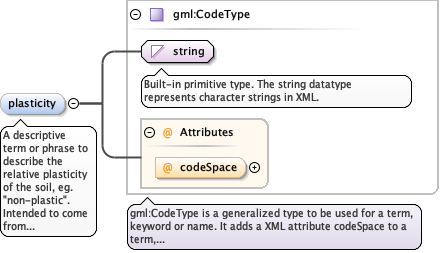
Element diggs:FieldPropertiesType / diggs:plasticity
Namespace http://diggsml.org/schemas/2.6
Annotations
A descriptive term or phrase to describe the relative
plasticity of the soil, eg. "non-plastic". Intended to come from a
controlled list.
Diagram
Diagramgml3_2Profile_diggs_xsd_Complex_Type_gml_CodeType.tmp#CodeType_codeSpacegml3_2Profile_diggs_xsd_Complex_Type_gml_CodeType.tmp#CodeType
Type gml:CodeType
Properties
content complex
minOccurs 0
Attributes
QName Type Use
codeSpace anyURI optional
Source
<element minOccurs="0" name="plasticity" type="gml:CodeType">
  <annotation>
    <documentation>A descriptive term or phrase to describe the relative plasticity of the soil, eg. "non-plastic". Intended to come from a controlled list.</documentation>
  </annotation>
</element>
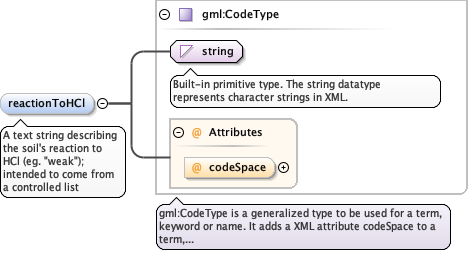
Element diggs:FieldPropertiesType / diggs:reactionToHCl
Namespace http://diggsml.org/schemas/2.6
Annotations
A text string describing the soil's reaction to HCl (eg.
"weak"); intended to come from a controlled list
Diagram
Diagramgml3_2Profile_diggs_xsd_Complex_Type_gml_CodeType.tmp#CodeType_codeSpacegml3_2Profile_diggs_xsd_Complex_Type_gml_CodeType.tmp#CodeType
Type gml:CodeType
Properties
content complex
minOccurs 0
Attributes
QName Type Use
codeSpace anyURI optional
Source
<element name="reactionToHCl" type="gml:CodeType" minOccurs="0">
  <annotation>
    <documentation>A text string describing the soil's reaction to HCl (eg. "weak"); intended to come from a controlled list</documentation>
  </annotation>
</element>
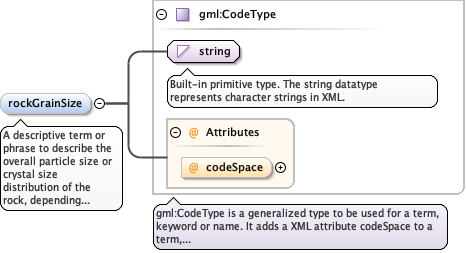
Element diggs:FieldPropertiesType / diggs:rockGrainSize
Namespace http://diggsml.org/schemas/2.6
Annotations
A descriptive term or phrase to describe the overall
particle size or crystal size distribution of the rock, depending on rock origin. For example, for cystalline igneous or metamorphic rocks, terms such as pegmatitic or aphanitic may be used. For clastic sedimentary rocks, terms such as fine sand or cobbles may be used, and for pyroclastic igneous rocks, terms such as "coarse ash" or "lapili" may be used. Intended to come from a controlled list of terms.
Diagram
Diagramgml3_2Profile_diggs_xsd_Complex_Type_gml_CodeType.tmp#CodeType_codeSpacegml3_2Profile_diggs_xsd_Complex_Type_gml_CodeType.tmp#CodeType
Type gml:CodeType
Properties
content complex
minOccurs 0
Attributes
QName Type Use
codeSpace anyURI optional
Source
<element minOccurs="0" name="rockGrainSize" type="gml:CodeType">
  <annotation>
    <documentation>A descriptive term or phrase to describe the overall particle size or crystal size distribution of the rock, depending on rock origin. For example, for cystalline igneous or metamorphic rocks, terms such as pegmatitic or aphanitic may be used. For clastic sedimentary rocks, terms such as fine sand or cobbles may be used, and for pyroclastic igneous rocks, terms such as "coarse ash" or "lapili" may be used. Intended to come from a controlled list of terms.</documentation>
  </annotation>
</element>
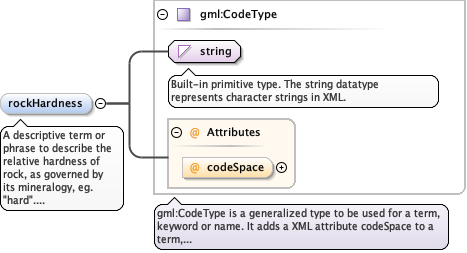
Element diggs:FieldPropertiesType / diggs:rockHardness
Namespace http://diggsml.org/schemas/2.6
Annotations
A descriptive term or phrase to describe the relative
hardness of rock, as governed by its mineralogy, eg. "hard".
Intended to come from a controlled list.
Diagram
Diagramgml3_2Profile_diggs_xsd_Complex_Type_gml_CodeType.tmp#CodeType_codeSpacegml3_2Profile_diggs_xsd_Complex_Type_gml_CodeType.tmp#CodeType
Type gml:CodeType
Properties
content complex
minOccurs 0
Attributes
QName Type Use
codeSpace anyURI optional
Source
<element minOccurs="0" name="rockHardness" type="gml:CodeType">
  <annotation>
    <documentation>A descriptive term or phrase to describe the relative hardness of rock, as governed by its mineralogy, eg. "hard". Intended to come from a controlled list.</documentation>
  </annotation>
</element>
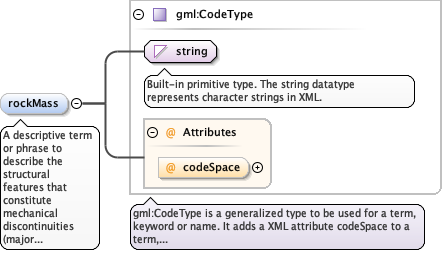
Element diggs:FieldPropertiesType / diggs:rockMass
Namespace http://diggsml.org/schemas/2.6
Annotations
A descriptive term or phrase to describe the structural features that constitute mechanical discontinuities (major geological features). Rock mass refers to any in situ rock with all inherent geomechanical discontinuities (eg. fissile, blocky, fractured, etc.)
Diagram
Diagramgml3_2Profile_diggs_xsd_Complex_Type_gml_CodeType.tmp#CodeType_codeSpacegml3_2Profile_diggs_xsd_Complex_Type_gml_CodeType.tmp#CodeType
Type gml:CodeType
Properties
content complex
minOccurs 0
Attributes
QName Type Use
codeSpace anyURI optional
Source
<element minOccurs="0" name="rockMass" type="gml:CodeType">
  <annotation>
    <documentation>A descriptive term or phrase to describe the structural features that constitute mechanical discontinuities (major geological features). Rock mass refers to any in situ rock with all inherent geomechanical discontinuities (eg. fissile, blocky, fractured, etc.)</documentation>
  </annotation>
</element>
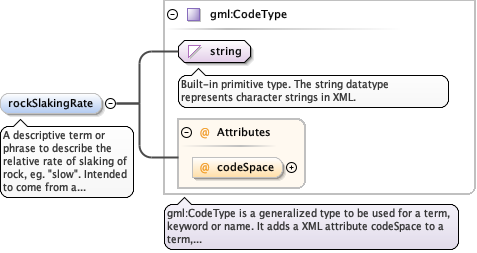
Element diggs:FieldPropertiesType / diggs:rockSlakingRate
Namespace http://diggsml.org/schemas/2.6
Annotations
A descriptive term or phrase to describe the relative
rate of slaking of rock, eg. "slow". Intended to come from a
controlled list.
Diagram
Diagramgml3_2Profile_diggs_xsd_Complex_Type_gml_CodeType.tmp#CodeType_codeSpacegml3_2Profile_diggs_xsd_Complex_Type_gml_CodeType.tmp#CodeType
Type gml:CodeType
Properties
content complex
minOccurs 0
Attributes
QName Type Use
codeSpace anyURI optional
Source
<element minOccurs="0" name="rockSlakingRate" type="gml:CodeType">
  <annotation>
    <documentation>A descriptive term or phrase to describe the relative rate of slaking of rock, eg. "slow". Intended to come from a controlled list.</documentation>
  </annotation>
</element>
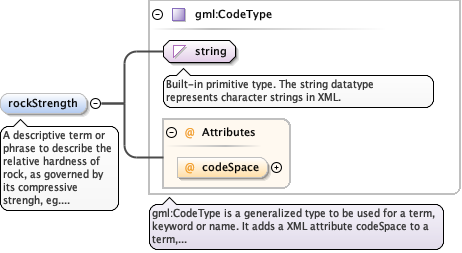
Element diggs:FieldPropertiesType / diggs:rockStrength
Namespace http://diggsml.org/schemas/2.6
Annotations
A descriptive term or phrase to describe the relative
hardness of rock, as governed by its compressive strengh, eg.
"strong". Intended to come from a controlled list.
Diagram
Diagramgml3_2Profile_diggs_xsd_Complex_Type_gml_CodeType.tmp#CodeType_codeSpacegml3_2Profile_diggs_xsd_Complex_Type_gml_CodeType.tmp#CodeType
Type gml:CodeType
Properties
content complex
minOccurs 0
Attributes
QName Type Use
codeSpace anyURI optional
Source
<element minOccurs="0" name="rockStrength" type="gml:CodeType">
  <annotation>
    <documentation>A descriptive term or phrase to describe the relative hardness of rock, as governed by its compressive strengh, eg. "strong". Intended to come from a controlled list.</documentation>
  </annotation>
</element>
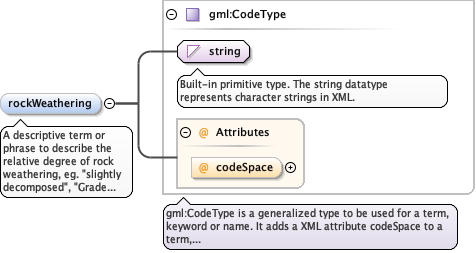
Element diggs:FieldPropertiesType / diggs:rockWeathering
Namespace http://diggsml.org/schemas/2.6
Annotations
A descriptive term or phrase to describe the relative
degree of rock weathering, eg. "slightly decomposed", "Grade III", etc.
Intended to come from a controlled list.
Diagram
Diagramgml3_2Profile_diggs_xsd_Complex_Type_gml_CodeType.tmp#CodeType_codeSpacegml3_2Profile_diggs_xsd_Complex_Type_gml_CodeType.tmp#CodeType
Type gml:CodeType
Properties
content complex
minOccurs 0
Attributes
QName Type Use
codeSpace anyURI optional
Source
<element minOccurs="0" name="rockWeathering" type="gml:CodeType">
  <annotation>
    <documentation>A descriptive term or phrase to describe the relative degree of rock weathering, eg. "slightly decomposed", "Grade III", etc. Intended to come from a controlled list.</documentation>
  </annotation>
</element>
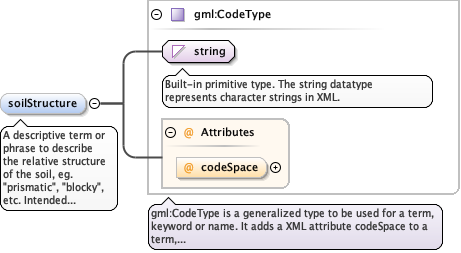
Element diggs:FieldPropertiesType / diggs:soilStructure
Namespace http://diggsml.org/schemas/2.6
Annotations
A descriptive term or phrase to describe the relative
structure of the soil, eg. "prismatic", "blocky", etc. Intended to
come from a controlled list.
Diagram
Diagramgml3_2Profile_diggs_xsd_Complex_Type_gml_CodeType.tmp#CodeType_codeSpacegml3_2Profile_diggs_xsd_Complex_Type_gml_CodeType.tmp#CodeType
Type gml:CodeType
Properties
content complex
minOccurs 0
Attributes
QName Type Use
codeSpace anyURI optional
Source
<element minOccurs="0" name="soilStructure" type="gml:CodeType">
  <annotation>
    <documentation>A descriptive term or phrase to describe the relative structure of the soil, eg. "prismatic", "blocky", etc. Intended to come from a controlled list.</documentation>
  </annotation>
</element>
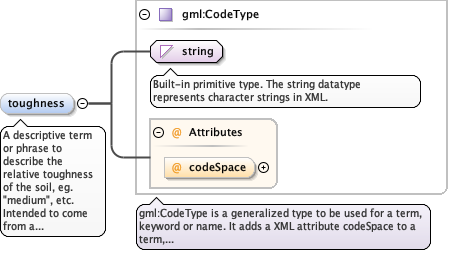
Element diggs:FieldPropertiesType / diggs:toughness
Namespace http://diggsml.org/schemas/2.6
Annotations
A descriptive term or phrase to describe the relative
toughness of the soil, eg. "medium", etc. Intended to come from a
controlled list.
Diagram
Diagramgml3_2Profile_diggs_xsd_Complex_Type_gml_CodeType.tmp#CodeType_codeSpacegml3_2Profile_diggs_xsd_Complex_Type_gml_CodeType.tmp#CodeType
Type gml:CodeType
Properties
content complex
minOccurs 0
Attributes
QName Type Use
codeSpace anyURI optional
Source
<element minOccurs="0" name="toughness" type="gml:CodeType">
  <annotation>
    <documentation>A descriptive term or phrase to describe the relative toughness of the soil, eg. "medium", etc. Intended to come from a controlled list.</documentation>
  </annotation>
</element>
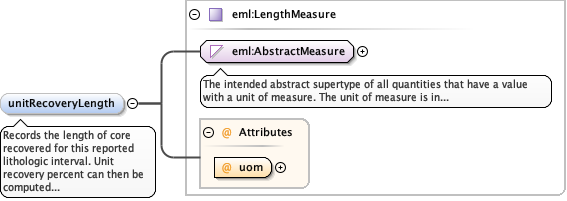
Element diggs:FieldPropertiesType / diggs:unitRecoveryLength
Namespace http://diggsml.org/schemas/2.6
Annotations
Records the length of core recovered for this reported
lithologic interval. Unit recovery percent can then be computed by
dividing this value by the interval thickness.
Diagram
DiagramBaseTypes_xsd_Simple_Type_eml_AbstractMeasure.tmp#AbstractMeasureMeasureType_xsd_Complex_Type_eml_LengthMeasure.tmp#LengthMeasure_uomMeasureType_xsd_Complex_Type_eml_LengthMeasure.tmp#LengthMeasure
Type eml:LengthMeasure
Type hierarchy
Properties
content complex
minOccurs 0
Attributes
QName Type Use
uom eml:LengthUom required
Source
<element minOccurs="0" name="unitRecoveryLength" type="eml:LengthMeasure">
  <annotation>
    <documentation>Records the length of core recovered for this reported lithologic interval. Unit recovery percent can then be computed by dividing this value by the interval thickness.</documentation>
  </annotation>
</element>
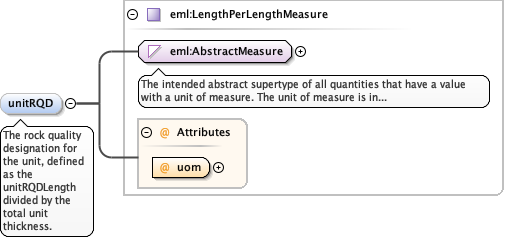
Element diggs:FieldPropertiesType / diggs:unitRQD
Namespace http://diggsml.org/schemas/2.6
Annotations
The rock quality designation for the unit, defined as the unitRQDLength divided by the total unit thickness.
Diagram
DiagramBaseTypes_xsd_Simple_Type_eml_AbstractMeasure.tmp#AbstractMeasureMeasureType_xsd_Complex_Type_eml_LengthPerLengthMeasure.tmp#LengthPerLengthMeasure_uomMeasureType_xsd_Complex_Type_eml_LengthPerLengthMeasure.tmp#LengthPerLengthMeasure
Type eml:LengthPerLengthMeasure
Type hierarchy
Properties
content complex
minOccurs 0
Attributes
QName Type Use
uom eml:LengthPerLengthUom required
Source
<element minOccurs="0" name="unitRQD" type="eml:LengthPerLengthMeasure">
  <annotation>
    <documentation>The rock quality designation for the unit, defined as the unitRQDLength divided by the total unit thickness.</documentation>
  </annotation>
</element>
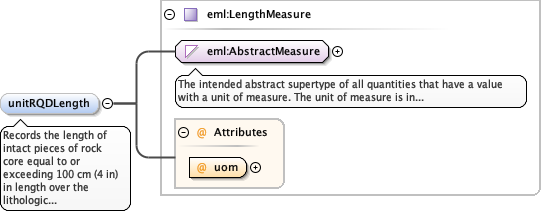
Element diggs:FieldPropertiesType / diggs:unitRQDLength
Namespace http://diggsml.org/schemas/2.6
Annotations
Records the length of intact pieces of rock core equal to
or exceeding 100 cm (4 in) in length over the lithologic
interval.
Diagram
DiagramBaseTypes_xsd_Simple_Type_eml_AbstractMeasure.tmp#AbstractMeasureMeasureType_xsd_Complex_Type_eml_LengthMeasure.tmp#LengthMeasure_uomMeasureType_xsd_Complex_Type_eml_LengthMeasure.tmp#LengthMeasure
Type eml:LengthMeasure
Type hierarchy
Properties
content complex
minOccurs 0
Attributes
QName Type Use
uom eml:LengthUom required
Source
<element minOccurs="0" name="unitRQDLength" type="eml:LengthMeasure">
  <annotation>
    <documentation>Records the length of intact pieces of rock core equal to or exceeding 100 cm (4 in) in length over the lithologic interval.</documentation>
  </annotation>
</element>
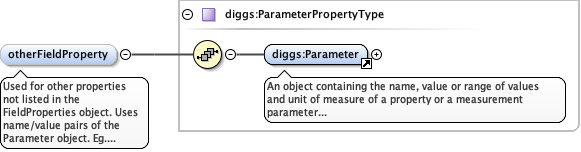
Element diggs:FieldPropertiesType / diggs:otherFieldProperty
Namespace http://diggsml.org/schemas/2.6
Annotations
Used for other properties not listed in the
FieldProperties object. Uses name/value pairs of the Parameter
object. Eg. name = Additional Description, value = with
slag
Diagram
DiagramKernel_xsd_Element_diggs_Parameter.tmp#ParameterKernel_xsd_Complex_Type_diggs_ParameterPropertyType.tmp#ParameterPropertyType
Type diggs:ParameterPropertyType
Properties
content complex
minOccurs 0
maxOccurs unbounded
Model
Children diggs:Parameter
Instance
<diggs:otherFieldProperty xmlns:diggs="http://diggsml.org/schemas/2.6">
  <diggs:Parameter gml:id="" diggs:index="">{1,1}</diggs:Parameter>
</diggs:otherFieldProperty>
Source
<element minOccurs="0" name="otherFieldProperty" maxOccurs="unbounded" type="diggs:ParameterPropertyType">
  <annotation>
    <documentation>Used for other properties not listed in the FieldProperties object. Uses name/value pairs of the Parameter object. Eg. name = Additional Description, value = with slag</documentation>
  </annotation>
</element>
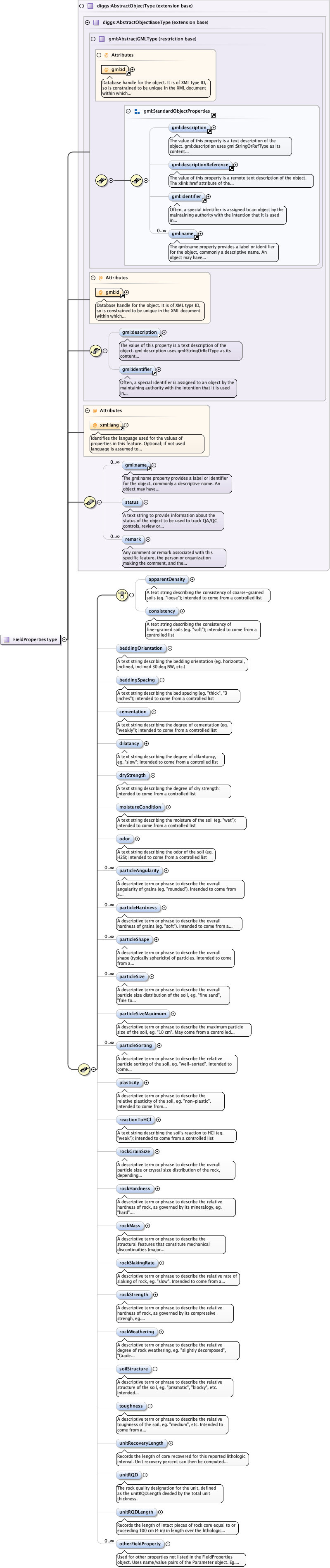
Complex Type diggs:FieldPropertiesType
Namespace http://diggsml.org/schemas/2.6
Diagram
Diagramgml3_2Profile_diggs_xsd_Attribute_gml_id.tmp#idgml3_2Profile_diggs_xsd_Element_gml_description.tmp#descriptiongml3_2Profile_diggs_xsd_Element_gml_descriptionReference.tmp#descriptionReferencegml3_2Profile_diggs_xsd_Element_gml_identifier.tmp#identifiergml3_2Profile_diggs_xsd_Element_gml_name.tmp#namegml3_2Profile_diggs_xsd_Element_Group_gml_StandardObjectProperties.tmp#StandardObjectPropertiesgml3_2Profile_diggs_xsd_Complex_Type_gml_AbstractGMLType.tmp#AbstractGMLTypegml3_2Profile_diggs_xsd_Attribute_gml_id.tmp#idgml3_2Profile_diggs_xsd_Element_gml_description.tmp#descriptiongml3_2Profile_diggs_xsd_Element_gml_identifier.tmp#identifierKernel_xsd_Complex_Type_diggs_AbstractObjectBaseType.tmp#AbstractObjectBaseTypexml_xsd_Attribute_xml_lang.tmp#langgml3_2Profile_diggs_xsd_Element_gml_name.tmp#nameKernel_xsd_Complex_Type_diggs_AbstractObjectType.tmp#AbstractObjectType_statusKernel_xsd_Complex_Type_diggs_AbstractObjectType.tmp#AbstractObjectType_remarkKernel_xsd_Complex_Type_diggs_AbstractObjectType.tmp#AbstractObjectTypeKernel_xsd_Complex_Type_diggs_FieldPropertiesType.tmp#FieldPropertiesType_apparentDensityKernel_xsd_Complex_Type_diggs_FieldPropertiesType.tmp#FieldPropertiesType_consistencyKernel_xsd_Complex_Type_diggs_FieldPropertiesType.tmp#FieldPropertiesType_beddingOrientationKernel_xsd_Complex_Type_diggs_FieldPropertiesType.tmp#FieldPropertiesType_beddingSpacingKernel_xsd_Complex_Type_diggs_FieldPropertiesType.tmp#FieldPropertiesType_cementationKernel_xsd_Complex_Type_diggs_FieldPropertiesType.tmp#FieldPropertiesType_dilatancyKernel_xsd_Complex_Type_diggs_FieldPropertiesType.tmp#FieldPropertiesType_dryStrengthKernel_xsd_Complex_Type_diggs_FieldPropertiesType.tmp#FieldPropertiesType_moistureConditionKernel_xsd_Complex_Type_diggs_FieldPropertiesType.tmp#FieldPropertiesType_odorKernel_xsd_Complex_Type_diggs_FieldPropertiesType.tmp#FieldPropertiesType_particleAngularityKernel_xsd_Complex_Type_diggs_FieldPropertiesType.tmp#FieldPropertiesType_particleHardnessKernel_xsd_Complex_Type_diggs_FieldPropertiesType.tmp#FieldPropertiesType_particleShapeKernel_xsd_Complex_Type_diggs_FieldPropertiesType.tmp#FieldPropertiesType_particleSizeKernel_xsd_Complex_Type_diggs_FieldPropertiesType.tmp#FieldPropertiesType_particleSizeMaximumKernel_xsd_Complex_Type_diggs_FieldPropertiesType.tmp#FieldPropertiesType_particleSortingKernel_xsd_Complex_Type_diggs_FieldPropertiesType.tmp#FieldPropertiesType_plasticityKernel_xsd_Complex_Type_diggs_FieldPropertiesType.tmp#FieldPropertiesType_reactionToHClKernel_xsd_Complex_Type_diggs_FieldPropertiesType.tmp#FieldPropertiesType_rockGrainSizeKernel_xsd_Complex_Type_diggs_FieldPropertiesType.tmp#FieldPropertiesType_rockHardnessKernel_xsd_Complex_Type_diggs_FieldPropertiesType.tmp#FieldPropertiesType_rockMassKernel_xsd_Complex_Type_diggs_FieldPropertiesType.tmp#FieldPropertiesType_rockSlakingRateKernel_xsd_Complex_Type_diggs_FieldPropertiesType.tmp#FieldPropertiesType_rockStrengthKernel_xsd_Complex_Type_diggs_FieldPropertiesType.tmp#FieldPropertiesType_rockWeatheringKernel_xsd_Complex_Type_diggs_FieldPropertiesType.tmp#FieldPropertiesType_soilStructureKernel_xsd_Complex_Type_diggs_FieldPropertiesType.tmp#FieldPropertiesType_toughnessKernel_xsd_Complex_Type_diggs_FieldPropertiesType.tmp#FieldPropertiesType_unitRecoveryLengthKernel_xsd_Complex_Type_diggs_FieldPropertiesType.tmp#FieldPropertiesType_unitRQDKernel_xsd_Complex_Type_diggs_FieldPropertiesType.tmp#FieldPropertiesType_unitRQDLengthKernel_xsd_Complex_Type_diggs_FieldPropertiesType.tmp#FieldPropertiesType_otherFieldProperty
Type extension of diggs:AbstractObjectType
Type hierarchy
Used by
Model
Children diggs:apparentDensity, diggs:beddingOrientation, diggs:beddingSpacing, diggs:cementation, diggs:consistency, diggs:dilatancy, diggs:dryStrength, diggs:moistureCondition, diggs:odor, diggs:otherFieldProperty, diggs:particleAngularity, diggs:particleHardness, diggs:particleShape, diggs:particleSize, diggs:particleSizeMaximum, diggs:particleSorting, diggs:plasticity, diggs:reactionToHCl, diggs:remark, diggs:rockGrainSize, diggs:rockHardness, diggs:rockMass, diggs:rockSlakingRate, diggs:rockStrength, diggs:rockWeathering, diggs:soilStructure, diggs:status, diggs:toughness, diggs:unitRQD, diggs:unitRQDLength, diggs:unitRecoveryLength, gml:description, gml:identifier, gml:name
Attributes
QName Type Use Annotation
gml:id ID required
Database handle for the object. It is of XML type ID, so is constrained to be
unique in the XML document within which it occurs. An external identifier for the object in
the form of a URI may be constructed using standard XML and XPointer methods. This is done
by concatenating the URI for the document, a fragment separator, and the value of the id
attribute.
xml:lang union of(xs:language, restriction of xs:string) optional
<div>
  <h3>lang (as an attribute name)</h3>
  <p>denotes an attribute whose value is a language code for the natural language of the content of any element; its value is inherited. This name is reserved by virtue of its definition in the XML specification.</p>
</div>
<div>
  <h4>Notes</h4>
  <p>Attempting to install the relevant ISO 2- and 3-letter codes as the enumerated possible values is probably never going to be a realistic possibility.</p>
  <p>See BCP 47 at
    <a href="http://www.rfc-editor.org/rfc/bcp/bcp47.txt">http://www.rfc-editor.org/rfc/bcp/bcp47.txt</a>and the IANA language subtag registry at
    <a href="http://www.iana.org/assignments/language-subtag-registry">http://www.iana.org/assignments/language-subtag-registry</a>for further information.</p>
  <p>The union allows for the 'un-declaration' of xml:lang with the empty string.</p>
</div>
Source
<complexType name="FieldPropertiesType">
  <complexContent>
    <extension base="diggs:AbstractObjectType">
      <sequence>
        <choice>
          <element name="apparentDensity" type="gml:CodeType" minOccurs="0">
            <annotation>
              <documentation>A text string describing the consistency of coarse-grained soils (eg. "loose"); intended to come from a controlled list</documentation>
            </annotation>
          </element>
          <element name="consistency" type="gml:CodeType" minOccurs="0">
            <annotation>
              <documentation>A text string describing the consistency of fine-grained soils (eg. "soft"); intended to come from a controlled list</documentation>
            </annotation>
          </element>
        </choice>
        <element name="beddingOrientation" type="diggs:DiggsStringType" minOccurs="0">
          <annotation>
            <documentation>A text string describing the bedding orientation (eg. horizontal, inclined, inclined 30 deg NW, etc.)</documentation>
          </annotation>
        </element>
        <element name="beddingSpacing" type="gml:CodeType" minOccurs="0">
          <annotation>
            <documentation>A text string describing the bed spacing (eg. "thick", "3 inches"); intended to come from a controlled list</documentation>
          </annotation>
        </element>
        <element name="cementation" type="gml:CodeType" minOccurs="0">
          <annotation>
            <documentation>A text string describing the degree of cementation (eg. "weakly"); intended to come from a controlled list</documentation>
          </annotation>
        </element>
        <element name="dilatancy" type="gml:CodeType" minOccurs="0">
          <annotation>
            <documentation>A text string describing the degree of dilantancy, eg. "slow"; intended to come from a controlled list</documentation>
          </annotation>
        </element>
        <element name="dryStrength" type="gml:CodeType" minOccurs="0">
          <annotation>
            <documentation>A text string describing the degree of dry strength; intended to come from a controlled list</documentation>
          </annotation>
        </element>
        <element name="moistureCondition" type="gml:CodeType" minOccurs="0">
          <annotation>
            <documentation>A text string describing the moisture of the soil (eg. "wet"); intended to come from a controlled list</documentation>
          </annotation>
        </element>
        <element name="odor" type="gml:CodeType" minOccurs="0">
          <annotation>
            <documentation>A text string describing the odor of the soil (eg. H2S); intended to come from a controlled list</documentation>
          </annotation>
        </element>
        <element minOccurs="0" name="particleAngularity" type="diggs:SizeClassCodeType" maxOccurs="unbounded">
          <annotation>
            <documentation>A descriptive term or phrase to describe the overall angularity of grains (eg. "rounded"). Intended to come from a controlled list.</documentation>
          </annotation>
        </element>
        <element minOccurs="0" name="particleHardness" type="diggs:SizeClassCodeType" maxOccurs="unbounded">
          <annotation>
            <documentation>A descriptive term or phrase to describe the overall hardness of grains (eg. "soft"). Intended to come from a controlled list.</documentation>
          </annotation>
        </element>
        <element minOccurs="0" name="particleShape" type="diggs:SizeClassCodeType" maxOccurs="unbounded">
          <annotation>
            <documentation>A descriptive term or phrase to describe the overall shape (typically sphericity) of particles. Intended to come from a controlled list.</documentation>
          </annotation>
        </element>
        <element minOccurs="0" name="particleSize" type="diggs:SizeClassCodeType" maxOccurs="unbounded">
          <annotation>
            <documentation>A descriptive term or phrase to describe the overall particle size distribution of the soil, eg. "fine sand", "fine to coarse". "silt and very fine sand". Intended to come from a controlled list.</documentation>
          </annotation>
        </element>
        <element minOccurs="0" name="particleSizeMaximum" type="gml:CodeType">
          <annotation>
            <documentation>A descriptive term or phrase to describe the maximum particle size of the soil, eg. "10 cm". May come from a controlled list.</documentation>
          </annotation>
        </element>
        <element minOccurs="0" name="particleSorting" type="diggs:SizeClassCodeType" maxOccurs="unbounded">
          <annotation>
            <documentation>A descriptive term or phrase to describe the relative particle sorting of the soil, eg. "well-sorted". Intended to come from a controlled list.</documentation>
          </annotation>
        </element>
        <element minOccurs="0" name="plasticity" type="gml:CodeType">
          <annotation>
            <documentation>A descriptive term or phrase to describe the relative plasticity of the soil, eg. "non-plastic". Intended to come from a controlled list.</documentation>
          </annotation>
        </element>
        <element name="reactionToHCl" type="gml:CodeType" minOccurs="0">
          <annotation>
            <documentation>A text string describing the soil's reaction to HCl (eg. "weak"); intended to come from a controlled list</documentation>
          </annotation>
        </element>
        <element minOccurs="0" name="rockGrainSize" type="gml:CodeType">
          <annotation>
            <documentation>A descriptive term or phrase to describe the overall particle size or crystal size distribution of the rock, depending on rock origin. For example, for cystalline igneous or metamorphic rocks, terms such as pegmatitic or aphanitic may be used. For clastic sedimentary rocks, terms such as fine sand or cobbles may be used, and for pyroclastic igneous rocks, terms such as "coarse ash" or "lapili" may be used. Intended to come from a controlled list of terms.</documentation>
          </annotation>
        </element>
        <element minOccurs="0" name="rockHardness" type="gml:CodeType">
          <annotation>
            <documentation>A descriptive term or phrase to describe the relative hardness of rock, as governed by its mineralogy, eg. "hard". Intended to come from a controlled list.</documentation>
          </annotation>
        </element>
        <element minOccurs="0" name="rockMass" type="gml:CodeType">
          <annotation>
            <documentation>A descriptive term or phrase to describe the structural features that constitute mechanical discontinuities (major geological features). Rock mass refers to any in situ rock with all inherent geomechanical discontinuities (eg. fissile, blocky, fractured, etc.)</documentation>
          </annotation>
        </element>
        <element minOccurs="0" name="rockSlakingRate" type="gml:CodeType">
          <annotation>
            <documentation>A descriptive term or phrase to describe the relative rate of slaking of rock, eg. "slow". Intended to come from a controlled list.</documentation>
          </annotation>
        </element>
        <element minOccurs="0" name="rockStrength" type="gml:CodeType">
          <annotation>
            <documentation>A descriptive term or phrase to describe the relative hardness of rock, as governed by its compressive strengh, eg. "strong". Intended to come from a controlled list.</documentation>
          </annotation>
        </element>
        <element minOccurs="0" name="rockWeathering" type="gml:CodeType">
          <annotation>
            <documentation>A descriptive term or phrase to describe the relative degree of rock weathering, eg. "slightly decomposed", "Grade III", etc. Intended to come from a controlled list.</documentation>
          </annotation>
        </element>
        <element minOccurs="0" name="soilStructure" type="gml:CodeType">
          <annotation>
            <documentation>A descriptive term or phrase to describe the relative structure of the soil, eg. "prismatic", "blocky", etc. Intended to come from a controlled list.</documentation>
          </annotation>
        </element>
        <element minOccurs="0" name="toughness" type="gml:CodeType">
          <annotation>
            <documentation>A descriptive term or phrase to describe the relative toughness of the soil, eg. "medium", etc. Intended to come from a controlled list.</documentation>
          </annotation>
        </element>
        <element minOccurs="0" name="unitRecoveryLength" type="eml:LengthMeasure">
          <annotation>
            <documentation>Records the length of core recovered for this reported lithologic interval. Unit recovery percent can then be computed by dividing this value by the interval thickness.</documentation>
          </annotation>
        </element>
        <element minOccurs="0" name="unitRQD" type="eml:LengthPerLengthMeasure">
          <annotation>
            <documentation>The rock quality designation for the unit, defined as the unitRQDLength divided by the total unit thickness.</documentation>
          </annotation>
        </element>
        <element minOccurs="0" name="unitRQDLength" type="eml:LengthMeasure">
          <annotation>
            <documentation>Records the length of intact pieces of rock core equal to or exceeding 100 cm (4 in) in length over the lithologic interval.</documentation>
          </annotation>
        </element>
        <element minOccurs="0" name="otherFieldProperty" maxOccurs="unbounded" type="diggs:ParameterPropertyType">
          <annotation>
            <documentation>Used for other properties not listed in the FieldProperties object. Uses name/value pairs of the Parameter object. Eg. name = Additional Description, value = with slag</documentation>
          </annotation>
        </element>
      </sequence>
    </extension>
  </complexContent>
</complexType>