Showing:

Annotations
Attributes
Diagrams
Facets
Model
Properties
Source
Used by
Element diggs:BoundaryType / diggs:dipAngle
Namespace http://diggsml.org/schemas/2.6
Annotations
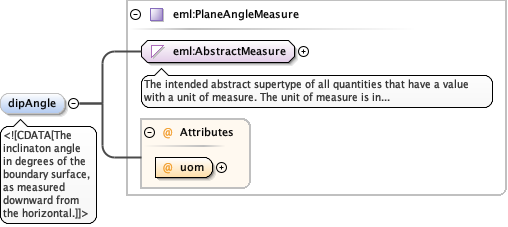
The inclinaton angle in degrees of the boundary surface, as measured downward from the horizontal.
Diagram
DiagramBaseTypes_xsd_Simple_Type_eml_AbstractMeasure.tmp#AbstractMeasureMeasureType_xsd_Complex_Type_eml_PlaneAngleMeasure.tmp#PlaneAngleMeasure_uomMeasureType_xsd_Complex_Type_eml_PlaneAngleMeasure.tmp#PlaneAngleMeasure
Type eml:PlaneAngleMeasure
Type hierarchy
Properties
content complex
minOccurs 0
Attributes
QName Type Use
uom eml:PlaneAngleUom required
Source
<element minOccurs="0" name="dipAngle" type="eml:PlaneAngleMeasure">
  <annotation>
    <documentation>
      <![CDATA[The inclinaton angle in degrees of the boundary surface, as measured downward from the horizontal.]]>
    </documentation>
  </annotation>
</element>
Element diggs:BoundaryType / diggs:dipDirection
Namespace http://diggsml.org/schemas/2.6
Annotations
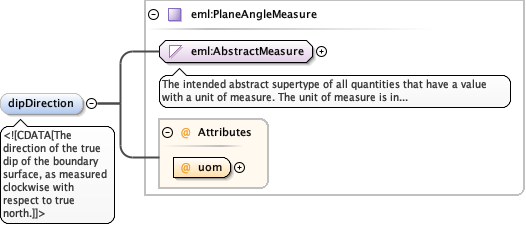
The direction of the true dip of the boundary surface, as measured clockwise with respect to true north.
Diagram
DiagramBaseTypes_xsd_Simple_Type_eml_AbstractMeasure.tmp#AbstractMeasureMeasureType_xsd_Complex_Type_eml_PlaneAngleMeasure.tmp#PlaneAngleMeasure_uomMeasureType_xsd_Complex_Type_eml_PlaneAngleMeasure.tmp#PlaneAngleMeasure
Type eml:PlaneAngleMeasure
Type hierarchy
Properties
content complex
minOccurs 0
Attributes
QName Type Use
uom eml:PlaneAngleUom required
Source
<element minOccurs="0" name="dipDirection" type="eml:PlaneAngleMeasure">
  <annotation>
    <documentation>
      <![CDATA[The direction of the true dip of the boundary surface, as measured clockwise with respect to true north.]]>
    </documentation>
  </annotation>
</element>
Element diggs:BoundaryType / diggs:distinctness
Namespace http://diggsml.org/schemas/2.6
Annotations
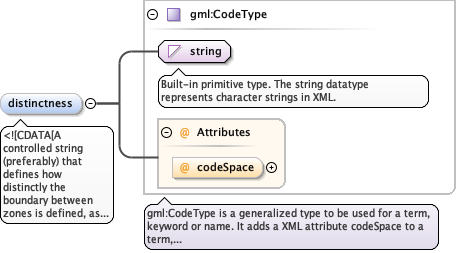
A controlled string (preferably) that defines how distinctly the boundary between zones is defined, as governed by both the contrast between adjacent zones and by the width of the boundary. (eg. sharp, gradational)
Diagram
Diagramgml3_2Profile_diggs_xsd_Complex_Type_gml_CodeType.tmp#CodeType_codeSpacegml3_2Profile_diggs_xsd_Complex_Type_gml_CodeType.tmp#CodeType
Type gml:CodeType
Properties
content complex
minOccurs 0
Attributes
QName Type Use
codeSpace anyURI optional
Source
<element minOccurs="0" name="distinctness" type="gml:CodeType">
  <annotation>
    <documentation>
      <![CDATA[A controlled string (preferably) that defines how distinctly the boundary between zones is defined, as governed by both the contrast between adjacent zones and by the width of the boundary. (eg. sharp, gradational)]]>
    </documentation>
  </annotation>
</element>
Element diggs:BoundaryType / diggs:origin
Namespace http://diggsml.org/schemas/2.6
Annotations
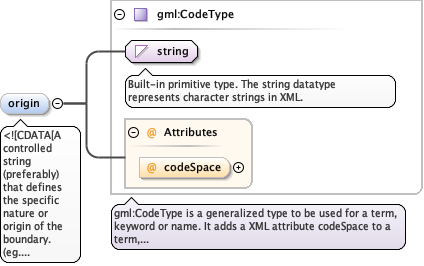
A controlled string (preferably) that defines the specific nature or origin of the boundary. (eg. unconformity, fault, etc.)
Diagram
Diagramgml3_2Profile_diggs_xsd_Complex_Type_gml_CodeType.tmp#CodeType_codeSpacegml3_2Profile_diggs_xsd_Complex_Type_gml_CodeType.tmp#CodeType
Type gml:CodeType
Properties
content complex
minOccurs 0
Attributes
QName Type Use
codeSpace anyURI optional
Source
<element minOccurs="0" name="origin" type="gml:CodeType">
  <annotation>
    <documentation>
      <![CDATA[A controlled string (preferably) that defines the specific nature or origin of the boundary. (eg. unconformity, fault, etc.)]]>
    </documentation>
  </annotation>
</element>
Element diggs:BoundaryType / diggs:topography
Namespace http://diggsml.org/schemas/2.6
Annotations
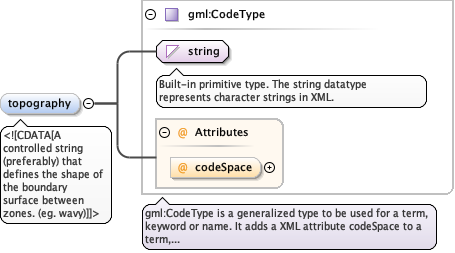
A controlled string (preferably) that defines the shape of the boundary surface between zones. (eg. wavy)
Diagram
Diagramgml3_2Profile_diggs_xsd_Complex_Type_gml_CodeType.tmp#CodeType_codeSpacegml3_2Profile_diggs_xsd_Complex_Type_gml_CodeType.tmp#CodeType
Type gml:CodeType
Properties
content complex
minOccurs 0
Attributes
QName Type Use
codeSpace anyURI optional
Source
<element minOccurs="0" name="topography" type="gml:CodeType">
  <annotation>
    <documentation>
      <![CDATA[A controlled string (preferably) that defines the shape of the boundary surface between zones. (eg. wavy)]]>
    </documentation>
  </annotation>
</element>
Complex Type diggs:BoundaryType
Namespace http://diggsml.org/schemas/2.6
Diagram
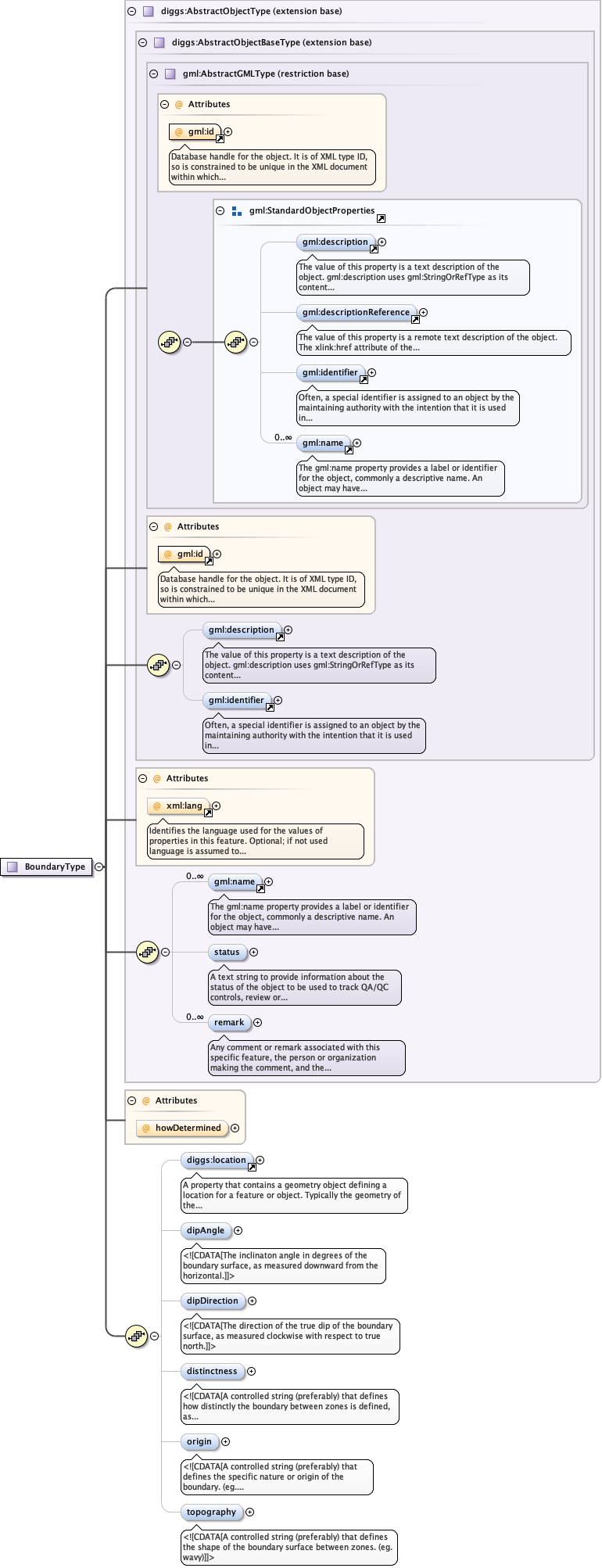
Diagramgml3_2Profile_diggs_xsd_Attribute_gml_id.tmp#idgml3_2Profile_diggs_xsd_Element_gml_description.tmp#descriptiongml3_2Profile_diggs_xsd_Element_gml_descriptionReference.tmp#descriptionReferencegml3_2Profile_diggs_xsd_Element_gml_identifier.tmp#identifiergml3_2Profile_diggs_xsd_Element_gml_name.tmp#namegml3_2Profile_diggs_xsd_Element_Group_gml_StandardObjectProperties.tmp#StandardObjectPropertiesgml3_2Profile_diggs_xsd_Complex_Type_gml_AbstractGMLType.tmp#AbstractGMLTypegml3_2Profile_diggs_xsd_Attribute_gml_id.tmp#idgml3_2Profile_diggs_xsd_Element_gml_description.tmp#descriptiongml3_2Profile_diggs_xsd_Element_gml_identifier.tmp#identifierKernel_xsd_Complex_Type_diggs_AbstractObjectBaseType.tmp#AbstractObjectBaseTypexml_xsd_Attribute_xml_lang.tmp#langgml3_2Profile_diggs_xsd_Element_gml_name.tmp#nameKernel_xsd_Complex_Type_diggs_AbstractObjectType.tmp#AbstractObjectType_statusKernel_xsd_Complex_Type_diggs_AbstractObjectType.tmp#AbstractObjectType_remarkKernel_xsd_Complex_Type_diggs_AbstractObjectType.tmp#AbstractObjectTypeKernel_xsd_Complex_Type_diggs_BoundaryType.tmp#BoundaryType_howDeterminedKernel_xsd_Element_diggs_location.tmp#locationKernel_xsd_Complex_Type_diggs_BoundaryType.tmp#BoundaryType_dipAngleKernel_xsd_Complex_Type_diggs_BoundaryType.tmp#BoundaryType_dipDirectionKernel_xsd_Complex_Type_diggs_BoundaryType.tmp#BoundaryType_distinctnessKernel_xsd_Complex_Type_diggs_BoundaryType.tmp#BoundaryType_originKernel_xsd_Complex_Type_diggs_BoundaryType.tmp#BoundaryType_topography
Type extension of diggs:AbstractObjectType
Type hierarchy
Used by
Element diggs:Boundary
Model
Children diggs:dipAngle, diggs:dipDirection, diggs:distinctness, diggs:location, diggs:origin, diggs:remark, diggs:status, diggs:topography, gml:description, gml:identifier, gml:name
Attributes
QName Type Use Annotation
gml:id ID required
Database handle for the object. It is of XML type ID, so is constrained to be
unique in the XML document within which it occurs. An external identifier for the object in
the form of a URI may be constructed using standard XML and XPointer methods. This is done
by concatenating the URI for the document, a fragment separator, and the value of the id
attribute.
howDetermined diggs:DescriptorMethodEnumType optional
xml:lang union of(xs:language, restriction of xs:string) optional
<div>
  <h3>lang (as an attribute name)</h3>
  <p>denotes an attribute whose value is a language code for the natural language of the content of any element; its value is inherited. This name is reserved by virtue of its definition in the XML specification.</p>
</div>
<div>
  <h4>Notes</h4>
  <p>Attempting to install the relevant ISO 2- and 3-letter codes as the enumerated possible values is probably never going to be a realistic possibility.</p>
  <p>See BCP 47 at
    <a href="http://www.rfc-editor.org/rfc/bcp/bcp47.txt">http://www.rfc-editor.org/rfc/bcp/bcp47.txt</a>and the IANA language subtag registry at
    <a href="http://www.iana.org/assignments/language-subtag-registry">http://www.iana.org/assignments/language-subtag-registry</a>for further information.</p>
  <p>The union allows for the 'un-declaration' of xml:lang with the empty string.</p>
</div>
Source
<complexType name="BoundaryType">
  <complexContent>
    <extension base="diggs:AbstractObjectType">
      <sequence>
        <element minOccurs="0" ref="diggs:location"/>
        <element minOccurs="0" name="dipAngle" type="eml:PlaneAngleMeasure">
          <annotation>
            <documentation>
              <![CDATA[The inclinaton angle in degrees of the boundary surface, as measured downward from the horizontal.]]>
            </documentation>
          </annotation>
        </element>
        <element minOccurs="0" name="dipDirection" type="eml:PlaneAngleMeasure">
          <annotation>
            <documentation>
              <![CDATA[The direction of the true dip of the boundary surface, as measured clockwise with respect to true north.]]>
            </documentation>
          </annotation>
        </element>
        <element minOccurs="0" name="distinctness" type="gml:CodeType">
          <annotation>
            <documentation>
              <![CDATA[A controlled string (preferably) that defines how distinctly the boundary between zones is defined, as governed by both the contrast between adjacent zones and by the width of the boundary. (eg. sharp, gradational)]]>
            </documentation>
          </annotation>
        </element>
        <element minOccurs="0" name="origin" type="gml:CodeType">
          <annotation>
            <documentation>
              <![CDATA[A controlled string (preferably) that defines the specific nature or origin of the boundary. (eg. unconformity, fault, etc.)]]>
            </documentation>
          </annotation>
        </element>
        <element minOccurs="0" name="topography" type="gml:CodeType">
          <annotation>
            <documentation>
              <![CDATA[A controlled string (preferably) that defines the shape of the boundary surface between zones. (eg. wavy)]]>
            </documentation>
          </annotation>
        </element>
      </sequence>
      <attribute name="howDetermined" type="diggs:DescriptorMethodEnumType"/>
    </extension>
  </complexContent>
</complexType>
Attribute diggs:BoundaryType / @howDetermined
Namespace No namespace
Type diggs:DescriptorMethodEnumType
Properties
content simple
Facets
enumeration assigned
enumeration calculated
enumeration extrapolated
enumeration graphic
enumeration inferred
enumeration interpolated
enumeration maximum
enumeration measured
enumeration minimum
enumeration missing
enumeration modeled
enumeration moving average
enumeration other
enumeration reported
enumeration unknown
enumeration visual
Used by
Complex Type diggs:BoundaryType
Source
<attribute name="howDetermined" type="diggs:DescriptorMethodEnumType"/>