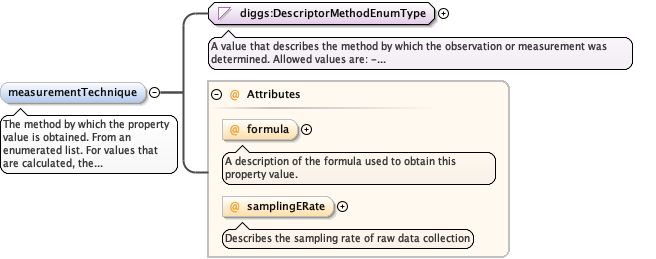
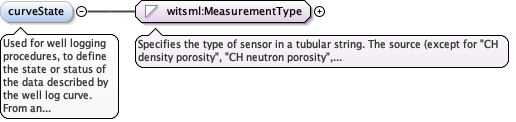
| maxLength |
64 |
|
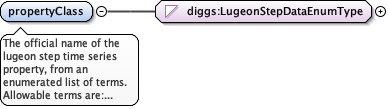
| enumeration |
acceleration |
Output from an accelerometer on a logging tool.
|
|
| enumeration |
acoustic caliper |
A well log that uses an acoustic device to measure hole diameter.
|
|
| enumeration |
acoustic casing collar locator |
The signal measured by an acoustic device at the location of casing collars and other features (e.g., perforations).
|
|
| enumeration |
acoustic impedance |
Seismic velocity multiplied by density.
|
|
| enumeration |
acoustic porosity |
Porosity calculated from an acoustic log.
|
|
| enumeration |
acoustic velocity |
The velocity of an acoustic wave.
|
|
| enumeration |
acoustic wave matrix travel time |
The time it takes for an acoustic wave to traverse a fixed distance of a given material or matrix. In this case the material or matrix is a specific, zero-porosity rock, e.g., sandstone, limestone or dolomite.
|
|
| enumeration |
acoustic wave travel time |
The time it takes for an acoustic wave to traverse a fixed distance.
|
|
| enumeration |
amplitude |
Any measurement of the maximum departure of a wave from an average value.
|
|
| enumeration |
amplitude of acoustic wave |
The extent of departure of an acoustic wave measured from the mean position.
|
|
| enumeration |
amplitude of E-M wave |
The extent of departure of an electromagnetic wave measured from the mean position.
|
|
| enumeration |
amplitude ratio |
The ratio of two amplitudes.
|
|
| enumeration |
area |
A particular extent of space or surface.
|
|
| enumeration |
attenuation |
The amount of reduction in the amplitude of a wave.
|
|
| enumeration |
attenuation of acoustic wave |
The amount of reduction in the amplitude of an acoustic wave.
|
|
| enumeration |
attenuation of E-M wave |
The amount of reduction in the amplitude of an electromagnetic wave.
|
|
| enumeration |
auxiliary |
A general classification for measurements, which are very specialized and not normally accessed by petrophysicists.
|
|
| enumeration |
average porosity |
The pore volume of a rock averaged using various well log or core porosity measurements.
|
|
| enumeration |
azimuth |
In the horizontal plane, it is the clockwise angle of departure from magnetic north (while looking down hole).
|
|
| enumeration |
barite mud correction |
A trace that has been corrected for the effects of barite in the borehole fluid.
|
|
| enumeration |
bed thickness correction |
A trace that has been corrected for bed thickness effects.
|
|
| enumeration |
bit size |
The diameter of the drill bit used to drill the hole.
|
|
| enumeration |
blocked |
A well log trace that has been edited to reflect sharp bed boundaries. The trace has a square wave appearance.
|
|
| enumeration |
borehole environment correction |
A trace that has been corrected for the effects of the borehole environment, e.g., borehole size.
|
|
| enumeration |
borehole fluid correction |
A trace that has been corrected for the effects of borehole fluid; e.g., a mud cake correction.
|
|
| enumeration |
borehole size correction |
A trace that has been corrected for the effects of borehole size.
|
|
| enumeration |
bromide mud correction |
A trace that has been corrected for the effects of bromide in the borehole fluid.
|
|
| enumeration |
bulk compressibility |
The relative compressibility of a material.
|
|
| enumeration |
bulk density |
The measured density of a rock with the pore volume filled with fluid. The pore fluid is generally assumed to be water.
|
|
| enumeration |
bulk volume |
A quantity-per-unit volume.
|
|
| enumeration |
bulk volume gas |
The quantity of gas present in a unit volume of rock. The product of gas saturation and total porosity.
|
|
| enumeration |
bulk volume hydrocarbon |
The quantity of hydrocarbon present in a unit volume of rock. The product of hydrocarbon saturation and total porosity.
|
|
| enumeration |
bulk volume oil |
The quantity of oil present in a unit volume of rock. The product of oil saturation and total porosity.
|
|
| enumeration |
bulk volume water |
The quantity of formation water present in a unit volume of rock. The product of water saturation and total porosity.
|
|
| enumeration |
C/O ratio |
The ratio of the carbon measurement to the oxygen measurement.
|
|
| enumeration |
caliper |
A well log used to record hole diameter (open or cased).
|
|
| enumeration |
cased hole correction |
A trace that has been corrected for the effects of being recorded in a cased hole, e.g., corrected for casing weight and thickness.
|
|
| enumeration |
casing collar locator |
The signal measured by a device at the location of casing collars and other features (e.g., perforations).
|
|
| enumeration |
casing correction |
A trace that has been corrected for the effects of casing; this includes things such as casing weight, thickness and diameter.
|
|
| enumeration |
casing diameter correction |
A trace that has been corrected for the effects of casing diameter.
|
|
| enumeration |
casing inspection |
Any of the measurements made for the purpose of determining the properties of the well casing.
|
|
| enumeration |
casing thickness correction |
A trace that has been corrected for the effects of casing thickness.
|
|
| enumeration |
casing weight correction |
A trace that has been corrected for the effects of casing weight.
|
|
| enumeration |
cement correction |
A trace that has been corrected for the effects of the cement surrounding the casing; this includes cement thickness, density and type.
|
|
| enumeration |
cement density correction |
A trace that has been corrected for the effects of cement density.
|
|
| enumeration |
cement evaluation |
Any of the measurements made to determine the presence and quality of the cement bond to casing or to formation.
|
|
| enumeration |
cement thickness correction |
A trace that has been corrected for the effects of cement thickness.
|
|
| enumeration |
cement type correction |
A trace that has been corrected for the effects of the type of cement used.
|
|
| enumeration |
CH density porosity |
|
| enumeration |
CH dolomite density porosity |
Porosity calculated from the bulk density measurement of a cased hole density log using a dolomite matrix density.
|
|
| enumeration |
CH dolomite neutron porosity |
Porosity calculated from a cased hole neutron log using a dolomite matrix.
|
|
| enumeration |
CH limestone density porosity |
Porosity calculated from the bulk density measurement of a cased hole density log using a limestone matrix density.
|
|
| enumeration |
CH limestone neutron porosity |
Porosity calculated from a cased-hole neutron log using a limestone matrix.
|
|
| enumeration |
CH neutron porosity |
|
| enumeration |
CH sandstone density porosity |
Porosity calculated from the bulk density measurement of a cased-hole density log using a sandstone matrix density.
|
|
| enumeration |
CH sandstone neutron porosity |
Porosity calculated from an openhole neutron log using a sandstone matrix.
|
|
| enumeration |
compressional wave dolomite porosity |
Porosity calculated from a compressional wave acoustic log using a dolomite matrix.
|
|
| enumeration |
compressional wave limestone porosity |
Porosity calculated from a compressional wave acoustic log using a limestone matrix
|
|
| enumeration |
compressional wave matrix travel time |
The time it takes for a compressional acoustic wave to traverse a fixed distance of a given material or matrix. In this case the material or matrix is a specific, zero porosity rock, e.g. sandstone, limestone or dolomite.
|
|
| enumeration |
compressional wave sandstone porosity |
Porosity calculated from a compressional wave acoustic log using a sandstone matrix.
|
|
| enumeration |
compressional wave travel time |
The time it takes for a compressional acoustic wave to traverse a fixed distance.
|
|
| enumeration |
conductivity |
The property of a medium (solid or fluid) that allows the medium to conduct a form of energy; e.g., electrical conductivity or thermal conductivity.
|
|
| enumeration |
conductivity from attenuation |
Conductivity calculated from the attenuation of an electromagnetic wave. Generally recorded from a LWD resistivity tool.
|
|
| enumeration |
conductivity from phase shift |
Conductivity calculated from the phase shift of an electromagnetic wave. Generally recorded from a LWD resistivity tool.
|
|
| enumeration |
connate water conductivity |
The conductivity of the water entrapped in the interstices of the rock.
|
|
| enumeration |
connate water resistivity |
The resistivity of the water entrapped in the interstices of the rock.
|
|
| enumeration |
conventional core porosity |
Porosity from a measurement made on a conventional core.
|
|
| enumeration |
core matrix density |
The density of a rock matrix measured on a core sample.
|
|
| enumeration |
core permeability |
The permeability derived from a core.
|
|
| enumeration |
core porosity |
Porosity from a core measurement.
|
|
| enumeration |
corrected |
A trace that has had corrections applied; e.g. environmental corrections.
|
|
| enumeration |
count rate |
The rate of occurrences; e.g. the far counts from a density tool..
|
|
| enumeration |
count rate ratio |
The ratio of two count rates.
|
|
| enumeration |
cross plot porosity |
The pore volume of a rock calculated from cross plotting two or more well log porosity measurements.
|
|
| enumeration |
decay time |
The time it takes for a population to decay, generally expressed as a half life.
|
|
| enumeration |
deep conductivity |
The conductivity that represents a measurement made several feet into the formation; generally considered a measurement of the undisturbed formation.
|
|
| enumeration |
deep induction conductivity |
The conductivity, measured by an induction log, which represents a measurement made several feet into the formation; generally considered a measurement of the undisturbed formation.
|
|
| enumeration |
deep induction resistivity |
The resistivity, measured by an induction log, which represents a measurement made several feet into the formation; generally considered a measurement of the undisturbed formation.
|
|
| enumeration |
deep laterolog conductivity |
The conductivity, measured by a laterolog, which represents a measurement made several feet into the formation; generally considered a measurement of the undisturbed formation.
|
|
| enumeration |
deep laterolog resistivity |
The resistivity, measured by a laterolog, which represents a measurement made several feet into the formation; generally considered a measurement of the undisturbed formation.
|
|
| enumeration |
deep resistivity |
The resistivity, which represents a measurement made several feet into the formation; generally considered a measurement of the undisturbed formation.
|
|
| enumeration |
density |
Mass per unit Volume; well logging units are usually gm/cc.
|
|
| enumeration |
density porosity |
Porosity calculated using the bulk density measurement from a density log.
|
|
| enumeration |
depth |
The distance to a point in a wellbore.
|
|
| enumeration |
depth adjusted |
The process of depth correcting a trace by depth matching it to a reference trace.
|
|
| enumeration |
depth derived from velocity |
The depth calculated from velocity information.
|
|
| enumeration |
deviation |
Departure of a borehole from vertical. Also, the angle measured between the tool axis and vertical.
|
|
| enumeration |
dielectric |
|
| enumeration |
diffusion correction |
A trace that has been corrected for the effects of diffusion.
|
|
| enumeration |
dip |
The angle that a structural surface, e.g. a bedding or fault plane, makes with the horizontal, measured perpendicular to the strike of the structure.
|
|
| enumeration |
dipmeter |
Any of a number of measurements produced by a tool designed to measure formation dip and borehole characteristics through direct and indirect measurements.
|
|
| enumeration |
dipmeter conductivity |
The conductivity, measured by a dipmeter, which represents a measurement made approximately one to two feet into the formation; generally considered to measure the formation where it contains fluids that are comprised primarily of mud filtrate.
|
|
| enumeration |
dipmeter resistivity |
The resistivity, measured by a dipmeter, which represents a measurement made approximately one to two feet into the formation; generally considered to measure the formation where it contains fluids that are comprised primarily of mud filtrate.
|
|
| enumeration |
dolomite acoustic porosity |
Porosity calculated from an acoustic log using a dolomite matrix.
|
|
| enumeration |
dolomite density porosity |
Porosity calculated from the bulk density measurement of a density log using a dolomite matrix density.
|
|
| enumeration |
dolomite neutron porosity |
Porosity calculated from a neutron log using a dolomite matrix.
|
|
| enumeration |
edited |
A well log trace which has been corrected or adjusted through an editing process.
|
|
| enumeration |
effective porosity |
The interconnected pore volume occupied by free fluids.
|
|
| enumeration |
electric current |
The flow of electric charge.
|
|
| enumeration |
electric potential |
The difference in electrical energy between two systems.
|
|
| enumeration |
electromagnetic wave matrix travel time |
The time it takes for an electromagnetic wave to traverse a fixed distance of a given material or matrix. In this case the material or matrix is a specific, zero porosity rock, e.g. sandstone, limestone or dolomite.
|
|
| enumeration |
electromagnetic wave travel time |
The time it takes for an electromagnetic wave to traverse a fixed distance.
|
|
| enumeration |
element |
The elemental composition, generally in weight percent, of a formation as calculated from information obtained from a geochemical logging pass; e.g., weight percent of Al, Si, Ca, Fe, etc.
|
|
| enumeration |
elemental ratio |
The ratio of two different elemental measurements; e.g. K/U.
|
|
| enumeration |
enhanced |
A well log trace that has been filtered to improve its value; e.g. inverse filtering for better resolution.
|
|
| enumeration |
filtered |
A well log trace which has had a filter applied to it.
|
|
| enumeration |
flowmeter |
A logging tool to measure the rate and/or direction of fluid flow in a wellbore.
|
|
| enumeration |
fluid density |
The quantity per unit volume of fluid.
|
|
| enumeration |
fluid velocity |
The velocity of a flowing fluid.
|
|
| enumeration |
fluid viscosity |
The amount of a fluid resistance to flow.
|
|
| enumeration |
flushed zone conductivity |
The conductivity of the zone immediately behind the mud cake and which is considered to be flushed by mud filtrate, i.e., it is considered to have all mobile formation fluids displaced from it.
|
|
| enumeration |
flushed zone resistivity |
The resistivity of the zone immediately behind the mud cake and which is considered to be flushed by mud filtrate, i.e., it is considered to have all mobile formation fluids displaced from it.
|
|
| enumeration |
flushed zone saturation |
The fraction or percentage of pore volume of rock occupied by drilling mud or mud filtrate in the flushed zone.
|
|
| enumeration |
force |
Energy exerted or brought to bear.
|
|
| enumeration |
formation density correction |
A trace that has been corrected for formation density effects.
|
|
| enumeration |
formation properties correction |
A trace that has been corrected for formation properties; e.g., salinity.
|
|
| enumeration |
formation salinity correction |
A trace that has been corrected for the salinity effects from the water in the formation.
|
|
| enumeration |
formation saturation correction |
A trace that has been corrected for formation saturation effects.
|
|
| enumeration |
formation volume factor correction |
A trace that has been corrected for the effects of the hydrocarbon formation volume factor.
|
|
| enumeration |
formation water density correction |
A trace that has been corrected for the effects of the density of the formation water.
|
|
| enumeration |
formation water saturation correction |
A trace that has been corrected for water saturation effects.
|
|
| enumeration |
free fluid index |
The percent of the bulk volume occupied by fluids that are free to flow as measured by the nuclear magnetism log.
|
|
| enumeration |
friction effect correction |
A trace that has been corrected for the effects of friction.
|
|
| enumeration |
gamma ray |
The measurement of naturally occurring gamma ray radiation being released by radioisotopes in clay or other minerals in the formation.
|
|
| enumeration |
gamma ray minus uranium |
The measurement of the naturally occurring gamma radiation less the radiation attributed to uranium.
|
|
| enumeration |
gas saturation |
The fraction or percentage of pore volume of rock occupied by gas.
|
|
| enumeration |
gradiomanometer |
The measurement of the average density of fluids in a wellbore.
|
|
| enumeration |
high frequency conductivity |
A measurement of the conductivity of the formation, by a high frequency electromagnetic tool, within the first few cubic inches of the borehole wall.
|
|
| enumeration |
high frequency electromagnetic |
High frequency electromagnetic measurements, e.g. from a dielectric logging tool.
|
|
| enumeration |
high frequency electromagnetic porosity |
Porosity calculated using a high frequency electromagnetic measurement as input.
|
|
| enumeration |
high frequency E-M phase shift |
The amount of change in the phase of a high frequency electromagnetic wave.
|
|
| enumeration |
high frequency resistivity |
A measurement of the resistivity of the formation, by a high frequency electromagnetic tool, within the first few cubic inches of the borehole wall.
|
|
| enumeration |
hydrocarbon correction |
A trace that has been corrected for the effects of hydrocarbons.
|
|
| enumeration |
hydrocarbon density correction |
A trace that has been corrected for the effects of hydrocarbon density.
|
|
| enumeration |
hydrocarbon gravity correction |
A trace that has been corrected for the effects of hydrocarbon gravity.
|
|
| enumeration |
hydrocarbon saturation |
The fraction or percentage of pore volume of rock occupied by hydrocarbon.
|
|
| enumeration |
hydrocarbon viscosity correction |
A trace that has been corrected for the effects of hydrocarbon viscosity.
|
|
| enumeration |
image |
The likeness of an object produced by an electrical device.
|
|
| enumeration |
interpretation variable |
A variable in a well log interpretation equation.
|
|
| enumeration |
iron mud correction |
A trace that has been corrected for the effects of iron in the borehole fluid.
|
|
| enumeration |
joined |
A well log trace that has had two or more runs spliced together to make a single trace.
|
|
| enumeration |
KCl mud correction |
A trace that has been corrected for the effects of KCl in the borehole fluid.
|
|
| enumeration |
length |
A measured distance or dimension.
|
|
| enumeration |
limestone acoustic porosity |
Porosity calculated from an acoustic log using a limestone matrix.
|
|
| enumeration |
limestone density porosity |
Porosity calculated from the bulk density measurement of a density log using a limestone matrix density.
|
|
| enumeration |
limestone neutron porosity |
Porosity calculated from a neutron log using a limestone matrix.
|
|
| enumeration |
lithology correction |
A trace that has been corrected for lithology effects.
|
|
| enumeration |
log derived permeability |
The permeability derived from a well log.
|
|
| enumeration |
log matrix density |
The density of a rock matrix used with, or derived from, the bulk density from a well log. The matrix is assumed to have zero porosity.
|
|
| enumeration |
magnetic casing collar locator |
The signal measured by a magnetic device at the location of casing collars and other features (e.g., perforations).
|
|
| enumeration |
matrix density |
The density of a rock matrix. In this case, the matrix is assumed to have zero porosity.
|
|
| enumeration |
matrix travel time |
The time it takes for an electromagnetic or acoustic wave to traverse a fixed distance of a given material or matrix. In this case the material or matrix is a specific, zero porosity rock, e.g. sandstone, limestone or dolomite.
|
|
| enumeration |
measured depth |
The distance measured along the path of a wellbore.
|
|
| enumeration |
mechanical caliper |
A well log which uses a mechanical device to measure hole diameter.
|
|
| enumeration |
mechanical casing collar locator |
The signal measured by a mechanical device at the location of casing collars and other features (e.g., perforations).
|
|
| enumeration |
medium conductivity |
The conductivity which represents a measurement made approximately two to three feet into the formation; generally considered to measure the formation where it contain fluids which are a mixture of mud filtrate, connate water and possibly hydrocarbons.
|
|
| enumeration |
medium induction conductivity |
The conductivity, made by an induction log, which represents a measurement made approximately two to three feet into the formation.
|
|
| enumeration |
medium induction resistivity |
The resistivity, made by an induction log, which represents a measurement made approximately two to three feet into the formation.
|
|
| enumeration |
medium laterolog conductivity |
The conductivity, measured by a laterolog, which represents a measurement made approximately two to three feet into the formation.
|
|
| enumeration |
medium laterolog resistivity |
The resistivity, measured by a laterolog, which represents a measurement made approximately two to three feet into the formation.
|
|
| enumeration |
medium resistivity |
The resistivity which represents a measurement made approximately two to three feet into the formation; generally considered to measure the formation where it contain fluids which are a mixture of mud filtrate, connate water and possibly hydrocarbons.
|
|
| enumeration |
micro conductivity |
A measurement of the conductivity of the formation within the first few cubic inches of the borehole wall.
|
|
| enumeration |
micro inverse conductivity |
A conductivity measurement made by a micro log tool which measures within the first few cubic inches of the borehole wall.
|
|
| enumeration |
micro inverse resistivity |
A resistivity measurement made by a micro log tool which measures within the first few cubic inches of the borehole wall.
|
|
| enumeration |
micro laterolog conductivity |
A measurement of the conductivity of the formation, by a laterolog, within the first few cubic inches of the borehole wall.
|
|
| enumeration |
micro laterolog resistivity |
A measurement of the resistivity of the formation, by a laterolog, within the first few cubic inches of the borehole wall.
|
|
| enumeration |
micro normal conductivity |
A conductivity measurement made by a micro log tool which measures within the first few cubic inches of the borehole wall.
|
|
| enumeration |
micro normal resistivity |
A resistivity measurement made by a micro log tool which measures within the first few cubic inches of the borehole wall.
|
|
| enumeration |
micro resistivity |
A measurement of the resistivity of the formation within the first few cubic inches of the borehole wall.
|
|
| enumeration |
micro spherically focused conductivity |
A measurement of the conductivity of the formation, by a spherically focused tool, within the first few cubic inches of the borehole wall.
|
|
| enumeration |
micro spherically focused resistivity |
A measurement of the resistivity of the formation, by a spherically focused tool, within the first few cubic inches of the borehole wall.
|
|
| enumeration |
mineral |
The mineral composition, generally in weight percent, of a formation as calculated from elemental information obtained from a geochemical logging pass; e.g., weight percent of dolomite, calcite, illite, quartzite, etc.
|
|
| enumeration |
mud cake conductivity |
The conductivity of the filter cake, the residue deposited on the borehole wall as mud loses filtrate into porous and permeable rock.
|
|
| enumeration |
mud cake correction |
A trace which has been corrected for the effects of mud cake; e.g., mud cake thickness and/or density.
|
|
| enumeration |
mud cake density correction |
A trace which has been corrected for the effects of mud cake density.
|
|
| enumeration |
mud cake resistivity |
The resistivity of the filter cake, the residue deposited on the borehole wall as mud loses filtrate into porous and permeable rock.
|
|
| enumeration |
mud cake resistivity correction |
A trace which has been corrected for the effects of mud cake resistivity.
|
|
| enumeration |
mud cake thickness correction |
A trace which has been corrected for the effects of mud cake thickness.
|
|
| enumeration |
mud composition correction |
A trace which has been corrected for the effects of borehole fluid composition; e.g., a correction for KCl in the borehole fluid.
|
|
| enumeration |
mud conductivity |
The conductivity of the continuous phase liquid used for the drilling of the well.
|
|
| enumeration |
mud filtrate conductivity |
The conductivity of the effluent of the continuous phase liquid of the drilling mud which permeates porous and permeable rock.
|
|
| enumeration |
mud filtrate correction |
A trace which has been corrected for the effects of mud filtrate. This includes things such as filtrate salinity.
|
|
| enumeration |
mud filtrate density correction |
A trace which has been corrected for the effects of mud filtrate density.
|
|
| enumeration |
mud filtrate resistivity |
The resistivity of the effluent of the continuous phase liquid of the drilling mud which permeates porous and permeable rock.
|
|
| enumeration |
mud filtrate resistivity correction |
A trace which has been corrected for the effects of mud filtrate resistivity.
|
|
| enumeration |
mud filtrate salinity correction |
A trace which has been corrected for the effects of mud filtrate salinity.
|
|
| enumeration |
mud resistivity |
The resistivity of the continuous phase liquid used for the drilling of the well.
|
|
| enumeration |
mud salinity correction |
A trace which has been corrected for the effects of salinity in the borehole fluid.
|
|
| enumeration |
mud viscosity correction |
A trace which has been corrected for the effects of the viscosity of the borehole fluid.
|
|
| enumeration |
mud weight correction |
A trace which has been corrected for the effects of weighting the borehole fluid.
|
|
| enumeration |
neutron die away time |
The time it takes for a neutron population to die away to half value.
|
|
| enumeration |
neutron porosity |
Porosity from a neutron log.
|
|
| enumeration |
nuclear caliper |
A well log which uses a nuclear device to measure hole diameter.
|
|
| enumeration |
nuclear magnetic decay time |
The decay time of a nuclear magnetic signal.
|
|
| enumeration |
nuclear magnetism log permeability |
The permeability derived from a nuclear magnetism log.
|
|
| enumeration |
nuclear magnetism porosity |
Porosity calculated using the measurements from a nuclear magnetism logging pass.
|
|
| enumeration |
OH density porosity |
|
| enumeration |
OH dolomite density porosity |
Porosity calculated from the bulk density measurement of an open hole density log using a dolomite matrix density.
|
|
| enumeration |
OH dolomite neutron porosity |
Porosity calculated from an open hole neutron log using a dolomite matrix.
|
|
| enumeration |
OH limestone density porosity |
Porosity calculated from the bulk density measurement of an open hole density log using a limestone matrix density.
|
|
| enumeration |
OH limestone neutron porosity |
Porosity calculated from an open hole neutron log using a limestone matrix.
|
|
| enumeration |
OH neutron porosity |
|
| enumeration |
OH sandstone density porosity |
Porosity calculated from the bulk density measurement of an open hole density log using a sandstone matrix density.
|
|
| enumeration |
OH sandstone neutron porosity |
Porosity calculated from an open hole neutron log using a sandstone matrix.
|
|
| enumeration |
oil based mud correction |
A trace which has been corrected for the effects of oil based borehole fluid.
|
|
| enumeration |
oil saturation |
The fraction or percentage of pore volume of rock occupied by oil.
|
|
| enumeration |
perforating |
The procedure for introducing holes through casing into a formation so that formation fluids can enter into the casing.
|
|
| enumeration |
permeability |
The permeability of the surrounding formation.
|
|
| enumeration |
phase shift |
A change or variation according to a harmonic law from a standard position or instant of starting.
|
|
| enumeration |
photoelectric absorption |
The effect measured by the density log and produced by the process of a photon colliding with an atom, and then being completely absorbed and its total energy used to eject one of the orbital electrons from those surrounding the nucleus.
|
|
| enumeration |
photoelectric absorption correction |
The correction that is to be made to the photoelectric absorption curve.
|
|
| enumeration |
physical measurement correction |
A trace which has been corrected for various physical measurement effects; e.g. spreading loss.
|
|
| enumeration |
plane angle |
An angle formed by two intersecting lines.
|
|
| enumeration |
porosity |
The total pore volume occupied by fluid in a rock. Includes isolated nonconnecting pores and volume occupied by absorbed, immobile fluid.
|
|
| enumeration |
porosity correction |
A trace which has been corrected for porosity effects.
|
|
| enumeration |
potassium |
The measurement of gamma radiation emitted by potassium.
|
|
| enumeration |
pressure |
The force or thrust exerted upon a surface divided by the area of the surface.
|
|
| enumeration |
pressure correction |
A trace which has been corrected for the effects of pressure in the borehole.
|
|
| enumeration |
processed |
A well log trace which has been processed in some way; e.g., depth adjusted or environmentally corrected.
|
|
| enumeration |
pulsed neutron porosity |
Porosity calculated from a pulsed neutron log.
|
|
| enumeration |
quality |
|
| enumeration |
ratio |
A relationship between two values usually expressed as a fraction.
|
|
| enumeration |
raw |
A well log trace which has not had any processing. In other words, a trace which has not been depth adjusted or environmentally corrected.
|
|
| enumeration |
relative bearing |
While looking down hole, it is the clockwise angle from the upper side of the sonde to the reference pad or electrode.
|
|
| enumeration |
resistivity |
The property measuring the resistance to flow of an electrical current.
|
|
| enumeration |
resistivity factor correction |
A trace which has been corrected for resistivity factor effects.
|
|
| enumeration |
resistivity from attenuation |
Resistivity calculated from the attenuation of an electromagnetic wave. Generally recorded from a LWD resistivity tool.
|
|
| enumeration |
resistivity from phase shift |
Resistivity calculated from the phase shift of an electromagnetic wave. Generally recorded from a LWD resistivity tool.
|
|
| enumeration |
resistivity phase shift |
The amount of change in the phase of an electrical wave.
|
|
| enumeration |
resistivity ratio |
The ratio of two resistivity values.
|
|
| enumeration |
salinity |
The concentration of ions in solution.
|
|
| enumeration |
sampling |
To take a sample of or from something.
|
|
| enumeration |
sandstone acoustic porosity |
Porosity calculated from an acoustic log using a sandstone matrix.
|
|
| enumeration |
sandstone density porosity |
Porosity calculated from the bulk density measurement of a density log using a sandstone matrix density.
|
|
| enumeration |
sandstone neutron porosity |
Porosity calculated from a neutron log using a sandstone matrix.
|
|
| enumeration |
saturation |
The fraction or percentage of the pore volume of a rock.
|
|
| enumeration |
shale volume |
An estimate of the amount of shale present in the formation. Frequently calculated from a gamma ray or SP curve.
|
|
| enumeration |
shallow conductivity |
The conductivity which represents a measurement made approximately one to two feet into the formation; generally considered to measure the formation where it contains fluids which are comprised primarily of mud filtrate.
|
|
| enumeration |
shallow induction conductivity |
The conductivity, measured by an induction log, which represents a measurement made approximately one to two feet into the formation; generally considered to measure the formation where it contains fluids which are comprised primarily of mud filtrate.
|
|
| enumeration |
shallow induction resistivity |
The resistivity, measured by an induction log, which represents a measurement made approximately one to two feet into the formation; generally considered to measure the formation where it contains fluids which are comprised primarily of mud filtrate.
|
|
| enumeration |
shallow laterolog conductivity |
The conductivity, measured by a laterolog, which represents a measurement made approximately one to two feet into the formation; generally considered to measure the formation where it contains fluids which are comprised primarily of mud filtrate.
|
|
| enumeration |
shallow laterolog resistivity |
The resistivity, measured by a laterolog, which represents a measurement made approximately one to two feet into the formation; generally considered to measure the formation where it contains fluids which are comprised primarily of mud filtrate.
|
|
| enumeration |
shallow resistivity |
The resistivity which represents a measurement made approximately one to two feet into the formation; generally considered to measure the formation where it contains fluids which are comprised primarily of mud filtrate.
|
|
| enumeration |
shear wave dolomite porosity |
Porosity calculated from a shear wave acoustic log using a dolomite matrix.
|
|
| enumeration |
shear wave limestone porosity |
Porosity calculated from a shear wave acoustic log using a limestone matrix.
|
|
| enumeration |
shear wave matrix travel time |
The time it takes for a shear acoustic wave to traverse a fixed distance of a given material or matrix. In this case the material or matrix is a specific, zero porosity rock, e.g. sandstone, limestone or dolomite.
|
|
| enumeration |
shear wave sandstone porosity |
Porosity calculated from a shear wave acoustic log using a sandstone matrix.
|
|
| enumeration |
shear wave travel time |
The time it takes for a shear acoustic wave to traverse a fixed distance.
|
|
| enumeration |
shifted |
A well log trace which has had its original values shifted by some factor; e.g., added or multiplied by a constant.
|
|
| enumeration |
sidewall core porosity |
Porosity from a measurement made on a sidewall core.
|
|
| enumeration |
sigma |
The macroscopic capture cross section, i.e. the effective cross-sectional area per unit volume for the capture of neutrons.
|
|
| enumeration |
sigma formation |
The macroscopic capture cross section, i.e. the effective cross-sectional area per unit volume, of the formation for the capture of neutrons.
|
|
| enumeration |
sigma gas |
The macroscopic capture cross section, i.e. the effective cross-sectional area per unit volume, of gas for the capture of neutrons.
|
|
| enumeration |
sigma hydrocarbon |
The macroscopic capture cross section, i.e. the effective cross-sectional area per unit volume, of hydrocarbon for the capture of neutrons.
|
|
| enumeration |
sigma matrix |
The macroscopic capture cross section, i.e. the effective cross-sectional area per unit volume, of the rock matrix for the capture of neutrons.
|
|
| enumeration |
sigma oil |
The macroscopic capture cross section, i.e. the effective cross-sectional area per unit volume, of oil for the capture of neutrons.
|
|
| enumeration |
sigma water |
The macroscopic capture cross section, i.e. the effective cross-sectional area per unit volume, of water for the capture of neutrons.
|
|
| enumeration |
slippage velocity correction |
A trace which has been corrected for slippage velocity.
|
|
| enumeration |
smoothed |
A well log trace which has been filtered to smooth, or average the trace.
|
|
| enumeration |
spectral gamma ray |
The measurement of all the naturally occurring gamma radiation separated by energy windows.
|
|
| enumeration |
spherically focused conductivity |
The conductivity, measured by a spherically focused log, which represents the resistivity approximately one to two feet into the formation.
|
|
| enumeration |
spherically focused resistivity |
The resistivity, measured by a spherically focused log, which represents the resistivity approximately one to two feet into the formation.
|
|
| enumeration |
spontaneous potential |
The difference in potential (DC Voltage) between a moveable electrode in the borehole and a distant reference electrode usually at the surface.
|
|
| enumeration |
spreading loss correction |
A trace which has been corrected for the effects of spreading loss.
|
|
| enumeration |
synthetic well log trace |
A well log trace which has been artificially created, as opposed to an actual measurement, from associated measurements or information.
|
|
| enumeration |
temperature |
A temperature measurement.
|
|
| enumeration |
temperature correction |
A trace which has been corrected for the effects of the temperature in the borehole.
|
|
| enumeration |
tension |
The tension on the wireline cable while logging.
|
|
| enumeration |
Th/K ratio |
The ratio of the Thorium measurement to the Potassium measurement.
|
|
| enumeration |
thorium |
The measurement of gamma radiation emitted by thorium.
|
|
| enumeration |
time |
A measured or measurable period.
|
|
| enumeration |
tool diameter correction |
A trace which has been corrected for the tool diameter.
|
|
| enumeration |
tool eccentricity correction |
A trace which has been corrected for the effects of the tool not being centered in the borehole.
|
|
| enumeration |
total gamma ray |
The measurement of all the naturally occurring gamma radiation.
|
|
| enumeration |
total porosity |
The total pore volume occupied by fluid in a rock.
|
|
| enumeration |
tracer survey |
A well log used for the purpose of monitoring a traceable material; e.g. a radioactive isotope.
|
|
| enumeration |
travel time |
The time it takes for an acoustic or electromagnetic wave to traverse a specific distance.
|
|
| enumeration |
true conductivity |
The conductivity of fluid-filled rock where fluid distributions and saturations are representative of those in the uninvaded, undisturbed part of the formation.
|
|
| enumeration |
true resistivity |
The resistivity of fluid-filled rock where fluid distributions and saturations are representative of those in the uninvaded, undisturbed part of the formation.
|
|
| enumeration |
true vertical depth |
The distance along a straight, vertical path. Usually computed from a measured depth and deviation information.
|
|
| enumeration |
tube wave dolomite porosity |
Porosity calculated from a tube wave acoustic log using a dolomite matrix.
|
|
| enumeration |
tube wave limestone porosity |
Porosity calculated from a tube wave acoustic log using a limestone matrix.
|
|
| enumeration |
tube wave matrix travel time |
The time it takes for a acoustic tube wave to traverse a fixed distance of a given material or matrix. In this case the material or matrix is a specific, zero porosity rock, e.g. sandstone, limestone or dolomite.
|
|
| enumeration |
tube wave sandstone porosity |
Porosity calculated from a tube wave acoustic log using a sandstone matrix.
|
|
| enumeration |
tube wave travel time |
The time it takes for a tube acoustic wave to traverse a fixed distance.
|
|
| enumeration |
uranium |
The measurement of gamma radiation emitted by uranium.
|
|
| enumeration |
velocity |
|
| enumeration |
volume |
|
| enumeration |
water based fluid correction |
A trace which has been corrected for the effects of the components in a water based borehole fluid system; e.g., a correction for KCL in the mud.
|
|
| enumeration |
water holdup correction |
A trace which has been corrected for water holdup.
|
|
| enumeration |
water saturated conductivity |
The conductivity of rock completely saturated with connate water.
|
|
| enumeration |
water saturated resistivity |
The resistivity of rock completely saturated with connate water.
|
|
| enumeration |
water saturation |
The fraction or percentage of pore volume of rock occupied by water.
|
|