Showing:

Annotations
Diagrams
Facets
Instances
Model
Properties
Source
Element eml:TimeIndices / eml:TimeIndexCount
Namespace http://www.energistics.org/energyml/data/commonv2
Diagram
DiagramBaseTypes_xsd_Simple_Type_eml_PositiveLong.tmp#PositiveLong
Type eml:PositiveLong
Properties
content simple
minOccurs 1
maxOccurs 1
Facets
minInclusive 1
Source
<xs:element name="TimeIndexCount" type="eml:PositiveLong" minOccurs="1" maxOccurs="1"/>
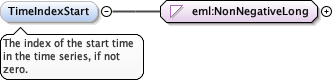
Element eml:TimeIndices / eml:TimeIndexStart
Namespace http://www.energistics.org/energyml/data/commonv2
Annotations
The index of the start time in the time series, if not zero.
Diagram
DiagramBaseTypes_xsd_Simple_Type_eml_NonNegativeLong.tmp#NonNegativeLong
Type eml:NonNegativeLong
Properties
content simple
minOccurs 0
maxOccurs 1
Facets
minInclusive 0
Source
<xs:element name="TimeIndexStart" type="eml:NonNegativeLong" minOccurs="0" maxOccurs="1">
  <xs:annotation>
    <xs:documentation>The index of the start time in the time series, if not zero.</xs:documentation>
  </xs:annotation>
</xs:element>
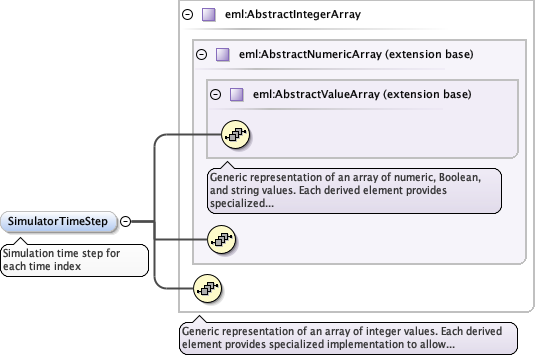
Element eml:TimeIndices / eml:SimulatorTimeStep
Namespace http://www.energistics.org/energyml/data/commonv2
Annotations
Simulation time step for each time index
Diagram
DiagramBaseTypes_xsd_Complex_Type_eml_AbstractValueArray.tmp#AbstractValueArrayBaseTypes_xsd_Complex_Type_eml_AbstractNumericArray.tmp#AbstractNumericArrayBaseTypes_xsd_Complex_Type_eml_AbstractIntegerArray.tmp#AbstractIntegerArray
Type eml:AbstractIntegerArray
Type hierarchy
Properties
content complex
minOccurs 0
maxOccurs 1
Model
Source
<xs:element name="SimulatorTimeStep" type="eml:AbstractIntegerArray" minOccurs="0" maxOccurs="1">
  <xs:annotation>
    <xs:documentation>Simulation time step for each time index</xs:documentation>
  </xs:annotation>
</xs:element>
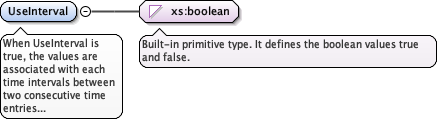
Element eml:TimeIndices / eml:UseInterval
Namespace http://www.energistics.org/energyml/data/commonv2
Annotations
When UseInterval is true, the values are associated with each time intervals between two consecutive time entries instead of each individual time entry. As a consequence the dimension of the value array corresponding to the time series is the number of entry in the series minus one.
Diagram
Diagram
Type xs:boolean
Properties
content simple
minOccurs 1
maxOccurs 1
Source
<xs:element name="UseInterval" type="xs:boolean" minOccurs="1" maxOccurs="1">
  <xs:annotation>
    <xs:documentation>When UseInterval is true, the values are associated with each time intervals between two consecutive time entries instead of each individual time entry. As a consequence the dimension of the value array corresponding to the time series is the number of entry in the series minus one.</xs:documentation>
  </xs:annotation>
</xs:element>
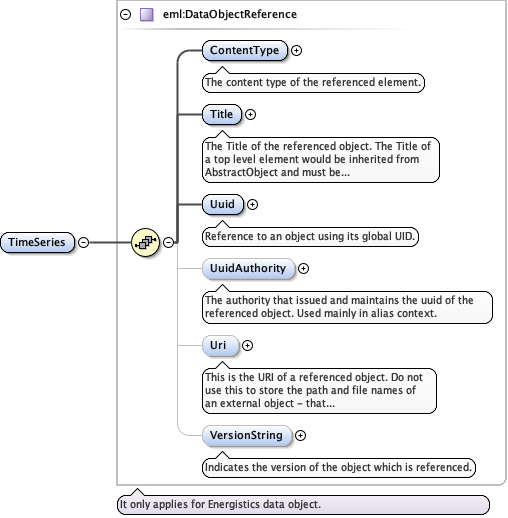
Element eml:TimeIndices / eml:TimeSeries
Namespace http://www.energistics.org/energyml/data/commonv2
Diagram
DiagramObjectReference_xsd_Complex_Type_eml_DataObjectReference.tmp#DataObjectReference_ContentTypeObjectReference_xsd_Complex_Type_eml_DataObjectReference.tmp#DataObjectReference_TitleObjectReference_xsd_Complex_Type_eml_DataObjectReference.tmp#DataObjectReference_UuidObjectReference_xsd_Complex_Type_eml_DataObjectReference.tmp#DataObjectReference_UuidAuthorityObjectReference_xsd_Complex_Type_eml_DataObjectReference.tmp#DataObjectReference_UriObjectReference_xsd_Complex_Type_eml_DataObjectReference.tmp#DataObjectReference_VersionStringObjectReference_xsd_Complex_Type_eml_DataObjectReference.tmp#DataObjectReference
Type eml:DataObjectReference
Properties
content complex
minOccurs 1
maxOccurs 1
Model
Children eml:ContentType, eml:Title, eml:Uri, eml:Uuid, eml:UuidAuthority, eml:VersionString
Instance
<eml:TimeSeries xmlns:eml="http://www.energistics.org/energyml/data/commonv2">
  <eml:ContentType>{1,1}</eml:ContentType>
  <eml:Title>{1,1}</eml:Title>
  <eml:Uuid>{1,1}</eml:Uuid>
  <eml:UuidAuthority>{0,1}</eml:UuidAuthority>
  <eml:Uri>{0,1}</eml:Uri>
  <eml:VersionString>{0,1}</eml:VersionString>
</eml:TimeSeries>
Source
<xs:element name="TimeSeries" type="eml:DataObjectReference" minOccurs="1" maxOccurs="1"/>
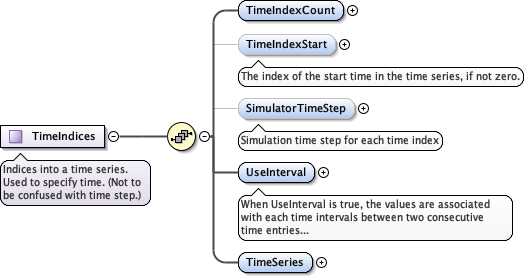
Complex Type eml:TimeIndices
Namespace http://www.energistics.org/energyml/data/commonv2
Annotations
Indices
into a time series. Used to specify time. (Not to be confused with time step.)
Diagram
DiagramCommonTypes_xsd_Complex_Type_eml_TimeIndices.tmp#TimeIndices_TimeIndexCountCommonTypes_xsd_Complex_Type_eml_TimeIndices.tmp#TimeIndices_TimeIndexStartCommonTypes_xsd_Complex_Type_eml_TimeIndices.tmp#TimeIndices_SimulatorTimeStepCommonTypes_xsd_Complex_Type_eml_TimeIndices.tmp#TimeIndices_UseIntervalCommonTypes_xsd_Complex_Type_eml_TimeIndices.tmp#TimeIndices_TimeSeries
Model
Children eml:SimulatorTimeStep, eml:TimeIndexCount, eml:TimeIndexStart, eml:TimeSeries, eml:UseInterval
Source
<xs:complexType name="TimeIndices">
  <xs:annotation>
    <xs:documentation>Indices into a time series. Used to specify time. (Not to be confused with time step.)</xs:documentation>
  </xs:annotation>
  <xs:sequence>
    <xs:element name="TimeIndexCount" type="eml:PositiveLong" minOccurs="1" maxOccurs="1"/>
    <xs:element name="TimeIndexStart" type="eml:NonNegativeLong" minOccurs="0" maxOccurs="1">
      <xs:annotation>
        <xs:documentation>The index of the start time in the time series, if not zero.</xs:documentation>
      </xs:annotation>
    </xs:element>
    <xs:element name="SimulatorTimeStep" type="eml:AbstractIntegerArray" minOccurs="0" maxOccurs="1">
      <xs:annotation>
        <xs:documentation>Simulation time step for each time index</xs:documentation>
      </xs:annotation>
    </xs:element>
    <xs:element name="UseInterval" type="xs:boolean" minOccurs="1" maxOccurs="1">
      <xs:annotation>
        <xs:documentation>When UseInterval is true, the values are associated with each time intervals between two consecutive time entries instead of each individual time entry. As a consequence the dimension of the value array corresponding to the time series is the number of entry in the series minus one.</xs:documentation>
      </xs:annotation>
    </xs:element>
    <xs:element name="TimeSeries" type="eml:DataObjectReference" minOccurs="1" maxOccurs="1"/>
  </xs:sequence>
</xs:complexType>