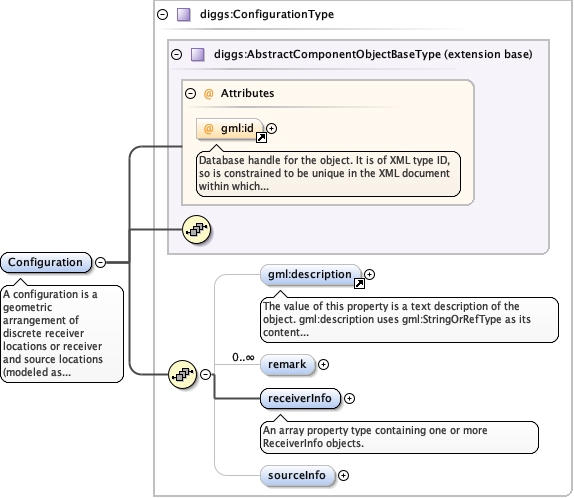
A configuration is a geometric arrangement of discrete receiver locationsor receiver and source locations (modeled as point geometries). AGeophysicalFieldSurvey may consist of more than one configuration where a singleconfiguration may not extend over the entire set of associated sampling features.For example a seismic reflection survey may consist of one or more source-receiverarrays that are moved progressively along a GP_Trackline. In this case, each arraylocation would be described by a Configuration object.
Database handle for the object. It is of XML type ID, so is constrained to beunique in the XML document within which it occurs. An external identifier for the object inthe form of a URI may be constructed using standard XML and XPointer methods. This is doneby concatenating the URI for the document, a fragment separator, and the value of the idattribute.
Source
<element name="Configuration" type="diggs:ConfigurationType"><annotation><documentation>A configuration is a geometric arrangement of discrete receiver locations or receiver and source locations (modeled as point geometries). A GeophysicalFieldSurvey may consist of more than one configuration where a single configuration may not extend over the entire set of associated sampling features. For example a seismic reflection survey may consist of one or more source-receiver arrays that are moved progressively along a GP_Trackline. In this case, each array location would be described by a Configuration object.</documentation></annotation></element>