Showing:

Attributes
Diagrams
Model
Source
Used by
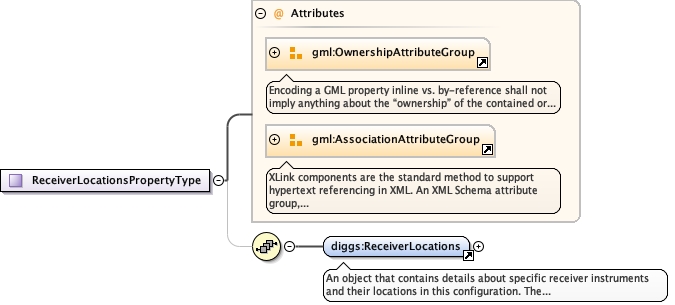
Complex Type diggs:ReceiverLocationsPropertyType
Namespace http://diggsml.org/schema-dev
Diagram
Diagramgml3_2Profile_diggs_xsd_Attribute_Group_gml_OwnershipAttributeGroup.tmp#OwnershipAttributeGroupgml3_2Profile_diggs_xsd_Attribute_Group_gml_AssociationAttributeGroup.tmp#AssociationAttributeGroupGeophysics_xsd_Element_diggs_ReceiverLocations.tmp#ReceiverLocations
Used by
Model
Children diggs:ReceiverLocations
Attributes
QName Type Fixed Default Use Annotation
nilReason gml:NilReasonType optional
owns boolean false optional
xlink:actuate restriction of string optional
The 'actuate' attribute is used to communicate the desired timing 
of traversal from the starting resource to the ending resource; 
it's value should be treated as follows:
onLoad - traverse to the ending resource immediately on loading 
         the starting resource 
onRequest - traverse from the starting resource to the ending 
            resource only on a post-loading event triggered for 
            this purpose 
other - behavior is unconstrained; examine other markup in link 
        for hints 
none - behavior is unconstrained
xlink:arcrole anyURI optional
xlink:href anyURI optional
xlink:role anyURI optional
xlink:show restriction of string optional
The 'show' attribute is used to communicate the desired presentation 
of the ending resource on traversal from the starting resource; it's 
value should be treated as follows: 
new - load ending resource in a new window, frame, pane, or other 
      presentation context
replace - load the resource in the same window, frame, pane, or 
          other presentation context
embed - load ending resource in place of the presentation of the 
        starting resource
other - behavior is unconstrained; examine other markup in the 
        link for hints 
none - behavior is unconstrained
xlink:title string optional
xlink:type string simple optional
Source
<complexType name="ReceiverLocationsPropertyType">
  <sequence maxOccurs="1" minOccurs="0">
    <element ref="diggs:ReceiverLocations">
      <annotation>
        <documentation>An object that contains details about specific receiver instruments and their locations in this configuration. The object contains two properties: receiverRef and receiverLocations. receiverRef references a sincle GP_Receiver object. If only one GP_Receiver object is listed, then the receiverLocations property may contain any of PointLocation, MultiPointLocation or RecifiedGrid geometries. If MultiPointLocation or RectifiedGrid is used, then either the GP_Receiver identified is successively moved to all locations of the geometry or the GP_Receiver represents a class of receivers with identical properties that are installed at each location. This distinction is identified in the GP_Receiver object. If more than one GP_Receiver is referenced, then use of the PointLocation geometry implies that all receivers are located at the same point location. If MultiPointLocation or RectifiedGrid geometries are used, then there must be the same number of individual locations in the geometry as there are GF_Receiver objects referenced, and the individual locations must be in GP_Receiver order so that each receiver's location can be determined.</documentation>
      </annotation>
    </element>
  </sequence>
  <attributeGroup ref="gml:OwnershipAttributeGroup"/>
  <attributeGroup ref="gml:AssociationAttributeGroup"/>
</complexType>