Showing:

Annotations
Attributes
Diagrams
Instances
Model
Properties
Source
Used by
Element diggs:Referent
Namespace http://diggsml.org/schemas/3
Annotations
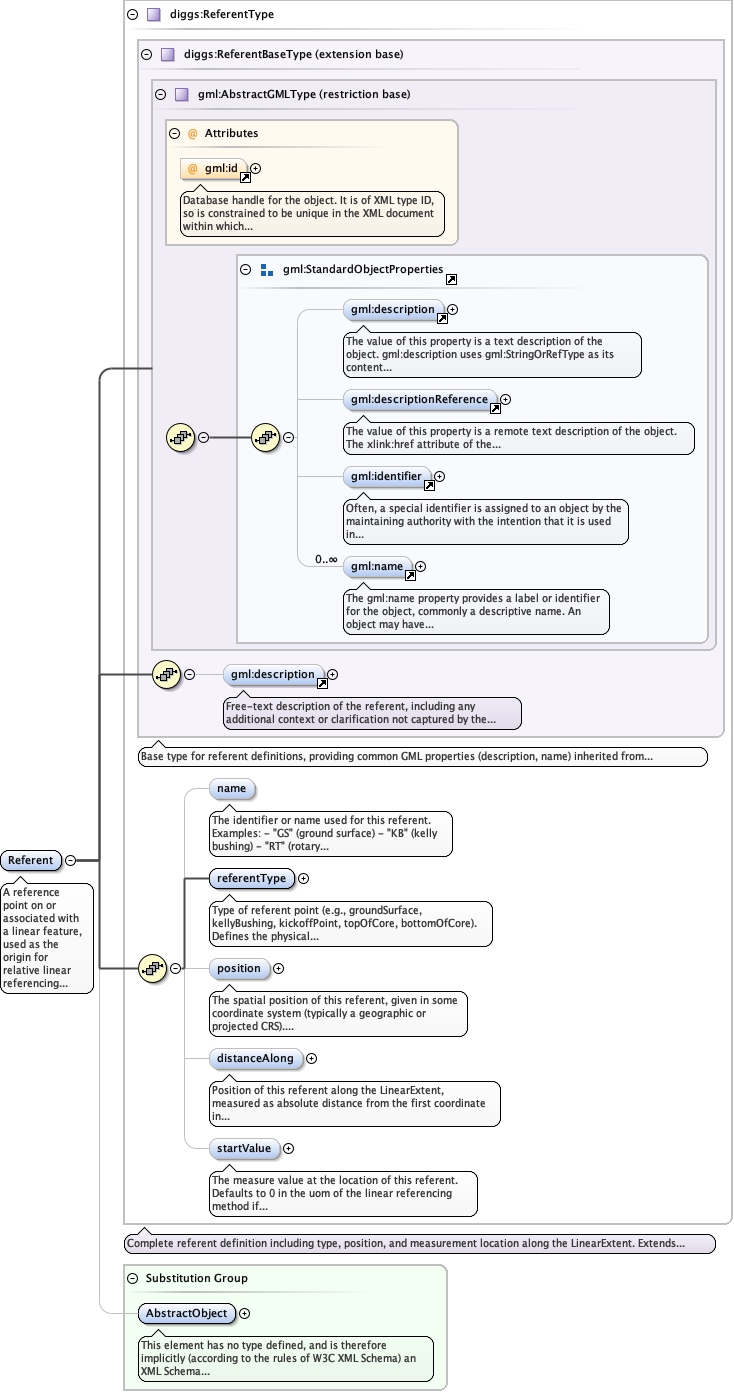
A reference point on or associated with a linear feature, used as 
the origin for relative linear referencing measurements, or as anchor 
points for geometric calibration.
                
Referents represent physical or logical datum points along LinearExtent 
features. Common examples include:
- Drilling: ground surface, kelly bushing, rotary table, casing top
- Marine: seafloor, mean sea level, mudline
- Geophysical: trackline start, trackline end, line intersections
- Wells: kickoff point, top of hole, bottom of hole
- Core: top of core, bottom of core
                
When a LinearSRS uses a relative LRMethod, the referent defines the 
zero point (origin) for measurements. When used as anchor points in 
LinearExtent, referents provide calibration for interpolative methods.
Diagram
Diagramgml3_2Profile_diggs_xsd_Attribute_gml_id.tmp#idgml3_2Profile_diggs_xsd_Element_gml_description.tmp#descriptiongml3_2Profile_diggs_xsd_Element_gml_descriptionReference.tmp#descriptionReferencegml3_2Profile_diggs_xsd_Element_gml_identifier.tmp#identifiergml3_2Profile_diggs_xsd_Element_gml_name.tmp#namegml3_2Profile_diggs_xsd_Element_Group_gml_StandardObjectProperties.tmp#StandardObjectPropertiesgml3_2Profile_diggs_xsd_Complex_Type_gml_AbstractGMLType.tmp#AbstractGMLTypegml3_2Profile_diggs_xsd_Element_gml_description.tmp#descriptionLinearReferencing_xsd_Complex_Type_diggs_ReferentBaseType.tmp#ReferentBaseTypeLinearReferencing_xsd_Complex_Type_diggs_ReferentType.tmp#ReferentType_nameLinearReferencing_xsd_Complex_Type_diggs_ReferentType.tmp#ReferentType_referentTypeLinearReferencing_xsd_Complex_Type_diggs_ReferentType.tmp#ReferentType_positionLinearReferencing_xsd_Complex_Type_diggs_ReferentType.tmp#ReferentType_distanceAlongLinearReferencing_xsd_Complex_Type_diggs_ReferentType.tmp#ReferentType_startValueLinearReferencing_xsd_Complex_Type_diggs_ReferentType.tmp#ReferentTypegml3_2Profile_diggs_xsd_Element_gml_AbstractObject.tmp#AbstractObject
Type diggs:ReferentType
Type hierarchy
Properties
content complex
Substitution Group Affiliation
Used by
Model
Children diggs:distanceAlong, diggs:name, diggs:position, diggs:referentType, diggs:startValue, gml:description
Instance
<diggs:Referent gml:id="" xmlns:diggs="http://diggsml.org/schemas/3" xmlns:gml="http://www.opengis.net/gml/3.2">
  <gml:description xlink:actuate="" xlink:arcrole="" xlink:href="" nilReason="" xlink:role="" xlink:show="" xlink:title="" xlink:type="simple">{0,1}</gml:description>
  <diggs:name>{0,1}</diggs:name>
  <diggs:referentType>{1,1}</diggs:referentType>
  <diggs:position xlink:role="" xlink:actuate="" xlink:show="" xlink:arcrole="" xlink:title="" xlink:href="" xlink:type="simple" nilReason="" owns="false">{0,1}</diggs:position>
  <diggs:distanceAlong howDetermined="" qualifier="" uom="">{0,1}</diggs:distanceAlong>
  <diggs:startValue howDetermined="" qualifier="" uom="">{0,1}</diggs:startValue>
</diggs:Referent>
Attributes
QName Type Use Annotation
gml:id ID optional
Database handle for the object. It is of XML type ID, so is constrained to be
unique in the XML document within which it occurs. An external identifier for the object in
the form of a URI may be constructed using standard XML and XPointer methods. This is done
by concatenating the URI for the document, a fragment separator, and the value of the id
attribute.
Source
<element name="Referent" type="diggs:ReferentType" substitutionGroup="gml:AbstractObject">
  <annotation>
    <documentation>A reference point on or associated with a linear feature, used as the origin for relative linear referencing measurements, or as anchor points for geometric calibration. Referents represent physical or logical datum points along LinearExtent features. Common examples include: - Drilling: ground surface, kelly bushing, rotary table, casing top - Marine: seafloor, mean sea level, mudline - Geophysical: trackline start, trackline end, line intersections - Wells: kickoff point, top of hole, bottom of hole - Core: top of core, bottom of core When a LinearSRS uses a relative LRMethod, the referent defines the zero point (origin) for measurements. When used as anchor points in LinearExtent, referents provide calibration for interpolative methods.</documentation>
  </annotation>
</element>