Showing:

Annotations
Attributes
Diagrams
Instances
Model
Properties
Source
Used by
Element diggs:LinearExtent
Namespace http://diggsml.org/schemas/3
Annotations
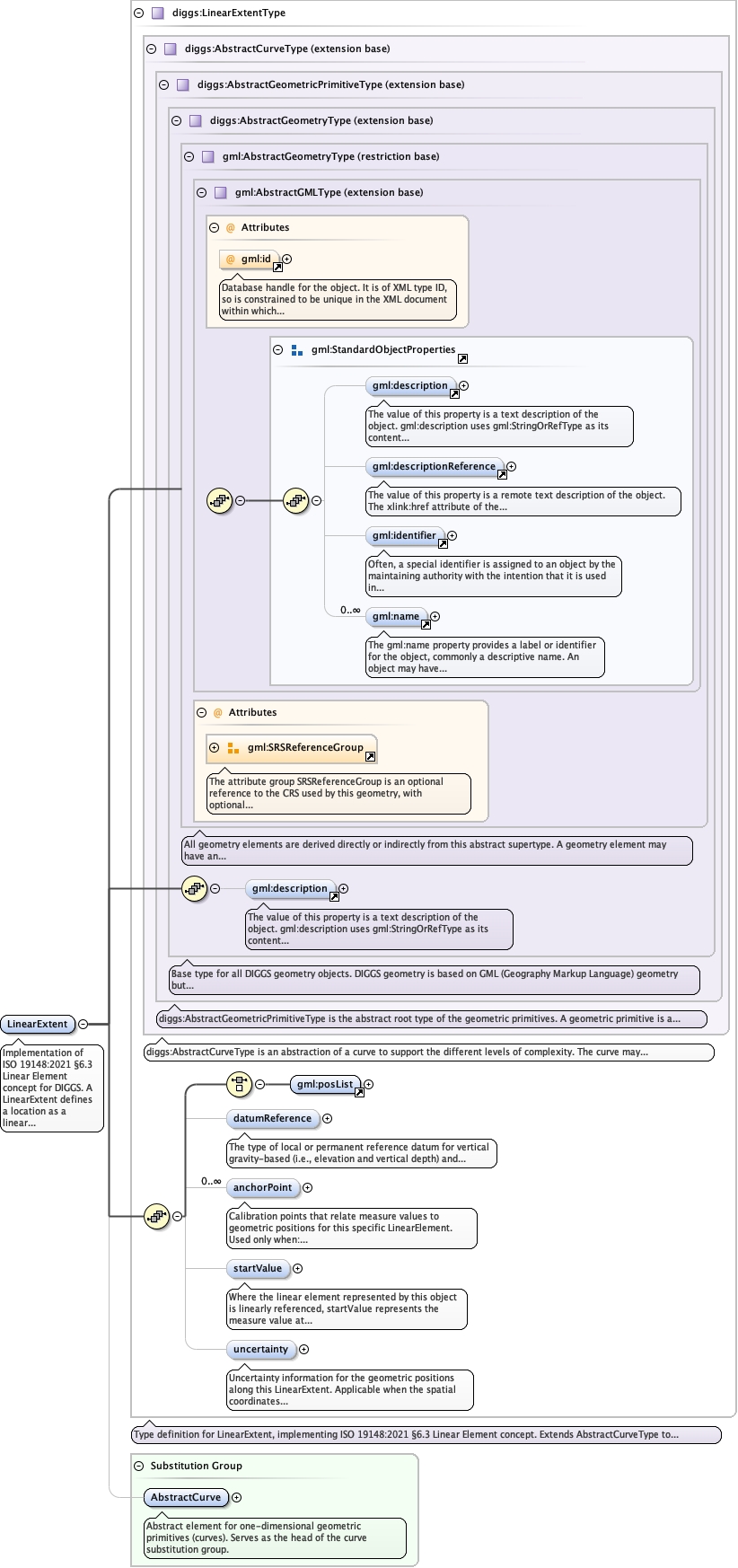
Implementation of ISO 19148:2021 §6.3 Linear Element concept for DIGGS.
A LinearExtent defines a location as a linear extent or interval, with the first
vertex representing the starting location and the last vertex representing the end
location. This is the fundamental spatial object along which linear referencing V
measurements are made. For DIGGS applications, LinearExtent typically represents: -
Borehole centerline (3D path from collar to bottom) - Well trajectory (including
deviated wells) - CPT sounding path - Geophysical trackline - Survey transect or
traverse The geometry is stored in gml:posList with coordinates in the order they
are traversed during measurement. Measurements proceed from first to last
coordinate.
Diagram
Diagramgml3_2Profile_diggs_xsd_Attribute_gml_id.tmp#idgml3_2Profile_diggs_xsd_Element_gml_description.tmp#descriptiongml3_2Profile_diggs_xsd_Element_gml_descriptionReference.tmp#descriptionReferencegml3_2Profile_diggs_xsd_Element_gml_identifier.tmp#identifiergml3_2Profile_diggs_xsd_Element_gml_name.tmp#namegml3_2Profile_diggs_xsd_Element_Group_gml_StandardObjectProperties.tmp#StandardObjectPropertiesgml3_2Profile_diggs_xsd_Complex_Type_gml_AbstractGMLType.tmp#AbstractGMLTypegml3_2Profile_diggs_xsd_Attribute_Group_gml_SRSReferenceGroup.tmp#SRSReferenceGroupgml3_2Profile_diggs_xsd_Complex_Type_gml_AbstractGeometryType.tmp#AbstractGeometryTypegml3_2Profile_diggs_xsd_Element_gml_description.tmp#descriptionCore_xsd_Complex_Type_diggs_AbstractGeometryType.tmp#http___diggsml.org_schemas_3_AbstractGeometryTypeCore_xsd_Complex_Type_diggs_AbstractGeometricPrimitiveType.tmp#AbstractGeometricPrimitiveTypeCore_xsd_Complex_Type_diggs_AbstractCurveType.tmp#AbstractCurveTypegml3_2Profile_diggs_xsd_Element_gml_posList.tmp#posListCore_xsd_Complex_Type_diggs_LinearExtentType.tmp#LinearExtentType_datumReferenceCore_xsd_Complex_Type_diggs_LinearExtentType.tmp#LinearExtentType_anchorPointCore_xsd_Complex_Type_diggs_LinearExtentType.tmp#LinearExtentType_startValueCore_xsd_Complex_Type_diggs_LinearExtentType.tmp#LinearExtentType_uncertaintyCore_xsd_Complex_Type_diggs_LinearExtentType.tmp#LinearExtentTypeCore_xsd_Element_diggs_AbstractCurve.tmp#http___diggsml.org_schemas_3_AbstractCurve
Type diggs:LinearExtentType
Type hierarchy
Properties
content complex
Substitution Group Affiliation
Used by
Model
Children diggs:anchorPoint, diggs:datumReference, diggs:startValue, diggs:uncertainty, gml:description, gml:posList
Instance
<diggs:LinearExtent axisLabels="" gml:id="" srsDimension="" srsName="" uomLabels="" xmlns:diggs="http://diggsml.org/schemas/3" xmlns:gml="http://www.opengis.net/gml/3.2">
  <gml:description xlink:actuate="" xlink:arcrole="" xlink:href="" nilReason="" xlink:role="" xlink:show="" xlink:title="" xlink:type="simple">{0,1}</gml:description>
  <gml:posList axisLabels="" count="" srsDimension="" srsName="" uomLabels="">{1,1}</gml:posList>
  <diggs:datumReference>{0,1}</diggs:datumReference>
  <diggs:anchorPoint xlink:actuate="" xlink:arcrole="" xlink:href="" nilReason="" xlink:role="" xlink:show="" xlink:title="" xlink:type="simple">{0,unbounded}</diggs:anchorPoint>
  <diggs:startValue howDetermined="" qualifier="" uom="">{0,1}</diggs:startValue>
  <diggs:uncertainty>{0,1}</diggs:uncertainty>
</diggs:LinearExtent>
Attributes
QName Type Use Annotation
axisLabels gml:NCNameList optional
gml:id ID optional
Database handle for the object. It is of XML type ID, so is constrained to be
unique in the XML document within which it occurs. An external identifier for the object in
the form of a URI may be constructed using standard XML and XPointer methods. This is done
by concatenating the URI for the document, a fragment separator, and the value of the id
attribute.
srsDimension positiveInteger optional
srsName anyURI optional
uomLabels gml:NCNameList optional
Source
<element name="LinearExtent" substitutionGroup="diggs:AbstractCurve" type="diggs:LinearExtentType">
  <annotation>
    <documentation>Implementation of ISO 19148:2021 §6.3 Linear Element concept for DIGGS. A LinearExtent defines a location as a linear extent or interval, with the first vertex representing the starting location and the last vertex representing the end location. This is the fundamental spatial object along which linear referencing V measurements are made. For DIGGS applications, LinearExtent typically represents: - Borehole centerline (3D path from collar to bottom) - Well trajectory (including deviated wells) - CPT sounding path - Geophysical trackline - Survey transect or traverse The geometry is stored in gml:posList with coordinates in the order they are traversed during measurement. Measurements proceed from first to last coordinate.</documentation>
  </annotation>
</element>